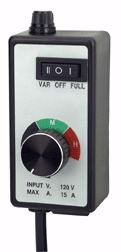
More than a year ago I was approached by an independent filmmaker about light dimmers. The problem fo them was how to get affordable light dimmers to control the film lighting. I was told that many independent non-commmercial filmmakers use a HarborFreight router speed control to dim the lights used for moviemaking. The reason is that they are are cheaper and far heavier (15A) than building our own from a 600W house lights dimmer. The problem with these router speed control devices is that they do not dim down enough to turn the lights off. They also don’t quite go to full brightness but that is a minor problem as they have a switch that bypasses the electronics and provides full power.
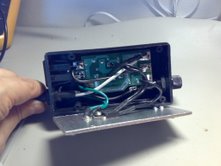
After some discussion I got one of these units mailed to me to see if there is a way to modify those to work as better light dimmer.First thing I did was to open the device to see how it was built out. Based on what I saw the circuit was pretty close to a traditional light dimmer. And there seemed to be also some adjustment trimmer for some adjustments. Looked promising.
The nest task was to test the device. The problem that those are designed to operate 110-120V AC 60 Hz power has a slight problem to me. In Finland the mains power is 230V AC 50 Hz. Getting real 120V 60Hz power and finding 120V AC light bulbs is hard here where I live. I got one 120V lamp with the router speed control device so I had suitable lamp. Getting real 60 Hz power would involve some expensive power converter or using 12V to 120V AC true sinewave inverter or something similar that I did not have at the moment. So I decided to do my first testing with 110V 50Hz power that I get easily with a suitable voltage conversion transformer (I used fully isolating transformer for safety).
I did some testing. I found that the controller trimmer potentiometer controls how dim the output can go. I was able to get lamp very dim. Here is the picture of the dimmer electronics with a well insulated screwdriver adjusting the trimmer (there is a hole on the circuit board that gives access to the trimmer). Well insulated screwdriver and isolation transformer powering the whole circuit makes it possible to do ajustments with live circuit pretty safely when you know what you are doing. I mailed the results back to person who sent me the router speed control and he tested the results with real 60 Hz power (they worked).
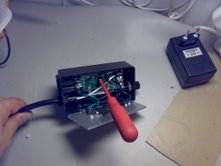
The adjustment instructions: Set the potentiometer lowest setting. Then adjust the trimmer so that you get as dim light as possible without noticeable side effects. When you set the trimmer to too low setting, turning potentiometer will cause the output to be completely off (lap turns off). When dimmer reaches this full iff state, the dimmer potentiometer need to be turned quite much (one third or one fouth) until the light turns back on, quite bright already. The ideal setting I think would be that the lowest dimmer potentimeter setting would just set the bulb to be just barely on (lamp filament dark red and does not make much light), so you have always full control range from it to full setting without problems.
In this way a relatively cheap router speed control device is converted to a relatively inexpensive high power light dimmer.
41 Comments
Janakiraman says:
Sir,
I need to know abt your dimmer system for NVG lab and whether it is compatible or not.
tomi says:
Compatible with specifically what?
Irondog says:
Tomi,
Thanks! I use these controls on some motors, but noticed that sometimes I could not slow thing down enough. Your tip on the internal pot that could be tweaked was very useful.
Cheers!
Mark
jean says:
I fully true!!! I think your site is nice !!! thanks for the story
Schummie says:
Hello Tomi,
thank you for your post about the Router Speed Control.
I’m searching for a longtime for a 220v router speed control.
My question is off this speed control also useful is for 220v?
The factory says yes, see http://www.nb-dazhong.com/enprosoall.asp?mmm=3&sele=19&text=19&fl=Various
I hope you can help me.
Thanks Schummie.
Tod Alferez says:
Interesting insight, amazed I never thought of that by myself
tomi says:
Quoting a small part of the text is OK when you mention your website name or URL.
tomi says:
This site use a custom made “theme”.
Digital Sports Photography says:
I recently come across your weblog and think this is a great post i enjoy reading and provide me some great information for that concern. Thanx for this great read.
Walter Sandland says:
I want to say – thank you for this!
John says:
I do not post on blogs too often, but this one deserved a comment. awsome information!
case mod says:
Funny, I actually had this on my mind a couple days ago and now I come across your blog…
Morris Moyd says:
Many thanks for taking the moment to discuss about this, I really feel fervently about it and I love studying about this subject. Please, as you gain info, please add more to this blog with more information. I have seen it very beneficial
BN says:
maybe a bit off-topic, but then again dead on
i just moved from europe to canada and brought my router.. stumbled upon this blog and i instantly knew why it wouldnt work, and how to fix it. europe uses 230v 50Hz and canada uses 115v 60Hz, combining two out of phase live wires makes 230v, now that was the easy part… the router still wouldnt work right. the moment i saw the picture of you adjusting the potentiometer it hit me… thats what i have to do, now it works like a dream. Thank you
Junior Grudt says:
Very good facts appreciation for posting about it. Basically in all of the content of this site you can find something to learn.
Concha Mazy says:
Excellently drafted write-up, if only all people created the same written content as you, the internet will be a far better place.
Christmas ornaments says:
Undoubtedly truly valuable article. Thanks a lot for your enthusiasm to offer these sort of helpful tips here.
blog play says:
blog play…
[...]Router speed control to light dimmer « Tomi Engdahl’s ePanorama blog[...]…
solar home says:
solar home…
[...]Router speed control to light dimmer « Tomi Engdahl’s ePanorama blog[...]…
Winston Dagle says:
I really wanted to send a brief note in order to express gratitude to you for all the fabulous steps you are writing at this site. My time intensive internet look up has at the end of the day been compensated with reputable ideas to talk about with my best friends. I d declare that many of us site visitors are extremely fortunate to be in a fine community with very many awesome people with helpful opinions. I feel rather privileged to have used your site and look forward to tons of more thrilling times reading here. Thanks once again for everything.
free twitter followers says:
free twitter followers…
[...]Router speed control to light dimmer « Tomi Engdahl’s ePanorama blog[...]…
Kirk Oniel says:
I like this web blog very much, Its a real nice situation to read and find info.
beffo says:
Undoubtedly truly valuable article. Thanks a lot for your enthusiasm to offer these sort of helpful tips here.
Olen Kyler says:
Fantastic goods from you, man. I have understand your stuff previous to and you are just extremely magnificent. I actually like what you’ve acquired here, certainly like what you are saying and the way in which you say it. You make it entertaining and you still care for to keep it smart. I can not wait to read much more from you. This is actually a terrific web site.
Leonia Haxby says:
All great ideas. I am social bookmarking this page, definitely Let me find writers-block.
Hobert Kiessling says:
Really like the story. Thanks for posting, I’ll be back to read more.
Chance Centola says:
You’re so cool! I won’t presume You will discover read anything like this ahead of.
hgaoidijwoi says:
This is the punish Router speed control to light dimmer Tomi Engdahl’s ePanorama blog journal for anyone who wants to move out out roughly this matter. You mention so some its almost exhausting to reason with you (not that I really would want…HaHa). You definitely put a new twisting on a substance thats been printed most for life. Pleasant matter, but enthusiastic!
Lucio says:
I agree completely with what you said. Fantastic Stuff. Maintain it going..
Lynsey Marti says:
I will right away take hold of your rss feed as I can not in finding your email subscription hyperlink or e-newsletter service. Do you’ve any? Kindly permit me recognise in order that I could subscribe. Thanks.
tomi says:
Use the RSS feed.
I don’t have email list or e-newsletter service at the moment.
westfalia says:
You can definitely see your enthusiasm within the paintings you write. The sector hopes for more passionate writers like you who aren’t afraid to say how they believe. Always follow your heart. “Experience is a good school, but the fees are high.” by Heinrich Heine.
this site has says:
I will immediately grasp your rss as I can not in finding your email subscription hyperlink or newsletter service. Do you have any? Kindly allow me recognize so that I may just subscribe. Thanks.
Larry Holmes says:
There are a couple of simple modifications you may make to this speed controller to solve the problems you are experiencing. These modifications.are not difficult for a technician to do but they may be too much for someone who does not know how to solder, how to add and remove components on a circuit board, and now to test his work to.be certain it works properly AND SAFELY! This post is old, however,week so it will be no trouble to share my results with you, as long as you ha e the technical skills I’ve me ruined if this “problem is still an issue needing to. be fixed in more useful manner, I can send instructions to you by email or postal mail. By coincidence, I am about to apply these modifications to the exact same controller from Harbor Freight. Next
tomi says:
Thank you for your feedback.
Larry Holmes says:
Thank you for this excellent article. I am an electrical engineer,so I am always interested in articles about practical issues and their solutions. I often find that articles written about subjects such as this one are either poorlywritten, technically wrong, or both! This article is accurate without being hard to understand, which means the author has the skill and experience to recommend this procedure and he emphasizes safety, which is EXTREMELY IMPORTANT for anything which plugs into the mains, which carries enough power to be VERY DEADLY if not handled with respect. BETTER TO HIRE A TECHNICIAN IF YOU AREN’T CERTAIN YOU CAN SAFELY DO THE MODIFICATION! That being said, my sincere compliments to the author!!!
tomi says:
Thank you very much on your feedback.
ledgrowlightscenter.blog.com says:
Pretty! This has been an incredibly wonderful article.
Many thanks for providing these details.
Www.Corridorrecovery.Com says:
I’m impressed, I have too admit. Seldom do I come across a blog that’s boyh educative
aand interesting, and let me tell you, you’ve hit the nail on the head.
The issue is an issue that not enough olks are speaking intelligently about.
I am very happy that I stumbled across this in my huntt for something regarding this.
Tomi Engdahl says:
https://www.electroschematics.com/rotative-speed-regulator-borer-driller-controller/
Tomi Engdahl says:
Reverse engineering of a mains power controller.
https://www.youtube.com/watch?v=SRUzMd3lwLQ
Inside a “4kW” ebay power controller with schematic.
https://www.youtube.com/watch?v=_4PwYm_7HKg