The European Commission supports industry’s commitment to provide a common charger for mobile telephones. Commission welcomes new EU standards for common mobile phone charger: European Standardisation Bodies CEN-CENELEC and ETSI have now made available the harmonised standards. The industry commits to provide chargers compatibility on the basis of the Micro-USB connector. The technical number for this micro-USB charging standard is EN 62684.

The European Commission expects the first common chargers and mobile phones compatible with the new standards to reach the European market in the first months of 2011. Sony-Ericsson, Nokia, Apple and all the others will now have about a year until the 1st of January 2012 to make sure that the majority of all phones will support the new standard.
Technical requirements: Output Voltage Range: 5V +/-0.25V from no load to maximum output current measured at the Micro-B plug of the captive cable or on Standard-A receptacle in case of detachable cable. Output Current Range at 5V +/-0.25V voltage range is 500 mA to 1500 mA (maximum 1.5A load at voltages below 4.75V). Output Voltage Ripple 80 mVp-p.
EPS shall short the D+ and D- lines with a resistance not greater than 200 ohms (per USB Battery Charging Specification).
The charger converts 90V-264VAC at 50-60Hz into 5VDC, 500-1500mA. The galvanic isolation required for user safety also isolates the charger output from earth ground, although there still exists capacitive coupling between the primary and secondary through the transformer. Output of the power adapter shall meet LPS, SELV, non-hazardous energy requirements. Maximum Current under Single Fault Condition shall not exceed 3A. The power adapter shall meet Class II requirements with max leakage current not exceeding 90 micro-Amps.
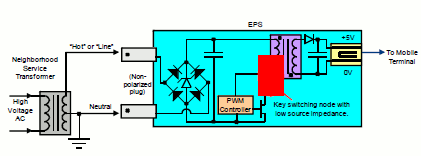
The power output to the mobile phone is isolated “floating” type. It should be noted that the common-mode noise exists independent of a well-regulated DC output, as the positive and negative DC output lines, the USB cable, and the Mobile Terminal are all pushed “up” and “down” together.
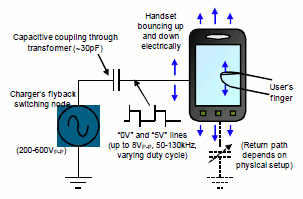
This is nothing new, just now well documented what happens. This same happens with practically any today’s mobile phone charged based on switch mode power supply technology. Mobile phones need to be designed so that they can live with it.
There is one Technical requirement that sounds quite hard at first but makes sense for end user point of view: The charger shall not be damaged as a result of any electrical overload, over-temperature condition or any short circuit condition.
The common charger will make life easier for consumers, reduce waste and benefit businesses. Please note that earlier there has already been a voluntary agreement on cell phone chargers in EU using the same connector and China implements standard USB charger for all mobile phones.
47 Comments
Tomi says:
According to Prosessori news
http://www.prosessori.fi/uutiset/uutinen2.asp?id=57112
there will be another charging connector that will stay in use.
Nokia will be using 2 mm charging connector on at least it’s cheapest phones. By the way the 2 mm barrel type charging connector is standardized in IEC 62637 (soon to be ratified to EN 62637).
Tomi says:
A sample of the new common mobile phone charger for Europe has been ceremonially handed over to European industry commissioner Antonio Tajani, ahead of a continent-wide roll-out this year (director-general of tech trade body DigitalEurope).
The universal charger is intended largely as an environmentally-friendly move, as it will over time make it unnecessary to ship a charger with each new handset. As well as being green, this should also cut down on manufacturers’ shipping costs as they will be able to deliver devices in smaller boxes.
Mobile phone manufacturers that signed the agreement, such as Nokia, Samsung and Sony Ericsson, have almost all implemented micro-USB ports in their devices. Apple, which has built up a lucrative industry around its proprietary dock connector, has not.
Source:
http://www.zdnet.co.uk/blogs/communication-breakdown-10000030/common-charger-ready-but-apple-stays-mum-on-adapter-10021666/
Tomi Engdahl says:
California imposes energy-efficiency standards on battery chargers
http://www.latimes.com/business/la-fi-energy-vampires-20120113,0,6391528.story
The California Energy Commission votes to approve efficiency standards designed to cut energy use by ‘vampire’ charging systems that waste as much as 60% of the electricity they consume.
California’s cellphones, tablet computers, power tools and hundreds of other portable electronic devices will be required to have energy-stingy battery chargers beginning next year.
For example, consumers might pay an additional 40 cents for an electric toothbrush with an efficient battery charger, but would save $1.19 in electricity costs over the lifetime of the product, according to a commission staff report. An upgraded battery charger would boost the price of a laptop computer by 50 cents but would save $19 in power costs.
The standards are part of a more than three-decade drive in California to make appliances and buildings more efficient to cut energy use, reduce pollution and save money.
Tomi Engdahl says:
Noise wars: Projected capacitance strikes back against internal noise
http://www.edn.com/article/520565-Noise_wars_Projected_capacitance_strikes_back_against_internal_noise.php
Charger and display noise affects touchscreens, but there are ways to tackle this problem.
Charger noise physically couples into the sensor through the battery charger during the presence of touch. Its effects include degraded accuracy or linearity of touch, false or phantom touches, or even an unresponsive or erratic touchscreen. The culprit is typically an aftermarket, low-cost charger.
Two common battery chargers are the ringing-choke converter and the flyback converter.
The ringing-choke converter has neither a microcontroller nor a capacitor, yielding a lack of PWM control, a lower-cost transformer, fewer diodes, and lower-capacitance polarized-input capacitors. These eliminations equate to cost savings for the manufacturer but a noisy system for the customer. Some ringing-choke-converter chargers are on the verge of becoming broadband noise generators because they emit as much as 40V p-p noise ranging from 1 to almost 100 kHz.
To address this phenomenon, many OEMs banded together to create EN (European Norm) specifications that govern the maximum noise levels a charger should emit at any frequency. EN 62684-2010 and EN 301489-34v1.1.1 govern these noise levels
manipulea says:
manipulea…
[...]EU standards for common mobile phone charger « Tomi Engdahl’s ePanorama blog[...]…
Tomi Engdahl says:
USB battery charging: it’s harder than it looks
http://www.eetimes.com/design/power-management-design/4237849/USB-battery-charging–it-s-harder-than-it-looks
As the USB port becomes increasingly ubiquitous, it is also becoming accepted as a universal charging port. Unfortunately, this concept of universal is easier to say than it is to do. This article is an introduction into the common challenges a designer runs into in creating this highly desirable, omnipresent USB charging port.
The native wall charger for a device will very often have a special signature on the data pins to let a device know it is safe to charge with more current. In some cases, it also prevents the device from charging at all if the host is unknown. This signature may come in the form of a specific voltage placed on D+, or D-, or both.
Make no mistake: selling specialized accessories is definitely in the business plan for a portable product. For every chargeable product purchased, about 50% of us will go out and buy another charger. The reason is simple: we do not like carrying them around, so we leave a charger in the other places we frequent, such as in our office or in the car.
Glayds Trappey says:
Just want to say your article is as astonishing. The clearness to your put up is just nice and i can think you are an expert on this subject. Well together with your permission let me to seize your RSS feed to stay up to date with approaching post. Thank you one million and please carry on the enjoyable work.
Claris Bihl says:
Strange but true. Your resource is expensive. At least it could be sold for good money on its auction!…
Crysta Schaad says:
I really like this excellent layout. What template are you having?
tomi says:
Custom made template.
Tomi Engdahl says:
USB power has a fundamental limitation – micro-USB connectors are only rated for 1.7 A. The USB charging spec maxes out at 1.5 A. That’s right at the edge for today’s phones and battery technology. Lithium batteries exist which can be charged at a 1C rate, and a 1.5 Ah battery is about what most smartphones have. It’s more limiting for tablets, which have batteries which can charge faster than USB can allow.
Source: comment at http://apple.slashdot.org/story/12/10/17/2135204/apple-patents-alternative-to-nfc
Tomi Engdahl says:
USB3 has charging standards which allow for much more power.
I don’t think any manufactures have added support for it yet though.
Profile 1 – 5V @ 2A
Profile 2 – 5V @ 2A or [email protected]
Profile 3 – 5V @ 2A or 12V@3A
Profile 4 – 20V@3A
Profile 5 – 12V or 20V at 5A (100W).
I believe the idea around profile 5 is so laptops can drop the custom power connector and use a USB3 port instead.
It makes things interesting if all laptop USB ports support all power profiles. You could charge one laptop from another and even make a figurative ‘energy black hole’ by looping the charge back again with another cable.
Source: comment at http://apple.slashdot.org/story/12/10/17/2135204/apple-patents-alternative-to-nfc
TEST says:
Article writing is also a fun, if you be acquainted with after that you can
write if not it is complicated to write.
Tomi Engdahl says:
DIY USB Power Strip
http://blog.thelifeofkenneth.com/2013/02/diy-usb-power-strip.html
I considered simply replacing the power supply and carrying on, but having a few more bed-side USB ports would be handy. I therefore opted to build myself a USB power strip.
On the right is a 2.1mm barrel jack to accept standard 12V wall warts (which I’ve made a standard of as many of my projects as possible), and on the left is 5 “dumb” USB ports for charging devices. Originally, USB wasn’t at all designed to be a charging port, and required quite a bit of intelligence on both ends of the connection to negotiate how much power the client device can consume. Manufacturers had no interest in spending the extra cost to make a phone charger that intelligent, so each manufacturer came up with its own bastardization of the USB spec (usually via random resistors between various pins).
This was little-to-no-fun, so the USB spec eventually caught up with reality and defined “dedicated charging ports,” which are dumb USB ports where the two data pins are simply shorted together to indicate to the client that they do nothing except provide power. Manufacturers like this because they no longer need to add a 15 cent IC to their chargers, and us hobbyists like it because shorting the two data pins together is a much easier way to build USB chargers than trying to reverse-engineer every manufacturer’s creativity on the issue
The 12V input is regulated down to 5V 3A with an LM2596 switching regulator module
The one point of interest that I added to this was 600mA polyfuses to four of the ports. These are solid-state fuses that don’t permanently blow, but will reset themselves after the load is removed. I left the fifth port un-fused
In hindsight, the fuses were a good idea that work out great, except that Apple seems to hate every spec they didn’t invent themselves. Dedicated charging ports are unable to digitally tell client devices how much power they can deliver (500mA? 1A? 2.5A?), and instead simply shut down the port when this limit is exceeded. It is then the client’s job to figure out where this limit is and to do the best it can to stay below it.
Touch screens and charger noise « Tomi Engdahl’s ePanorama blog says:
[...] to be designed to that they do not put out too much noise. Some details on this can be found at my EU standards for common mobile phone charger [...]
Will DC Power Distribution Make a Comeback? « Tomi Engdahl’s ePanorama blog says:
[...] can be charged from USB connector (5V power source). There is USB charging specification and EU standards for common mobile phone charger. USB power seems to be becoming more and more commonly available DC power source. There are [...]
Tomi Engdahl says:
Consumers toss out millions of battery chargers every year. In fact, cell phone chargers account for almost 100,000 tons of trash annually in the U.S. In the E.U., chargers represent about 51,000 tons of landfill waste.
Source: http://www.computerworld.com/s/article/9238553/Next_gen_USB_SuperSpeed_to_eliminate_power_cords
driver finder pro says:
The computer’s running might start to acquire stricken, plus the vendor may suffer a substandard penetration of results, the manufacturers web-site ought to be been to now. You should establish a sense for the correct distance and turn into an improved putter, not needing to be concerned about the proper take away or other bad thoughts, youre only thinking about the goal. I also came across an interesting food pairing article – Food Pairing Ideas for Lager Beer – in case you actually want some food with your lager.
bluray rip says:
Hi there! I could have sworn I’ve been to this website before but after checking through some of the post I realized it’s new to me.
Anyhow, I’m definitely glad I found it and I’ll be bookmarking and checking back frequently!
siti web google says:
One more thing to say is that an online business administration training course is designed for learners to be able to easily proceed to bachelor degree education. The 90 credit education meets the lower bachelor diploma requirements and when you earn your associate of arts in BA online, you’ll have access to up to date technologies on this field. Some reasons why students need to get their associate degree in business is because they can be interested in the field and want to obtain the general knowledge necessary in advance of jumping right bachelor college diploma program. Thx for the tips you really provide with your blog.
DIY USB soldering iron « Tomi Engdahl’s ePanorama blog says:
[...] that if your USB power source has any considerable leakage current (like on some laptops and some mobile phone chargers), that can potentially damage sensitive electronics that you try to solder. So you have been [...]
Tomi Engdahl says:
EU bureaucrats want to force Apple to adopt micro-USB adapter
http://www.tuaw.com/2013/09/27/eu-bureaucrats-want-to-force-apple-to-adopt-micro-usb-adapter/
Since the concept was first introduced, consumers have complained about proprietary chargers. Regardless if they’re needed or not for a given product, they can be annoying and inconvenient. But are they bad for the environment? That’s the argument being put forward by the Members of the European Parliament’s internal market committee.
On September 26, the body voted unanimously to propose a law that would require companies to use a universal mobile phone charger. The law requires mobile phone manufactures to include the universal micro-USB charger in its designs.
This isn’t the first time the European Union has sought to impose a charger standard on manufactures. In 2009, the Commission reached a voluntary agreement with 10 mobile phone manufacturers to adopt the micro-USB charge and sync interface as the industry standard. Apple signed the agreement, a Memorandum of Understanding, but has not replaced its 30-pin or 8-pin chargers.
Thursday’s vote means this formerly voluntary agreement is no longer voluntary. For Apple, with proprietary chargers that factor into the optimization of the iPhone design, this law raises some troubling concerns. Apple already sells iPhone micro-USB adaptors, and perhaps it could start including them with new iPhones as a workaround.
Standardized Laptop Charger Approved By IEC « Tomi Engdahl’s ePanorama blog says:
[...] all about Standardized Laptop Charger Approved By IEC. The IEC, the standards body which wrote the phone charger specification used in the EU, has approved a standardised laptop charger. IEC is optimistic that it will lead to a reduction in [...]
Electronics trends for 2014 « Tomi Engdahl’s ePanorama blog says:
[...] person every year. There will be aims to reduce the waste, for example project like standardizing mobile phone chargers and laptop power [...]
Alica says:
It’s a shame you don’t have a donate button! I’d definitely donate to this outstanding blog!
I guess for now i’ll settle for bookmarking and adding your RSS feed to my Google account.
I look forward to brand new updates and will share this website
with my Facebook group. Chat soon!
Tomi Engdahl says:
Europe approves common charger standard for mobe-makers
Apple and its proprietary Lightning rig may yet wriggle out of this one
http://www.theregister.co.uk/2014/03/17/europe_approves_common_charger_standard_for_mobemakers/
The European Parliament has signed off on its proposal to force mobile phone makers to adopt a common charging standard.
The new regulation means that if mobe-makers’ want to meet European standards for “radio equipment” they’ll have to ensure their products will have to be chargeable using micro-USB. But there are ways out of the proposal: the communiqué about the vote on the issue says “… it will be up to the European Commission to decide which specific types of radio equipment will have to meet this requirement”.
The vote also means that European Union members have two years in which to implement the regulation, with 2017 the target date for compliance by mobe-makers.
Sixta Bowersox says:
Practical suggestions ! I am thankful for the points , Does someone know where I can get access to a template a form document to work with ?
Tomi Engdahl says:
http://www.etn.fi/index.php/13-news/8286-eu-pakottaa-applen-luopumaan-omasta-liittimesta
Tomi Engdahl says:
Why The EU Could Force Apple To Drop The Lightning Cable
https://www.forbes.com/sites/carlieporterfield/2020/01/17/why-the-eu-could-force-apple-to-drop-the-lightning-cable/
European lawmakers this week renewed appeals for tech giants to use a universal charger for all the mobile devices and gadgets sold within the trading bloc .
Tomi Engdahl says:
Call to introduce common charger for all mobile phones
https://www.europarl.europa.eu/news/en/agenda/briefing/2020-01-13/13/call-to-introduce-common-charger-for-all-mobile-phones
To reduce electronic waste and make consumers’ life easier, MEPs want binding measures for chargers to fit all mobile phones and other portable devices.
In the 2014 Radio Equipment Directive, EU lawmakers called for a common charger to be developed and gave the Commission powers to pursue this via a delegated act.
Tomi Engdahl says:
Kaikki muut puhelinvalmistajat ovat siirtyneet yhteiseen liitäntään, mutta Apple vastustaa – miksi ihmeessä?
https://www.talouselama.fi/uutiset/kaikki-muut-puhelinvalmistajat-ovat-siirtyneet-yhteiseen-liitantaan-mutta-apple-vastustaa-miksi-ihmeessa/6d2b200f-a9fe-4dd6-ba7c-43c43c41c55f
Älypuhelinvalmistajat ovat siirtyneet lähes kautta linjan usb-c-latausliitännän käyttöön laitteissaan. Poikkeusta sääntöön ei tosin tarvitse kaukaa hakea – Apple luottaa omaan Lightning-porttiinsa.
BBC:n mukaan yhtiö selittää ratkaisuaan pitäytyä Lightning-liitännässä ja kaapeleissa ympäristösyistä. Mikäli latausliitäntä vaihdettaisiin usb-c-malliseksi, syntyisi valtavasti turhaa jätettä, kun kaikki vanhat Lightning-yhteensopivat laitteet eivät olisikaan yhteensopivia uusien iPhone-mallien kanssa.
Selitys kuulostaa sinänsä loogiselta. Syystä tai toisesta sama asia ei kuitenkaan haitannut Applea tippaakaan, kun se hylkäsi alkuperäisen iPhonen ja iPodien käyttämän 30-pinnisen latausliittimen. Myös kannettavien tietokoneiden ja iPad Pro-laitteiden latausliitäntää on vaihdettu – tällä hetkellä ne käyttävätkin usb-c:tä.
Apple says losing Lightning port will create waste
https://www.bbc.com/news/technology-51208912
Apple says being forced to abandon the Lightning connector used on its iPhones would create an “unprecedented amount of electronic waste”.
While the latest Android phones have a USB-C port, Apple’s iPhones still use the proprietary Lightning port.
Tomi Engdahl says:
https://www.bbc.com/news/technology-51208912
Apple says losing Lightning port will create waste
Tomi Engdahl says:
https://www.uusiteknologia.fi/2020/01/30/eu-lahtee-pakkotoimiin-yksi-ja-sama-laturiliitin-kannykoihin/
Tomi Engdahl says:
Feedback from:
European Environmental Citizens’ Organisation for Standardisation
https://ec.europa.eu/info/law/better-regulation/initiatives/ares-2018-6427186/feedback/F18110_en?p_id=342389
Tomi Engdahl says:
5 Reasons Why USB-C is Better than Lightning
https://www.tronsmart.com/blog/47_5-reasons-why-usb-c-is-better-than-lightning.html
Tomi Engdahl says:
https://www.vice.com/en_us/article/xgqwbd/europe-just-voted-in-favor-of-making-iphone-and-android-use-the-same-charger
Tomi Engdahl says:
Most modern phones are USB-C with various protocols for boost charging (this fucks me off tbh, USB was designed to integrate all systems to a standard, but you have a proprietary charging for fast-charge that will burn anything else to plug into it :/ ) but all can charge from USB albeit slowly
Tomi Engdahl says:
USB-C Makes Compelling Case as EU Moves Toward Single Charging Standard
https://www.electronicdesign.com/power-management/whitepaper/21131272/usbc-makes-compelling-case-as-eu-moves-toward-single-charging-standard?utm_source=EG+ED+Analog+%26+Power+Source&utm_medium=email&utm_campaign=CPS200508052&o_eid=7211D2691390C9R&rdx.ident%5Bpull%5D=omeda%7C7211D2691390C9R&oly_enc_id=7211D2691390C9R
The European Parliament recently voted to recommend a single, universal charger for all mobile phones and portable devices sold in Europe. USB-C could become that single-cable standard.
In January, members of the European Parliament voted to recommend a single, universal charger for all mobile phones and portable devices sold in Europe. By a 550 to 12 vote, they argued that standardization on a single charger would not only reduce e-waste, but also be more cost-effective for consumers. What’s more, a group that champions environmental interests across the EU, named the European Environmental Citizens’ Organization for Standardization, is recommending that USB-C become that single-cable standard.
USB-C is the “Holy Grail” of wired connectivity. It offers bidirectional data and power, and a tiny, orientation-agnostic connector that’s the same on both ends of the cord. And, because it carries up to 100 W of power, USB-C can truly become the one connector for any type of electronic device with a power adapter.
Tomi Engdahl says:
“Occasionally when i touch chasis edge(amplifier) it gives me a mild shock, low leakage current i guess.”
Low leakage current is most common. Sometimes it is possible higher leakage on device but you were well grounded.
“Out of curiosity when i change polarity of ac power cord everything becomes normal. What’s the reason?”
Many modern equipment that use swich mode power supplies have filter capacitors between mains side and chassis. Depending on equipment design there can be two capacitors (designed to be grounded equipment) or one capacitor from one of of the ungrounded power connector pins to case. Depending on mains plug polarity you have it from live to chassis (leakage) or neutral to chassis (almost no leakage).
Traditional transformer can have some leakage that can vary depending on which side of primary is on live or neutral.
“is it dangerous for human being?”
When equipment is properly designed, im good condition and built using proper parts, it is not dangerius.
Tomi Engdahl says:
Showdown Time For Non-Standard Chargers In Europe
https://hackaday.com/2021/10/12/showdown-time-for-non-standard-chargers-in-europe/
t seems that few features of a consumer electronic product will generate as much rancour as a mobile phone charger socket. For those of us with Android phones, the world has slowly been moving over the last few years from micro-USB to USB-C, while iPhone users regard their Lightning connector as the ultimate in connectivity. Get a set of different phone owners together and this can become a full-on feud, as micro-USB owners complain that nobody has a handy charging cable any more, USB-C owners become smug bores, and Apple owners do what they’ve always done and pretend that Steve Jobs invented USB. Throwing a flaming torch into this incendiary mix is the European Union, which is proposing to mandate the use of USB-C on all phones sold in its 27 member nations with the aim of reducing considerably the quantity of e-waste generated.
Minor annoyances over having to carry an extra micro-USB cable for an oddball device aside, we can’t find any reason not to applaud this move, because USB-C is a connector born of several decades of USB evolution and brings with it not only the reversible plug but also the enhanced power delivery standards that enable fast charging no matter whose USB-PD charger you are using. Mandating USB-C will put an end to needlessly overpriced proprietary cables, and bring eventual unity to a fractured world.
What Could Go Wrong?
The USB-C port is tough, convenient, and feature-rich, so where might be the snags in this plan? Imagine for a minute that they had made this move back in 1998 instead of 2021. There were a multitude of chargers on the market back then, but probably the most common was the Nokia 5 V miniature barrel jack. It would have made sense to go with the Nokia connector, so all phones made in the last couple of decades for the EU market would have it. By now the demands for an improved connector taking up less space and with some means of data transfer would be deafening, because the mobile phone has evolved in so many ways unimaginable in the days when a Nokia 5100 was an object of desire.
So it is today, the USB-C connector has all the features we can think of for a mobile device of the 2020s, and will remain useful for the coming years, right? But what about the 2030s or the 2040s? When a Galaxy Fold or an iPhone 13 look as quaint as that Nokia with Snake on it does today, will the 5 GB data transfer rate or 100 W power limit be enough? Any mandated standard must have within it a provision for revision to reflect technological advancement, otherwise we risk creating a throwback. Or push forward the next standard.
So we welcome the prospect of a truly unified charging cable for all our devices. We think USB-C is a good tool for the job, and we hope it doesn’t simply create standardised EU versions while leaving the rest of the world still arguing over which cable is best.
mcdvoice says:
Very interesting, Good job and thanks for sharing such a good blog. Excellent Article ! Thank you very much for your hard work Wow, it’s very helpful blog for comments. Will try to follow all these stuff! https://mcdvoice.me/
MYiClubOnline Planet Fitness says:
Same issue! Did you get any course of action?
MYiClubOnline Planet Fitness says:
I have a commensurate issue furthermore. I haven’t saw a reply regardless expected to whoop so they can fix the issue.
ncedcloud login info says:
Thank you for sharing this information and your experience!
kinsar says:
thank you so much for visiting our site
❤
towef52484 says:
Pineapple is an excellent and nutritious fresh tropical fruit, which has become a favorite among many. However, like any other fruit, it can go bad but are you wondering How to Know if Pineapple Is Bad? https://pineapplesinfo.com/how-to-know-if-pineapple-is-bad/
blackpaper says:
Thank you for information given by chip and cable in mobile
Visit more :- https://myappforpc12.weebly.com/