BBC plans to use 3D and ‘super hi-vision’ for London Olympics article tells that executive in charge of 2012 coverage has spoken about the proposed experiment: The BBC is considering plans to broadcast the 100 meters final of the London Olympics in 3D, as well as trying out a new super high-definition technology.
Super Hi-vision (Ultrahigh-Definition Wide-Screen System with 4000 Scanning Lines) is the technology developed by NHK Science & Technical Research Laboratories that delivers the images at considerable higher resolution than HDTV. The picture quality is picture quality is said to be 16 times better than HDTV.
It is claimed that this technology is so real that viewers feel as if they were actually at the site of the broadcast and find themselves attempting to touch what’s on the screen (by the way same type of promises was made in the introduction of HDTV if I remember rigt). The large, wide-screen video images with the resolution equivalent to that of printing strike viewers as a fresh surprise. The cutting-edge technology captures the attention of the international community.
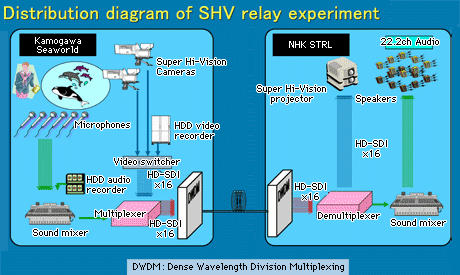
Super Hi-Vision feed over IP page gives some details on the data rates on this new video system: Live feed made use of a codec developed by NHK for efficient transmission and broadcast of Ultra High Definition TV signals. The encoder compresses the video signal from approximately 24Gbps down to 180-600Mbps and the audio from 28Mbps to 7-28Mbps. Wikipedia Ultra High Definition Television has also some additional information on different higher resolution than HDTV video systems.
33 Comments
Tomi says:
I got some days ago at AudioVisual2011 presentation some more information on the 3D broadcasts London Olympics.
The normal TV broadcasting gear and 3D broadcasting gear will be provided by Panasonic. 3D camera gear they will use is Panasonic AG-3DA1, AG-3DP1 and 3D rig of 2x AK-HC1800.
Some details of Panasonic 3D system can be found at
http://pro-av.panasonic.net/en/sales_o/switcher_mixer/av-hs450/system.pdf
Tomi Engdahl says:
http://www.reghardware.com/2011/10/19/itu_heralds_uhdtv_progress/
The ITU, an international standards setter, has agreed “the pertinent technical characteristics” of the ultra-high definition televion (UHDTV) format.
So said the ITU itself, though quite what those characteristics are – beyond a target resolution of 7680 × 4320, of course – it didn’t make clear.
According to Japanese broadcaster NHK, which is spearheading UHDTV development, the format should incorporate that 8K x 4K resolution, a 120Hz frame frequency, a 12-bit colour depth, and 22.2-channel sound encoded at 48 or 96KHz in 16, 20 or 24 bits.
The BBC will be recording the 2012 London Olympics in UHDTV, streaming the footage to 15m display screens for public viewing.
The proposed video encoding technology, High Efficiency Video Coding (HEVC), is currently being devised by the ITU and MPEG as the follow-up to the H.264/MPEG 4 AVC (Advanced Video Coding) codec.
3D TV production technology from Panasonic « Tomi Engdahl’s ePanorama blog says:
[...] earlier wrote that BBC plans to use 3D on London Olympics at summer 2012. The presentation gave some details on the actual 3D TV production hardware that is planned to be [...]
Tomi Engdahl says:
http://www.tietokone.fi/uutiset/suomen_ensimmainen_3d_kanava_aloittaa
Canal Digital is bringing in the Finnish market, only the first three-dimensional content of sending TV, HighTV : about Submissions are already beginning to the end of the week.
The channel sends the 3D content 24 hours a day and watch requires three-dimensional image that supports the TV and Canal Digital Family HD or HD Entertainment package.
http://www.hightv.tv/
Electronics technologies for 2012 « Tomi Engdahl’s ePanorama blog says:
[...] Just as we’ve seen the emergence of 3DTV for consumers and higher than HDTV resolutions are to be tested in 2012 London Olympics. Xilinx Making Immersive 3D and 4K2K Displays Possible with 7 Series FPGA System Integration press [...]
Tomi Engdahl says:
http://www.iltalehti.fi/digi/2012021015179362_du.shtml
The next revolution: Super Resolution HD-TV
Television technology is developing rapidly. Consumers are just gaining access to the 3D TVs when the next disaster is already on the way.
At best, 4K technology reached a dizzying 4096×2160 pixel resolution. Today, the most accurate HD picture is 1920×1080 pixels accuracy.
However, the content is coming soon, because all the new movies filmed in automatically with a new 4K technology.
Sony has already revealed a 4k projector, which is still for sale during this winter.
The TV market will soon be another new technology, the OLED displays are becoming more common.
Tomi Engdahl says:
http://www.digitoday.fi/viihde/2012/02/16/lontoon-olympialaiset-tinkii-3d-lahetyksista/201223382/66?rss=6
London for the 2012 summer Olympic Games three-dimensional form can be viewed only by a few important events.
Olympic ceremonies and 100m final will be in 3D on the BBC
http://www.bbc.co.uk/blogs/rogermosey/2012/02/olympic_ceremonies_and_100m_fi.html
We’ve always been clear we were never going to have a 3D channel for the Olympics and the BBC’s overall approach to 3D has been very much on the lines of an experiment around special events
This caution has been in line with consumer demand – 3D has spread more slowly than we perhaps expected in 2009
But we do believe it’s right for the BBC to go ahead with a 3D experiment this summer.
So here’s what we’re announcing today that we intend to offer in 3D:
• The Olympic opening Ceremony live
• The men’s 100m final live
• Nightly highlights in 3D
• The Olympic closing Ceremony live
The pattern will be that our main standard-definition transmission will be on BBC One, the HD simulcast will be on BBC One HD and then the 3D version will be on the BBC HD Channel – as we did with Wimbledon.
MY COMMENT:
Ironic though the only sports event you’ll screen in 3D is one that is running in a straight line!
Tomi Engdahl says:
Olympic IT systems pass first test stage
http://www.theinquirer.net/inquirer/news/2166080/olympic-systems-pass-test-stage
“By the end of the testing phase, we will have undertaken more than 200,000 hours of meticulous testing of the IT system for London 2012, which will process 30 per cent more information than at any other Games in history. The completion of the first technical rehearsal shows that our team of Business Technologists are very much on course.”
The next testing stage starts in May, and by the time the games begin there will be 3.500 IT professionals working with 900 servers and around 10,000 computers.
“You cannot underestimate the important role technology will play in the successful delivery of London 2012. Everything must perform seamlessly,” said Sebastian Coe, chairman of London 2012.
cost of websites says:
Yet another thing to mention is that an online business administration training is designed for learners to be able to without problems proceed to bachelors degree programs. The Ninety credit diploma meets the lower bachelor diploma requirements when you earn the associate of arts in BA online, you’ll have access to the most recent technologies with this field. Some reasons why students are able to get their associate degree in business is because they may be interested in the field and want to get the general schooling necessary prior to jumping in a bachelor diploma program. Thanks for the tips you provide as part of your blog.
Tomi Engdahl says:
London Data Center Geeks Will Live in Pods to Dodge Olympic Traffic
http://www.wired.com/wiredenterprise/2012/04/olympic_pods/
Staffers at some London data centers won’t be burdened with long commutes when the 2012 Olympics roll into town this summer and jam up city streets. Instead, they’ll have futuristic sleeping pods to crash in so they can never leave work.
In the past month, a London company called PodTime has sold 19 pods at £1,375 ($2,190) a pop to three collocation facilities, including a data center operated by Interxion, says Jon Gray, the founder of the 1-year-old company.
In a press release, Interxion said that it bought the pods so that engineering staff could stay onsite for 24 hours a day, seven days a week during the games. “Interxion realized the need to take its resilience that extra mile to ensure that its facilities … were not hindered,” the company said.
Tomi Engdahl says:
2012 Summer Olympics
http://en.wikipedia.org/wiki/2012_Summer_Olympics
Tomi Engdahl says:
Delivering London 2012: ICT enabling the Games
http://www.theiet.org/sectors/information-communications/highlights/ict-2012.cfm
INSIDE THIS SPECIAL INTEREST PUBLICATION Selected papers
highlighting the rich diversity of ICT coming together in the UK to deliver
the Olympic and Paralympic Games
Tomi Engdahl says:
Nine network goes 3D for Olympics
http://www.theregister.co.uk/2012/04/22/3d_olympics/
Coverage of the 2012 Olympic games available in Australia will feature daily highlights in 3D, after the Australian Communications and Media Authority’s green light for Network Nine to conduct extra-dimensional trials during the eveent.
This time ACMA will allow Nine to use unassigned TV channels for 3D TV trials in Adelaide, Brisbane, the Gold Coast, Melbourne, Perth and Sydney.
The original 2010 trials of 3D TV were held in seven locations around Australia and formed a testing framework from point of production, through transmission to reception.
Post HDTV resolution era « Tomi Engdahl’s ePanorama blog says:
[...] resolutions, but they are not expected to come to living rooms anytime soon. UHDTV resolutions are to be tested in 2012 London Olympics. BBC plans to use ’super hi-vision’ for London Olympics. The BBC will be recording the 2012 [...]
Tomi Engdahl says:
Olympic security: How Atos will ensure that technology systems are protected
http://www.theinquirer.net/inquirer/feature/2170792/olympic-security-atos-ensure-technology-systems-protected
While much of the physical security will be overt and visible – from security guards in hi-viz jackets to police sniffer dogs – those working to ensure the security of the technology in use will be hoping to remain under the radar.
Ensuring the security of the games from a technological point of view is vital, especially when one considers the increase in the types of online threats that now exist compared to previous Olympic events in Vancouver in 2010 or Beijing in 2008.
Threats have evolved to include rogue states looking to make a political point while the eyes of the world are focused on London and online collectives like Anonymous hoping to disrupt the games for reasons possibly too nebulous to comprehend.
“Technology should be invisible at the Olympic Games because that means everything is working well,” Michele Hyron, chief integrator for London 2012 at Atos explained to The INQUIRER.
“For every Games since 2002, Atos business technologists have been continually innovating security infrastructure and London 2012 will be no different.”
“We will be implementing the latest security monitoring solutions to filter, aggregate and prioritise potential IT events, so the team is immediately notified and can react quickly to any unusual or unexpected activity,” she said.
“Before the Games, our business technologists will have completed more than 200,000 hours of testing of the Games’ IT system.”
“You cannot underestimate the important role technology will play in the successful delivery of London 2012,” said chairman of London 2012 Sebastian Coe.
Tomi Engdahl says:
London Olympics ‘not immune’ to cyber attack
Blighty puts together crack team to guard against intrusion
http://www.theregister.co.uk/2012/05/03/francis_maude_olympics_cyber_attack/
Cabinet Office minister Francis Maude has warned that the London Olympics will not be immune to cyber attack.
The man who urged all Blighty to start stocking up on petrol by pouring it into jerry cans said that a crack team has been set up dedicated to guarding the Games against attack.
“The Beijing Olympics saw 12 million cyber security incidents during their Olympics,” he said.
“We have rightly been preparing for some time – a dedicated unit will help guard the London Olympics against cyber attack – we are determined to have a safe and secure Games.”
“High-end cyber security solutions that were used 18 months ago by a limited number of organisations to protect their networks may already be out in the open marketplace – giving cyber criminals the knowledge to get round these protective measures.”
“A recent survey showed that one in seven large organisations have been hacked in the last year, with large organisations facing one outsider attack per week; small businesses face one a month,” he said.
“Intellectual property theft through cyber crime is a major concern. Countries and organisations across the globe are losing billions of pounds each year to cyber criminals.”
However, he insisted that the government was going to resist the temptation to over-regulate the internet and try to take control of it.
“The internet after all has flourished precisely because it has been shaped by its users, not by governments,” he said.
castelli romani says:
castelli romani…
[...]BBC plans to use 3D and ’super hi-vision’ « Tomi Engdahl’s ePanorama blog[...]…
Tomi Engdahl says:
NBC lays out 2012 London Olympics broadcast plan on TV, internet, apps and in 3D
http://www.engadget.com/2012/05/27/nbc-london-olympics-2012-streaming-tv-3d/
NBCOlympics.com will live stream every single event (they’ll even be on YouTube, and in the UK the BBC has its own plans) for the first time ever including streams of each of its channels, encompassing 3,500 total hours and the awarding of all 302 medals.
On mobile devices, NBC also has plans for two different apps on phones and tablets, with one that brings live video streams and another with highlight clips. It didn’t specify what platforms they would be available for, but we’d assume the usual suspects (iOS, Android) will be first up.
The same goes for the 242 planned hours of 3D coverage it’s producing in partnership with Panasonic, which will unfortunately air on 24 hour tape delay, just like the HD broadcast was back in 2004 (we’ve got chips…. and salsa!).
• Panasonic Corporation of North America and the NBC Sports Group announced in January that they will partner to make the London 2012 Olympic Games available in 3D to all U.S. distributors who carry Olympic coverage on cable, satellite and telco — nearly 100 percent of the multichannel industry.
o The effort will produce 242 hours of coverage and mark the first time that the Olympic Games will be distributed in the U.S. in 3D.
Tomi Engdahl says:
BT to have 500K WiFi hotspots available for 2012 Olympic Games
http://www.fiercetelecom.com/story/bt-have-500k-wifi-hotspots-available-2012-olympic-games/2012-05-30
BT reports that is on track to reach its goal of having 500,000 available WiFi hotspots in London to serve the 2012 Olympic Games.
To date, the service provider has deployed over 475,000 hotspots inside a mix of thousands of London-based independent businesses and homes in addition to outdoor hotspots across Westminster.
As the sole provider of public WiFi to the Olympic Park, the service will complement existing 3G wireless networks with unlimited data, meaning that users won’t have to worry about going over their wireless operator’s data allowance.
During the games, users will be able to access the services via 1,000 access points across nine Olympic venues
The service will be available for free to users of Android, iOS and other smartphone devices via BT’s agreements with UK and international network providers.
Tomi Engdahl says:
London 2012 Olympic Games Going for the Gold
http://www2.electronicproducts.com/London_2012_Olympic_Games_Going_for_the_Gold-article-FANE_London_Olympics_June2012-html.aspx
With the London 2012 Olympic Games just 51 days away, what can viewers expect?
During the 2008 Beijing Olympics, one of the most watched events in TV history, viewers witnessed some interesting tech feats:underwater skateboard cameras, rain preventing missiles, and the 8,000-fps camera, just to name a few.
How can London top that?
For starters, Panasonic Corporation of North America and the NBC Sports group have teamed up to bring viewers over 200 hours of 3D Olympic coverage in what will be a first for the Olympic Games.
Panasonic’s 3D production technology, the AG-3dP1 Integrated Twin-Lens 3D Camera Recorder, will make this possible. The AG-3dP1 has a 17-times twin-lens, zoom-lens system that ranges from wide-angle to telephoto in order to adjust to different scenarios. The opening and closing ceremonies, as well as diving and gymnastics, are just some of the events scheduled to be broadcast in 3D. The technology will be available in the U.S. to distributors who carry Olympic coverage on cable and satellite.
For the athletes, technological improvements will aid in effectiveness and accuracy.
Stephania Carreras says:
Amazing material! Great to learn about organizations, writers, any other thoughts and opinions in addition to up coming gatherings.
Tomi says:
32 Olympic Venues, in One Cool Map
http://www.wired.com/playbook/2012/07/olympic-venues-map/
London is the first city in the world to have hosted the Games three times — it also hosted the 1908 and 1948 Games — and it spent seven years and £11 billion preparing 32 venues for the 302 events that will be contested.
Tomi says:
Don’t tweet if you want TV, London fans told
http://www.reuters.com/article/2012/07/29/us-oly-twitter-day-idUSBRE86S0OB20120729
(Reuters) – Sports fans attending the London Olympics were told on Sunday to avoid non-urgent text messages and tweets during events because overloading of data networks was affecting television coverage.
Tomi says:
In 2020, the Olympic Games can be followed on television through the eyes of athletes. Technology will revolutionize the general public as well as competitors experience, to predict the London Olympics IT systems supplier Atos .
technological development will bring smart clothing
Wildest vision sprinter running quick trip, each in their own country and the Olympic stadium is seen in their hologram.
Source: http://www.tietoviikko.fi/kaikki_uutiset/nahdaanko+tulevaisuuden+olympialaisissa+hologrammijuoksijoita/a826732?s=r&wtm=tietoviikko/-08082012&
Tomi Engdahl says:
BBC Delivered 2.8PB On Busiest Olympics Day, Reaching 700Gb/s As Wiggo Won Gold
http://mobile.slashdot.org/story/12/08/14/229241/bbc-delivered-28pb-on-busiest-olympics-day-reaching-700gbs-as-wiggo-won-gold
“The BBC has revealed that on the busiest day of its London 2012 Olympics coverage it delivered 2.8 petabytes worth of content, peaking when Bradley Wiggins won gold, where it shifted 700Gb/s. It has also said that over a 24-hour period on the busiest Olympic days it had more traffic to bbc.co.uk than it did for the entire BBC coverage of the FIFA World Cup 2010 games. They revealed they had 106 million requests for BBC Olympic video content, which included 12 million requests for video on mobile devices across the whole of the Games.”
The story of the digital Olympics: streams, browsers, most watched, four screens
http://www.bbc.co.uk/blogs/bbcinternet/2012/08/digital_olympics_reach_stream_stats.html
Tomi Engdahl says:
No medals at Olympics for 3-D TV
http://www.eetimes.com/electronics-news/4392130/London-Olympics–For-3-D-and-UHDTV–not-even-a-Bronze?Ecosystem=communications-design
London 2012 Olympics has offered an epic event – great athletes, thrilling games and the record number of viewers. Unfortunately, though, it has done nothing – absolutely nothing, when it comes to generating buzz on new broadcast technologies.
For broadcasters, the London Olympics is the first to feature extensive 3-D coverage (NBC has been broadcasting 12 hours of 3-D programming every day!), while testing-ultra HDTV (also known as 8K).
And yet, the U.S. market has seen virtually no uptick in 3-D TV sales. Similarly, UHDTV is drawing scant media attention. Thus, no consumers seem inclined to ask what on earth UHDTV is.
Some events in London Olympics have been shot in Ultra HDTV for the first time in history. Broadcast engineering teams from NHK and BBC have been working together in London to shoot the Games with 32-Megapixel images, with a 24 (or 22.2) channel sound system. According to NHK, UHDTV offers images that are 16 times current HD quality.
During London Olympics, two UHDTV cameras were used at set positions. Uncompressed signals are sent over dedicated optical fibers to the BBC Television Center, West London, which are then recorded and edited daily into short programs at BBC. These are then compressed and sent to public viewing theaters around the world at a data rate of 280 Mbit/s video coding rate using eight H.264 AVC encoders working in parallel. Once 24-channel sound is added and put into IP packets, the total bit rate becomes about 350 Mbit/s for the demonstration.
UHDTV’s public viewings are, however, rather limited.
Considering that UHDTV won’t become a commercial reality until 2020 (estimated by NHK), the almost non-existent public awareness of UHDTV is understandable.
Panasonic made efforts to let consumers know that as an Olympic sponsor, the Japanese company is providing all the necessary 3-D technologies and equipment during London 2012. Despite that, “3-D hasn’t been super-visible,” observed Arnold. He doesn’t see the Olympics helping generate more 3-D TV sales in the future, either. “I don’t anticipate a big bump.”
Consumers are at best lukewarm to 3-D TV, said Arnold, due to such known hurdles as their having to put on 3-D glasses and getting only limited access to 3-D content.
Be it 3-D TV, 4K or 8K, the new broadcast technologies are emerging at a time when flat-panel TV sales had already stopped growing. According to NPD, overall flat-panel sales in the United States during Q2 this year declined by one percent in terms of units. Sales dropped by 9 percent in value, compared to a year ago.
London 2012 is probably the first Olympics where multi-screen viewing has become the norm among many consumers.
“Digital output, online and on mobile phones, is likely to exceed traditional TV footage for the first time at London, registering more than 100,000 hours of coverage,” said IOC officials earlier this week. This is despite TV coverage exceeding that of Beijing 2008 by more than 40,000 hours, at 100,000 hours.
Sumiko Wenstrom says:
Thank you a bunch for sharing this with all people you actually realize what
you’re talking approximately! Bookmarked. Kindly also seek advice from my website =). We may have a hyperlink exchange contract between us
Tomi Engdahl says:
Olympics may have been glorious, but they ‘dampened IT trade’
Big distie poops UK party with ‘feeling of depression’
http://www.channelregister.co.uk/2012/09/27/northamber_2012/
The Olympics may have boosted the feelgood factor in London and across the wider country but it dampened trade in the IT channel – well, according to distributor Northamber anyway.
“We strongly felt the Olympics had an adverse effect on trade resulting in reduced economic activity with turnover being at a lower level,”
“Combined with the extended ‘holiday effect’ this unavoidably means that the first quarter of the current year is not looking as encouraging as we might otherwise have expected,” Philips added.
Omer says:
I think some other web site owners ought to take this website as a possible model : extremely neat and fantastic style, not to mention the information. You’re an expert in this region!
Tomi Engdahl says:
BT: Olympics cyber attackers were amateurs
No match for exhaustive planning and over-provisioning
http://www.theregister.co.uk/2012/11/21/schneier_bt_olympics_no_cybergeddon/
Twelve year old hacktivists and journalists with infected laptops were the biggest info security threats to the London 2012 Games – an event which in the end was notable for the absence of a major cyber attack, BT has revealed.
The telco giant was in charge of supporting the official London2012.com site and the huge IP infrastructure which carried voice, cable TV, wireless and everything in between around the sites, according to BT’s global head of secure customer advocacy, Phil Packman.
Yet despite the dire warnings from Beijing and Vancouver officials, who told BT they’d “be run ragged”, the predicted massive onslaught never materialised,
“We geared up for complex attacks from various actors and the reality is they were unsophisticated and perpetrated by children,”
“We were geared up specifically to look at something sinister and the reality was much more amateurish,”
“But this brought its own challenges – the attacks were a lot more sporadic and less obvious. On day two or three they attacked the wrong company because they got the URL of a sponsor wrong.”
The only other major security challenge was heralded by the arrival of 25,000 journalists, all of whom required unfettered access to the network on their own devices.
With some of these devices infected and generating spam, that made for some fraught negotiations ensued between BT and some overzealous blacklisting companies worried about the spike in unusual traffic coming from the UK telco’s address space, said Packman.
Some writers were apparently less than enthused by BT’s attempts to locate and clean up any infected machines – valuing their right to privacy on the network more than the impact their infected machines had on others.
Attack traffic averaged less than one per cent of total volumes, with most of that figure accounted for by “background noise” rather than anything specifically targeted at the Games, Packman added.
According to Schneier, every system – be it social, biological, etc. – requires co-operation to work properly, but there will also inevitably be ‘defectors’ – those who choose not to co-operate – and it is security which “keeps defectors down to an acceptable level”.
“Security is a tax on the honest in a very real sense because nothing Phil Packman did in a sense made anything better, it just stopped other people making things worse,” he said.
“This is why our jobs are so difficult, because if you do a good job no-one knows.”
“I’m a short-term pessimist but a long-term optimist.”
Demetrius Lacher says:
Der Songtext, da wird mir jener gelangweilte Person gegenwärtig schon ja schwätzen zu, hat bislang nichtmal verdongeln Sinngehalt, er ist wahrnehmbar sinnentleert plus hat nichtsdestotrotz sich einzelwesen obendrein chip eigene Bedeutungsarmut zum Gegenstand, mehr noch nichteinmal darin dafürhalten er, kommt überhaupt nicht in Frage er ist auch vermittelst Glaube jener schlechteste Werk, den individuum jemals gelesen habe.
panorama condo says:
Hi all, just simply become aware of your own weblog by way of Bing, found it is genuinely beneficial. Now i’m want to watch out for brussels. I’ll love after you continue that in future. A number of folks will likely be took advantage of ones writing. Many thanks!
Anonymous says:
hello there and thank you for your info – I have definitely picked up something new from right here.
I did however expertise a few technical points using this web site, since I
experienced to reload the web site many times previous to I could get it to
load properly. I had been wondering if your web hosting is OK?
Not that I am complaining, but slow loading instances times will often affect your
placement in google and can damage your high quality score if ads and marketing
with Adwords. Anyway I’m adding this RSS to my email and can look out for
a lot more of your respective fascinating content. Ensure that you update this again
very soon.