30 Years of .mp3: Three Letters That Changed the World
The technology behind these three letters has become an inseparable part of our daily lives: in 2025, the file extension “.mp3” celebrates its 30th anniversary. This audio format laid the foundation for many more groundbreaking audio codecs. The mp3 format cleverly takes advantage of the characteristics of human hearing. Audio signals always contain components that are inaudible to us. These irrelevant parts are stored with less precision – using fewer bits. The format was standardized in the 1990s by the ISO-MPEG committee. The first standard, MPEG-1, included three layers of audio coding: Layer 1, 2, and 3. The name “mp3” is short for “MPEG-1 Audio Layer-3” and was chosen on July 14, 1995, through an internal email poll at Fraunhofer IIS.
In the mid-1990s, the goal became to play back mp3 files on small, portable devices.
Apple’s iPod and the iTunes Music Store helped propel mp3’s successor, MPEG Advanced Audio Coding (AAC), into the mainstream.
Today’s highlights include the MPEG-H Audio System, which brings immersive sound into living rooms and introduces interactive features. Users can choose between several audio mixes.
The EVS speech codec, used in all 4G and 5G mobile calls, was also co-developed at Fraunhofer IIS
The Low Complexity Communication Codec (LC3) has become the Bluetooth standard, delivering excellent audio quality with minimal energy consumption for example on Bluetooth headsets.
Nobody celebrates the 30st aniversary of mp3 – why?
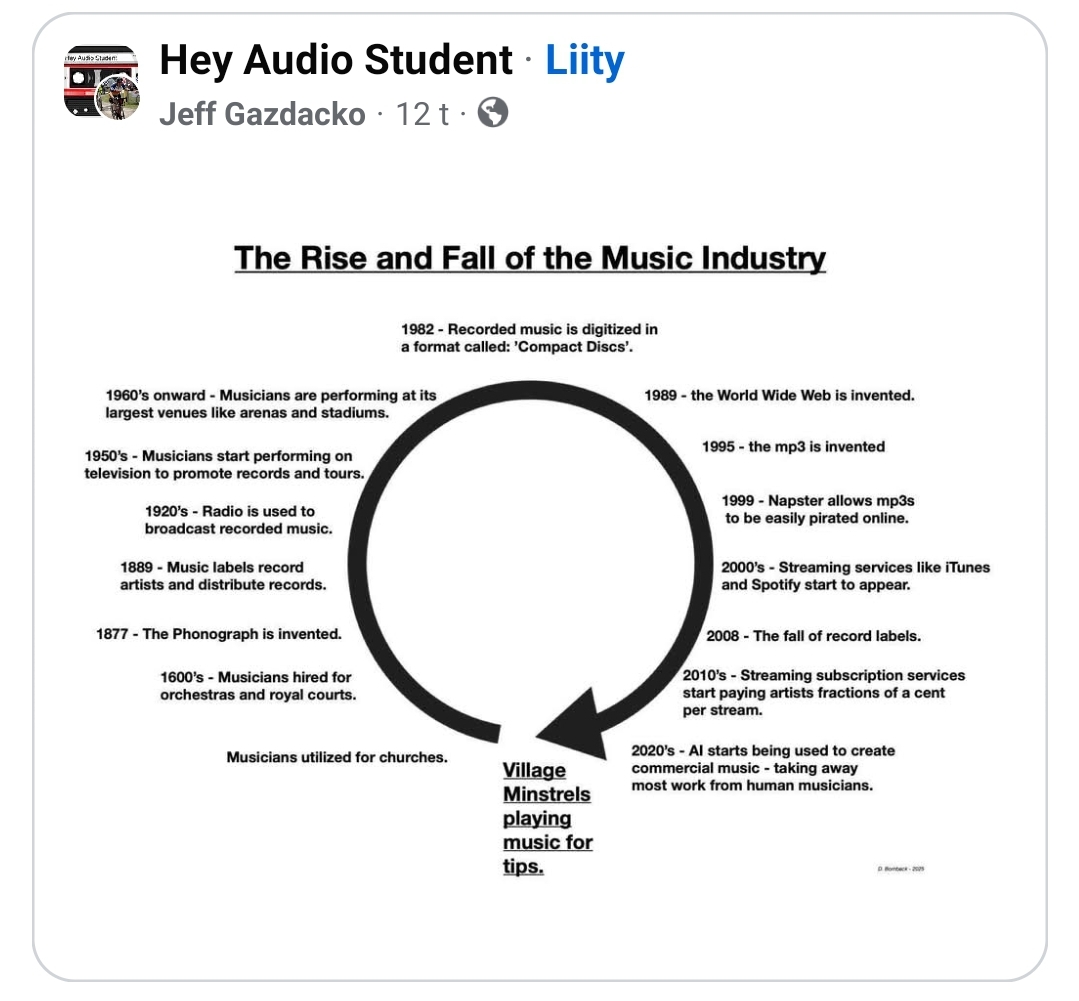
This is just another example of progress – and that the music industry isn’t immune to it.
It’s just how you adjust to it.
Horse and cart – Automobiles
Fletchers – Gunsmiths
Kodak- Digital photos
Typewriters – computers
The world is littered with examples. Napster effect would have been “Recorded music will become free and ticket prices to gigs will go up and musicians will have to work for a living.” If the music business had embraced the technology that Napster used rather than fighting it things would possibly have been different. Record labels and bands could have released albums either in the physical or as an MP3 for cheaper price.
It’s what the book industry did when Kindle came along. An e-book costs usually way less than a physical book yet books are still sold in their millions.
0 Comments
Be the first to post a comment.