John Huntington’s Blog has covered a lot of holiday light displays over the years. Brooklyn’s Holiday Light Spectacular is the newest one covered on the blog. It tells about Holiday Light Spectacular display with nice pictures, and also gives details on technology behind the display.
If you want to do your own holiday light display then here are some links to interesting project ideas from around Internet: Control your holiday lights with a magic wand circuit allows you to turn on your holiday bulbs with a wave of the magic wand. DIY Christmas Light Suit project uses LabVIEW to perform sound analysis of a playing music and uses LabVIEW Interface for Arduino (LIFA) to drive various Christmas light strings based on the power level at various frequency ranges. Smart Christmas Tree Lights with JenNet-IP video plays with the idea that “What if every Christmas tree light had an Internet address?”. Don’t forget my older Christmas Lights blog postings.

Light shows are nice to watch, but the technology used in them be can dangerous. Blink-182′s Mark Hoppus’ Retina Damaged by a Show Laser posting tells about the potential dangers of light displays that involve powerful lasers. In video Mark Hoppus Presents: The World’s Most Powerful Touring Laser Blink-182‘s bassist and singer Mark Hoppus talks about how he suffered retinal damage during a show in Milwaukee. In the video, he does a pretty good job of explaining how the laser show process works in terms of protecting the audience and what went wrong in performance. That show used a very powerful 26W Lightwave Lightwave Prism Series laser show equipment (you have read right, that’s watts, NOT milliwatts you normally see in most laser specifications).
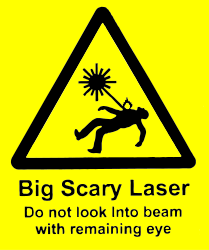
Remember that this kind of laser damage to eye is usually permanent. Primary personal hazards of high-power laser exposure are skin burns, blind spots when the laser strikes the retina, and the worst case total blindness. Lasers have been coming back into vogue in recent years on touring concerts, so be careful if you happen to be near them or operate them. Remember Laser Safety. There is also a a growing concern over the increased potential risk of eye damage from high power LEDs as well because intense blue light can cause damage to the retina. Do not stare at lasers or very high brightness LEDs, because doing so may cause permanent damage to your eyes. Remember that lasers can also damage cameras and camcorders, and even video projector chips (DLP).
266 Comments
Tomi Engdahl says:
Headphones with laser
https://www.facebook.com/share/r/1DNVj1PvXe/
Tomi Engdahl says:
China unveils laser defense-style mosquito killer that zaps 30 bugs per second using LiDAR precision. https://bit.ly/3IcP3df
Tomi Engdahl says:
https://youtu.be/OE5KJVAk7X0?si=PxcR26hkKGElFcvo
World Record: Largest Laser Show [1.100 lasers] – Verknipt ArenA 2025 | 360° Experience Show
Tomi Engdahl says:
https://www.lisungroup.com/news/technology-news/what-is-the-difference-between-iec-en-60825-1-and-iec-en-62471.html
Tomi Engdahl says:
https://futurism.com/science-energy/airport-laser-pentagon-trump?fbclid=IwdGRjcAP60whjbGNrA_rS7WV4dG4DYWVtAjExAHNydGMGYXBwX2lkDDM1MDY4NTUzMTcyOAABHojt3rDfIzLtsA9ptmKeMe2-4e5Wn-RE54nWWJiembVe53XQSg_WzALyOsw-_aem_ghMgKs9BeGLC_JrDKSNC-w
Tomi Engdahl says:
https://futurism.com/science-energy/immigration-officials-el-paso-balloon-laser?fbclid=IwdGRjcAP7uAZjbGNrA_u3-GV4dG4DYWVtAjExAHNydGMGYXBwX2lkDDM1MDY4NTUzMTcyOAABHpBIY5f3phprFEhB_8fM33F_IukGKcmpBwmNACvsmfVa-d7fV7feovD7WXjv_aem_Jmzt-UK6HuSGAAGW1gykiw
Tomi Engdahl says:
Laserhitsaus
https://youtu.be/0b1p7460WIw?si=Bjhdz_4BoI4ZM_FV
Tomi Engdahl says:
Building A Laser-Driven Photoacoustic Speaker
https://hackaday.com/2026/03/22/building-a-laser-driven-photoacoustic-speaker/
An MRI scan is never a pleasant occasion – even if you aren’t worried about the outcome, lying still in a confined, noisy space for long periods of time is at best an irksome experience. For hearing protection and to ameliorate boredom or claustrophobia, the patient wears headphones. Since magnets and wires can’t be used inside an MRI machine, the headphones have to literally pipe the sound in through tubes, which gives them poor sound quality and reduces the amount of noise they can block. [SomethingAboutScience], however, thinks that photoacoustic speakers could improve on these, and built some to demonstrate.
These speakers use the photoacoustic effect, which is mostly caused by surface heating when exposed to an intense light, then transferring the heat to the surrounding air, which expands. If the surface can transfer heat to the air quickly enough, and if the light source is modulated quickly, the rapid expansions and contractions in the surrounding air create sound waves. As a test, [SomethingAboutScience] shone a modulated 5-Watt laser on a piece of gold leaf, which produced recognizable music.
Gold leaf works because it absorbs blue light well and is thin enough to transfer heat to the air quickly. To cut out the absorbing surface, [SomethingAboutScience] also shone the laser directly into orange nitrogen dioxide gas, which produced a somewhat cleaner sound (in a purely auditory sense; nitrogen dioxide is quite dangerous, and calling it “a little toxic” is an understatement).
Tomi Engdahl says:
https://etn.fi/index.php/13-news/18767-uudenlainen-laser-vie-optisen-tiedonsiirron-ulos-laboratoriosta
Tomi Engdahl says:
https://hackaday.com/2026/05/06/rgb-laser-projector-does-colorful-asteroids-and-much-more/
Tomi Engdahl says:
https://hackaday.com/2018/02/15/laser-galvo-control-via-microcontrollers-dac/
Tomi Engdahl says:
https://hackaday.com/2026/06/24/all-the-different-lasers-and-how-well-they-mark-3d-prints/
Tomi Engdahl says:
https://hackaday.com/2026/06/24/laser-scanning-a-cave-with-homebrew-gear/
Tomi Engdahl says:
https://hackaday.com/2026/08/09/transmitting-analog-video-via-frikkin-laser-beams/
Tomi Engdahl says:
https://hackaday.com/2026/08/27/analog-optical-feedback-generates-4k-fractals-with-no-computer/
Tomi Engdahl says:
https://www.facebook.com/share/19GzEL53Qp/
A Chinese startup, Photon Matrix Lab, has developed a portable laser device that detects and kills mosquitoes while they are flying. The system uses lidar and AI vision to identify mosquito-sized targets and fires a laser pulse within about 3 milliseconds.
The device can reportedly target up to 30 mosquitoes per second from a distance of about 6 meters. Its AI system is designed to distinguish mosquitoes from people, pets, and other larger objects.
Unlike chemical insecticides, the system is designed to eliminate mosquitoes using targeted laser pulses. Its compact design allows it to be used both indoors and outdoors.
The device has raised more than $2.7 million on Indiegogo, far exceeding its original $20,000 goal. More than 4,000 backers from over 50 countries reportedly supported the project, with each unit priced at around $630