Advances in data center technology and Internet usage have pushed enterprises to 10 Gigabit Ethernet (Gbps) links. Services like search engines, carriers, ISPs need even higher speeds. Lacking alternatives to 10-Gbps connections, carriers and enterprises have resorted to using multiple 10 Gbps connection (expensive solution).
Projected Internet traffic growth mandates the need for higher speed Ethernet (HSE) connections sooner or later. The amount of backbone Internet bandwidth maintained by major Internet carriers has been expanding at 75 to125% per year. While 10 Gbps appears to be sufficient for most data centers today, 40 Gbps is expected to meet data center needs through 2014. 100 Gbps rate has been identified as the next high-speed network operator interface.
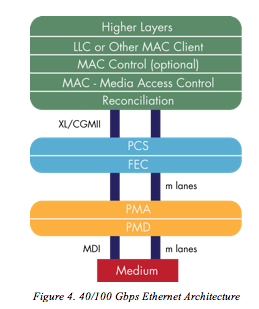
An IEEE Task Force has been established with the objective of standardizing 40 Gbps within the data center and 100 Gbps between major Internet nodes. Ensuring the success of High Speed Ethernet (HSE) tells you more about those new 100 GbE and 40 GbE Ethernet technologies around the corner.
9 Comments
Ventego says:
Are you a professional journalist? You write very well.
tomi says:
I write professionally to Prosessori magazine.
birendra singh says:
Everyday the needs of internet is increasing around the world, this is nice update on ethernet.
Mary Marazzi says:
I found this information interesting.
Carlita Flam says:
“You can copy it”
David says:
Such an excellent description! No idea how you were able to write this report..it’d take me days. Well worth it though, I’d assume. Have you considered selling banners on your blog?
œmieszne gry says:
mainstream music period dumbs ppl down
dududukkkkkkk says:
Nice post at Higher Speed Ethernet Tomi Engdahl’s ePanorama blog. I was checking continuously this blog and I am impressed! Extremely useful information particularly the last part I care for such info much. I was seeking this certain info for a very long time. Thank you and best of luck.
Tomi Engdahl says:
New group to set goals for next-gen Ethernet
http://www.eetimes.com/electronics-news/4394297/New-group-to-set-goals-for-next-gen-Ethernet
A new group will tackle an issue that’s been a hot debate in communications for at least two years—should the next big leap for Ethernet be to 400 Gbits/second or a Terabit/s. The IEEE 802.3 Industry Connections Higher Speed Ethernet Consensus group aims within a year to pick a target and kick off a formal standards effort.
The news comes as the IEEE 802.3 group overseeing Ethernet officially publishes its Ethernet Bandwidth Assessment report. The report, developed over the course of the last year, validated the group’s conclusions from an earlier study that demand for bandwidth is doubling about every 24 months. At that rate, networks will need to support capacity requirements of a terabit per second in 2015 and 10 terabit per second by 2020, it said.
“Everyone is worried about the coming tsunami of data,” said John D’Ambrosia, a veteran Ethernet standards organizer and chair of the new consensus group. “There’s a lot of nervousness out there about how people will do it in a cost effective manner,” he said.
The news comes as the IEEE 802.3 group overseeing Ethernet officially publishes its Ethernet Bandwidth Assessment report. The report, developed over the course of the last year, validated the group’s conclusions from an earlier study that demand for bandwidth is doubling about every 24 months. At that rate, networks will need to support capacity requirements of a terabit per second in 2015 and 10 terabit per second by 2020, it said.
“Everyone is worried about the coming tsunami of data,” said John D’Ambrosia, a veteran Ethernet standards organizer and chair of the new consensus group. “There’s a lot of nervousness out there about how people will do it in a cost effective manner,” he said.
Engineers are currently hammering out specifications for 25 Gbit/s serial lanes and starting work on 50 Gbit/s channels at the Optical Internetworking Forum. It would take 20 to 40 of those fastest channels working in parallel to deliver TBit/s Ethernet rates.
The consensus group could decide to set both 400G and a Tbit as parallel goals. The last big Ethernet effort simultaneously delivered standards for 40 and 100G to serve different markets.