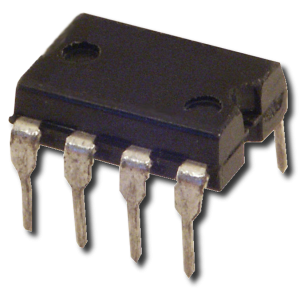
The 555 Timer IC is an integrated circuit (chip) implementing a variety of timer and multivibrator applications introduced in 1971. The 555 part is still in wide use, thanks to its ease of use, low price and good stability.
555 Contest claims to be biggest, newest, most-independently conceived 555 timer design contest the world has ever seen! The organizers of the contest are interest in seeing new designs and creativity blossom. Now it is time to act because all entries must be submitted by March 1st, 2011. Yeah, it’s quick, but the world moves fast. And remember that “You’ve got 8 pins…and one shot.” So visit http://www.555contest.com/ for more details.
111 Comments
Tomi Engdahl says:
There’s a guy on YouTube that makes a vacuum tube 555 and a 741 kit … https://youtu.be/Erdep7XInWU?si=y4NvohiozVHjMpYD
Tomi Engdahl says:
The Three Fives Kit: A Discrete 555 Timer
Re-create one of the most classic, popular, and all-around useful chips of all time.
https://shop.evilmadscientist.com/productsmenu/652
Tomi Engdahl says:
https://hackaday.com/2025/04/02/the-magic-touch-a-555-touch-switch/
Tomi Engdahl says:
https://hackaday.com/2025/07/22/2025-one-hertz-challenge-a-555-but-not-as-we-know-it/
Tomi Engdahl says:
https://www.peculiar-games.com/electronics/555-class-d-amplifier/555_amp_lg_schem
Tomi Engdahl says:
https://www.homemade-circuits.com/how-to-use-ic-555-for-generating-pwm/
Tomi Engdahl says:
https://lrak.net/wiki/555_Delta-Sigma_Modulator.html
Tomi Engdahl says:
https://hackaday.com/2026/04/01/a-novel-555-circuit-in-2026/
Tomi Engdahl says:
https://hackaday.com/2026/04/07/thermostat-do-it-with-a-555/
Tomi Engdahl says:
https://hackaday.com/2026/08/22/555-makes-a-useful-beat-frequency-oscillator/
Tomi Engdahl says:
DOOM Played On Series Of 555 Timers
https://hackaday.com/2026/08/28/doom-played-on-series-of-555-timers/
It’s technically true that any piece of software can be reproduced in hardware, although modern software’s size and complexity generally makes this a non-starter. But if we go far enough back in time, older software becomes easier and easier to implement in hardware. The original DOOM from 1993 might one day be recreated in full this way, but that day is not today. Instead, [Nick] has recreated the original music from that game, playing the opening track in nothing but 555 timers.
The circuit starts with a 555 timer that acts as a system clock with a rate of just over 7 Hz. These pulses feed a binary counter which in turn feeds a decoder, giving the circuit 15 positions. Each output of the decoder feeds to a diode matrix which stores information about what pitch the circuit should play. The circuit only needs to play six pitches so the diodes effectively connect each moment in time to one of these six notes. From there the circuit feeds into a set of switches which select different resistor networks of another 555 which is actually responsible for producing sound. The resistor networks have different values to adjust the timing of the 555 to produce different pitches.
Of course this entire exercise is largely academic as almost any microcontroller would be able to be programmed to play this chiptune quite easily,
https://www.youtube.com/watch?v=ER7X53e6r7c