For a change it is nice to see circuit designs that would work posted to Facebook (most AI Slop circuits seen in Facebook do not work at all). Even those circuits would work, those circuits are potentially very dangerous circuit if not built exactly right. The biggest dangers are electrocution and fire.
Start with circuit from https://www.facebook.com/share/p/1GJ5iBFZDq/
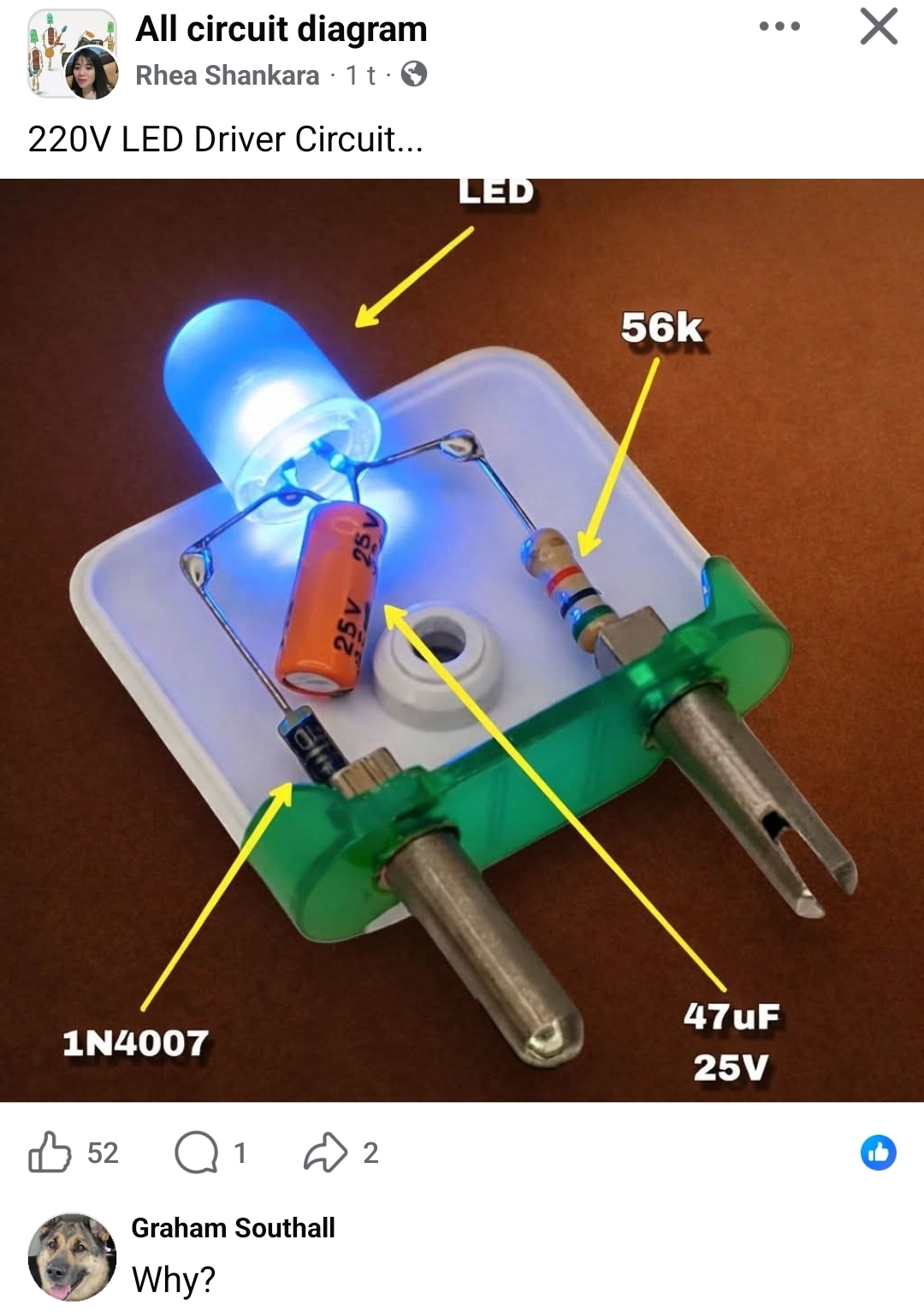
Most of the power in this circuit is lost on that resistor, approximately 500 mW. That resistor needs to be able to handle that power. Anything less 0.5W power rating will burn out (fire danger) and 0.5W resistor will run very hot (potentially can damage the plastic case, fire danger if case is not made of heat resisrant msterial). A “0.5 W resistor” is typically rated to dissipate 0.5 W at 70 °C ambient, in free air, with an allowed body temperature often up to 155–200 °C (depending on type).
The resistor needs to be with at least 1W power rating, and it would still run pretty hot (80–125 °C).
Second circuit from https://www.facebook.com/share/p/1CK3psPmdA/
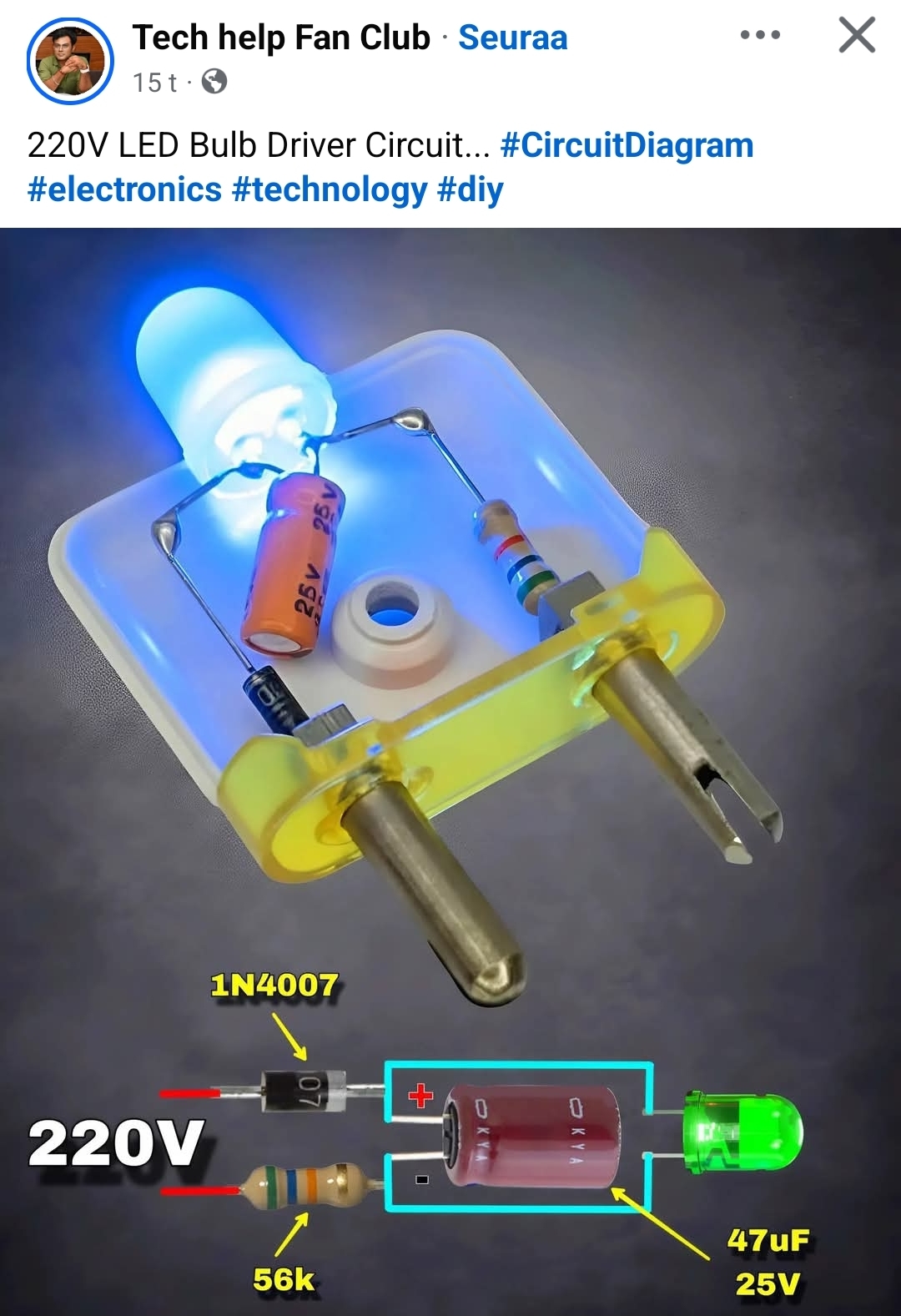
How does the circuit work with 220V?
The 220V LED bulb driver circuit works by using a capacitor (47uF 25V) to drop the voltage and limit the current to the LED. Here’s a simplified explanation:
1. The 220V AC power is applied to the circuit.
2. The capacitor (47uF 25V) acts as a reactance, reducing the voltage and limiting the current.
3. The diode (1N4007) rectifies the AC voltage, converting it to a pulsating DC voltage.
4. The resistor (56k) helps to further limit the current to the LED.
5. The LED bulb is connected across the circuit and lights up when the current flows through it.
This circuit is a simple and cost-effective way to drive an LED from a high-voltage AC source. However, it might not be suitable for long-term use due to potential voltage spikes and capacitor reliability issues.
Keep in mind that working with 220V AC can be hazardous, and proper safety precautions should be taken when building and testing such circuits. This is not a project for a beginner.
If you are used to calculating LED current of 20 mA with 3V voltage drop over the, you might wonder the component values. If you try to calculated the LED resistor for 20 mA, you would get 10850 ohms, not 56k like used in this circuit.
This circuit does not run the LED at 20 mA, but lower 4 mA current limited by resistor (only half of time). That lights up LED, but not at full brightness. With this circuit the resistor wastes 500mW power. If you change the resistor to your 10850 ohms, the power loss in resistor would be almost 5 watts (you would need a quite big power resistor that would not fit inside the case).
Why there is the series diode in the circuit? Isn’t an LED by definition a diode?
Yes. LED is diode, but they typically quite limited how much reverse voltage they can withstand (many LEDs have a 5V limit for safe reverse voltage). Another reason that there is also a capacitor to avoid the LED flickering at mains 50 Hz frequency. A diode is needed for charging the capacitor to DC that can power LED on the negative half wave the diode blocks.
And what would be the purpose of the capacitor?
With one diode rectifier, LED would flicker half time on and half time off at 50 Hz rate. That kind of LED looks flickering. Add a capacitor, and LED will stay on all the time without noticeable flickering.
I understand the current limiting of the Resistor but shouldn’t that be on the hot leg versus the neutral leg?
This kind of plug can be plugged in both ways so in circuit you can’t control if resistor get plugged to phase or neutral. There is no practical difference as long as the circuit is inside well insulated case.
Final comment: Learn from those circuits, but I don’t recommend building them. The circuits are potentially dangerous (electrocution and fire dangers). They also have very low efficiency (most power input is wasted as heat on the resistors).
0 Comments
Be the first to post a comment.