The Secret Weapon or a Safety Hazard?
The Truth About the OSS TEAM W01 Inductance Tester
If you’ve spent any time browsing electronics repair forums or watching diagnostic videos lately, you’ve probably seen it: A sleek, pen-sized black circuit board being waved over smartphone motherboards. The green LED lights up, and—boom—the component is declared healthy (claims many videos seen on Facebook and YouTube).
Advertisements call it a “Revolutionary Motherboard Repair Tool” that grants technicians “X-Ray Vision.” Sellers claim it can instantly stop the guesswork of component failures with a clear pass/fail signal.
But is the OSS TEAM W01 Inductance Tester truly a “secret weapon,” or is it just another over-hyped online hoax? Or something in between? Let’s strip away the marketing promises and look at what this tool actually does, how much it costs, and the hidden dangers you need to know about.
What is the OSS TEAM W01?
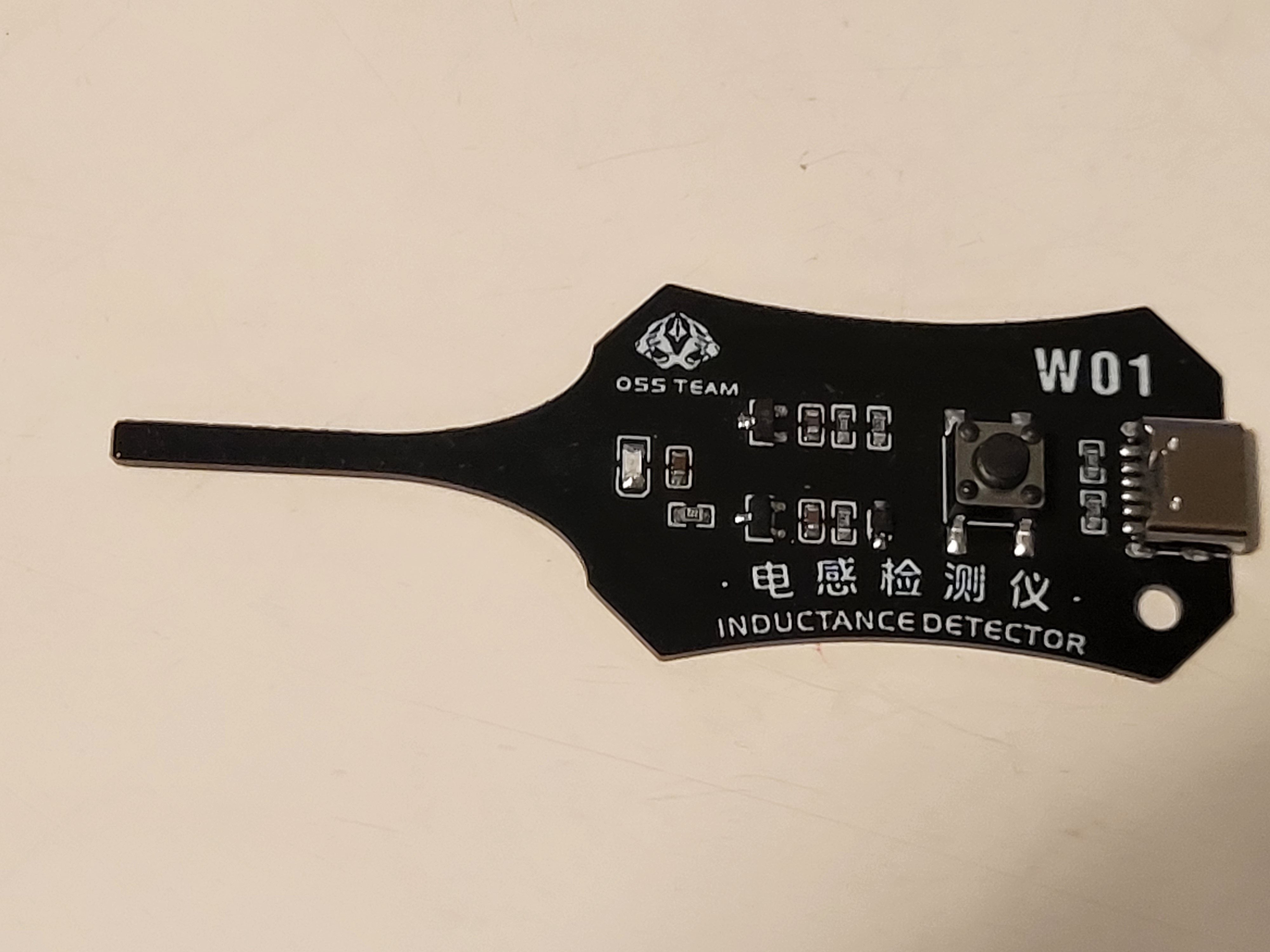
At its core, the OSS W01 is a compact, bare-board electromagnetic field (EMF) detector. It features:
A pointed detection tip at one end.
A central detection button you must press and hold.
A small green LED indicator light.
A Type-C power input that can run off a standard 5V power bank or phone charger.
The OSS W01 Inductance Detector is a compact, black circuit board with a pointed detection terminal at one end. It features a Type-C power input port, a detection button, and a small LED indicator light. The board is labeled with ‘W01′, ‘OSS TEAM’, and ‘INDUCTANCE DETECTOR’. Dimensions: 75mm x 27mm (approximately 2.95in x 1.06in)
I came across an advertisement for such a tester online. It claims to identify faulty components on circuit boards. I guess it’s all a hoax, though? If the green LED doesn’t light up, the component is faulty. So how can it tell? The advertisement showed testing resistors and capacitors.
OSS w01 Inductance Tester What would a product with a daily sales volume of 10,000 units look like?
https://www.youtube.com/watch?v=Mi4oGukxFTo
How It’s Supposed to Work
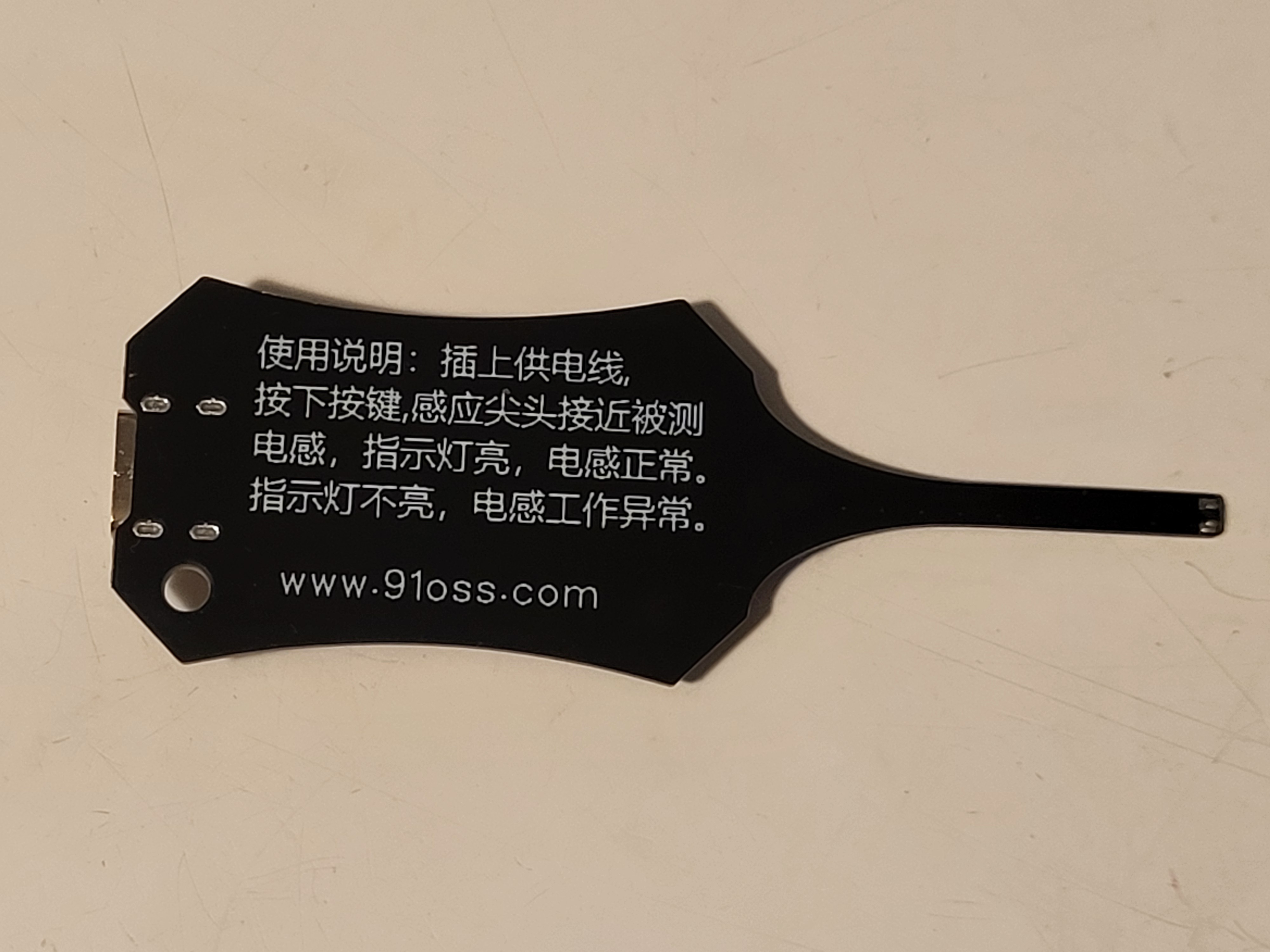
The marketing pitch is incredibly simple: If the green LED lights up, the inductor is functioning correctly. According to the instructions, you power up the motherboard you are troubleshooting. You plug in the W01 tester, hold down its button, and bring the pointed tip close to the inductor coil (about 1 to 3 mm away).
Green light stays on or flashes: The inductor is actively processing power; the internal coil is intact.
No light: The inductor coil is broken (open circuit) or not receiving power.
OSS TEAM W01 Type-C Inductance Tester is advertised as a Professional Repair Diagnostic Tool. The marketing promise is: If the LED lights up, the inductor is functioning correctly.
Advertisements are full of promises like:
Why This Pen-Sized Diagnostic Tool Is Revolutionizing Motherboard Repair (Hint: It Gives You ‘X-Ray Vision’)
Stop guessing component failures! Handheld tester gives clear pass/fail signal. Quality components, reinforced housing.
OSS TEAM W01 Inductance Tester, a compact and user-friendly device for rapid troubleshooting and fault detection of mobile phone inductors.
EMF Detector Type-C Inductance Tester High Precision Electronic Circuit Board Inductor Detector for Electronics Repair
Features Type-C power, rapid troubleshooting, and easy operation for mobile phone motherboard
If you’re nodding your head, you’re about to discover why thousands of repair techs are calling this pocket-sized tool their “secret weapon” against the most frustrating part of electronics repair…
I have seen an AI videos advertising these, claiming they will make your multimeter obsolete. W01 does not make your multimeter or oscilloscope obsolete. Not everyone will have a use for one of these, but if you do troubleshooting on systems with buck/boost converters for current and voltage regulation, then this could be a useful tool for doing a quick check on whether an inductor is being pulsed.
The Catch: It Doesn’t Have “Magic Vision”
The fact is that the W01 can sometimes successfully detect powered coils (if they have enough power going through them and they are not too well shielded). Sometimes the detection does not work.
While the device is a functional tool, online ads often stretch the truth. Watching how they use it…just touching around at random spots on an active circuit and they say “when the light does not come on, it is a bad component”. Some commercials show technicians using it to test resistors and capacitors and diodes. Spoiler alert: It doesn’t work on them.
The device is purely an induction and EMF tester. It detects the pulsing magnetic fields generated by a working coil. If you place it near a resistor or capacitor, the light won’t turn on—not because the component is broken, but because those components don’t generate the magnetic fields this pen is looking for.
Furthermore, metal heat sinks or shielding shells can trigger false positives by spreading interference, meaning the light might turn on even if you aren’t directly over a healthy inductor.
It can be a helpful troubleshooting tool for quick reference, but it cannot mystically diagnose your entire board. They only work for inductors that are powered with high frequency pulses. For inductors you don’t need them to be out of circuit to detect the em field generated by inductors when functioning properly. If you have a working board for comparison, you can test where you see light coming on in the working board, and then see if LED lights on the not working board.
Videos:
https://youtube.com/shorts/Mi4oGukxFTo?si=gSX3gqphKXq5ZW6L
https://youtube.com/shorts/8g822XrTB9s?si=nTPWQJiYnKNCSWkW
https://www.youtube.com/shorts/faQ0mO1lOrI
Instruction pictures
https://www.aliexpress.com/item/1005010320063815.html
Manual
https://manuals.plus/m/e92f476fbf03e51ea91d75fb8bb1c70f2db89e166420bedeb4f59ea78b0eb7e8
WARNING: The Hidden Danger of An Unenclosed Board
One of the most alarming aspects of the OSS W01 is its design. It is completely unenclosed—just a bare, exposed circuit board.Instruction manuals explicitly warn: “Place the front end close to the inductor, do not touch it, as some inductors are not insulated.”
Worse yet, some promotional videos on social media show users probing live, mains-powered electronic devices with this bare board. If an inexperienced hobbyist handles this unenclosed block, their fingers can easily slip and touch high-voltage components on the live board. This is incredibly dangerous and carries a genuine risk of electrical shock.
Video where probing live main powered device (potentially very dangerous) can be seen at
https://www.facebook.com/61577839981774/videos/-oss-inductance-detector-high-precision-electromagnetic-induction-measurement-al/868769249585152/
If you use this tool, it should strictly be confined to low-voltage motherboards (like smartphones), and you should handle it with extreme care. To avoid causing any short circuits, I recommend to add insulation around the tip of the W01 sensor (for example insulating tape or heat shrinking insulation).
Circuit analysis
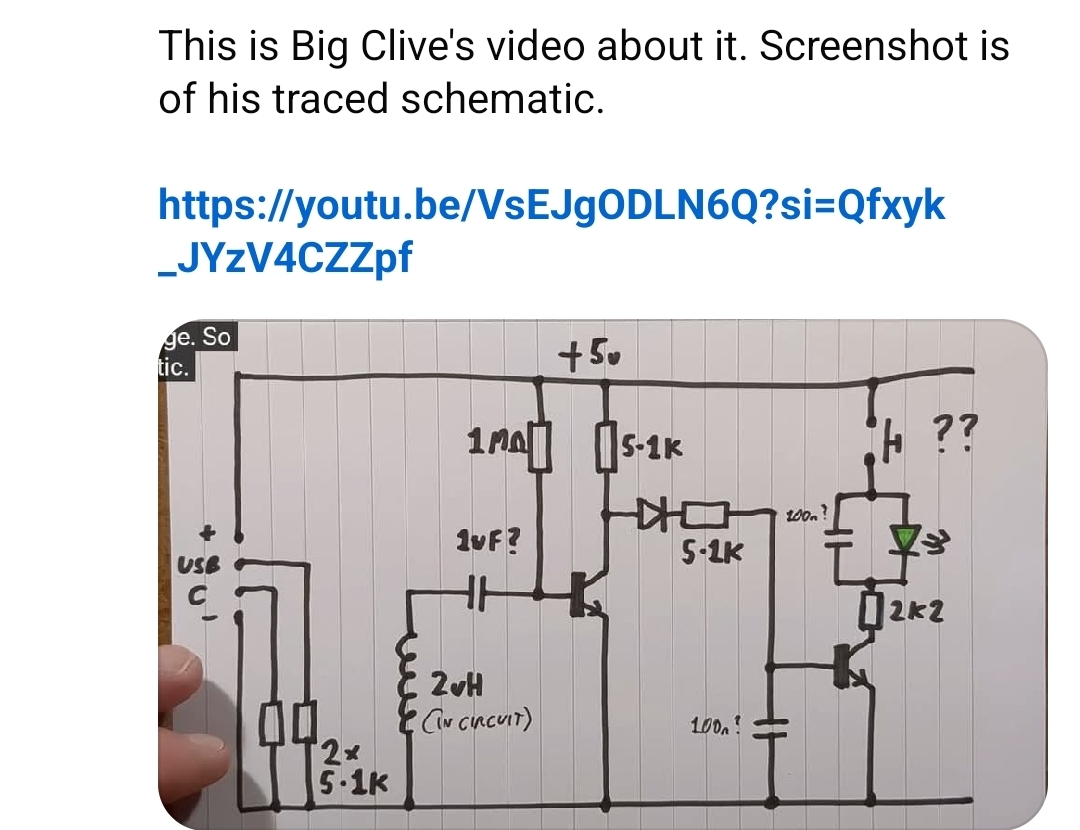
Circuit diagram for the sensor part. Traced from circuit board and component values measured in-circuit
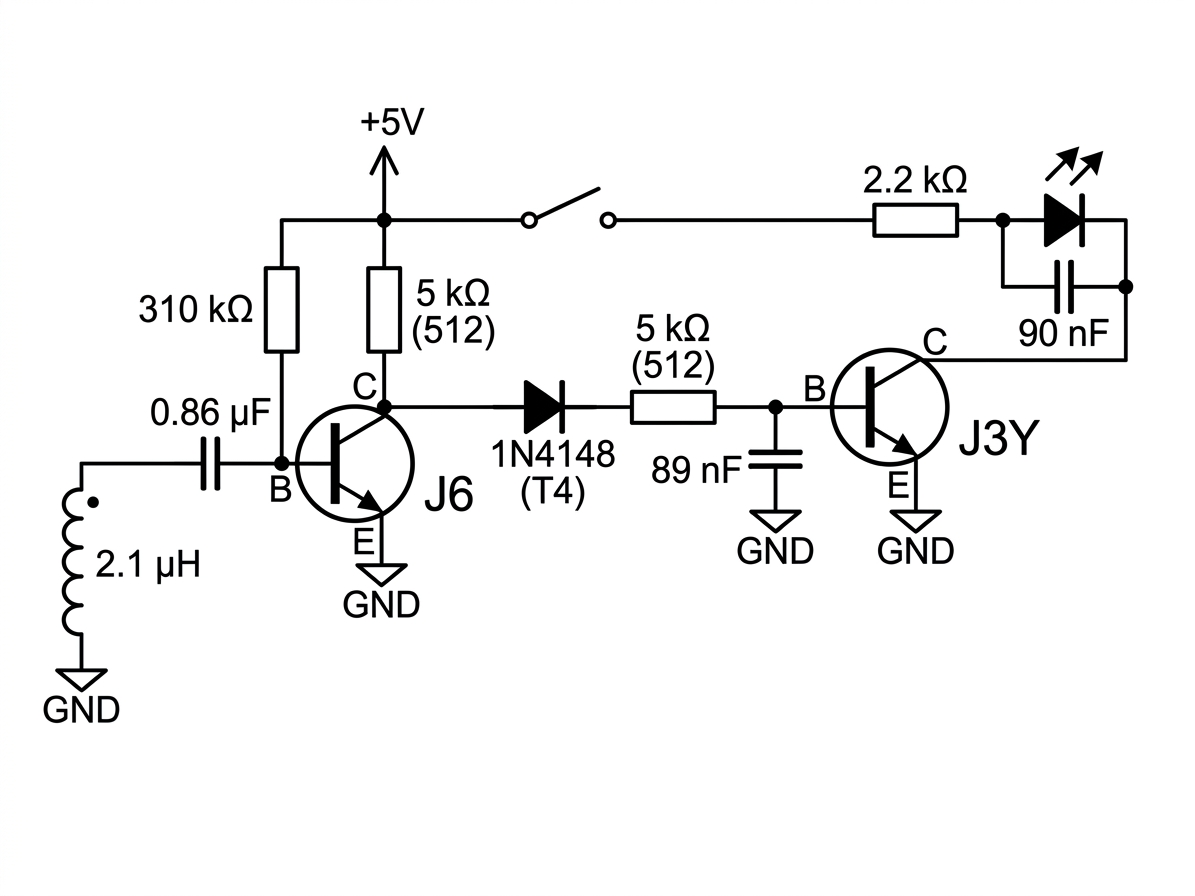
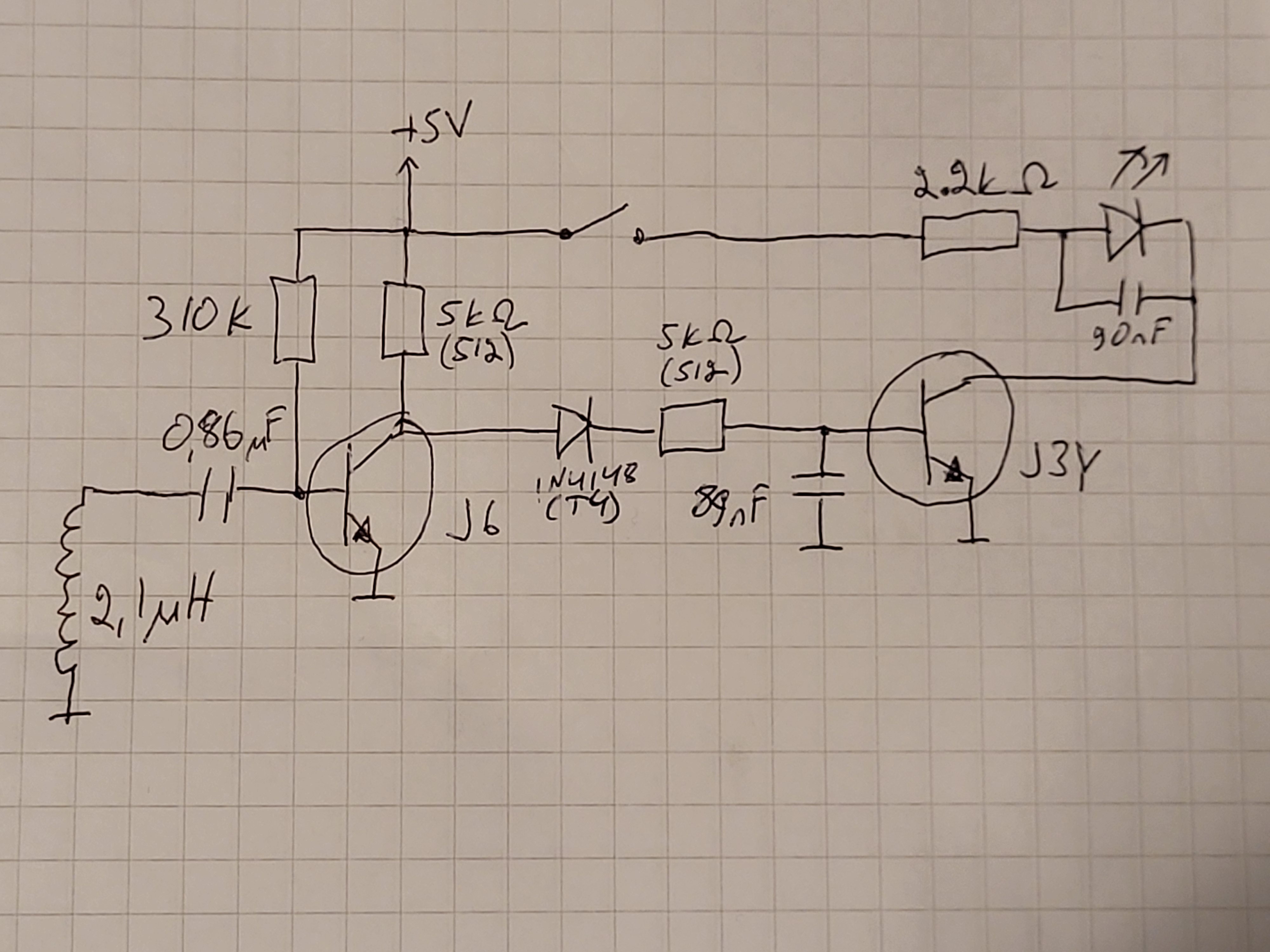
The circuitry is strange. Like a prototype or one that has been badly copied. It has some oddities, and the button on this unit looks like a legacy feature from the original lithium cell powered version.
This is Big Clive’s video about it. Screenshot is of his traced schematic.
https://youtu.be/VsEJgODLN6Q?si=Qfxyk_JYzV4CZZpf
Price Watch: From €1 to $17?
Perhaps the strangest thing about the OSS W01 (and its sibling, like the MECHANIC DT-001) is the wild pricing discrepancy online:
The Ultra-Cheap Tier: On websites like AliExpress, you can find this exact board selling for anywhere between €0.87 and €2.85.
The Premium Repair Tier: On specialized electronics repair sites or localized storefronts, the exact same tool is repackaged or marked up to anywhere between €16.00 and $16.99.
At less than a Euro, it’s a fun, low-risk novelty gadget to throw into your repair toolkit. At $17, the price tag starts to outpace the actual utility of a bare EMF-detecting PCB.
The Verdict: Hoax or Handy?
The OSS TEAM W01 Inductance Tester is not a hoax, but the marketing definitely pushes it into “too good to be true” territory. It won’t give you “X-Ray vision,” and it won’t replace a proper multimeter or oscilloscope. However, for a mobile phone technician who needs a 2-second check to see if an inductor coil is actively passing a signal without desoldering it, it’s a functional, handy little device. Just keep your fingers away from the live components, don’t try to use it on capacitors, and definitely don’t overpay for it!
8 Comments
https://www.drywallmarietta says:
If an inexperienced hobbyist handles this unenclosed block, their fingers can easily slip and touch high-voltage components on the live board. This is incredibly dangerous to https://www.drywallmarietta and carries a genuine risk of electrical shock.
jacksonville drywall company says:
Keep up your great work!
stone masonry says:
This thread is full of useful takeaways. Appreciate everyone contributing!
concrete patio says:
Thank you for taking the time to share this with us.
MyMilestoneCard online services says:
One of the most informative posts I’ve read recently. Great job!
patio screening says:
There’s always something new to learn here. Thanks for sharing!
enid says:
Really interesting teardown. I enjoyed seeing how the inductance tester works and what’s going on inside the device. Thanks for sharing! pool screen repair
acoustical drywall amarillo says:
The exact same tool is repackaged or marked up to anywhere between €16.00 and $16.99. Greetings from the acoustical drywall amarillo!