Anyone who regularly builds circuits or repairs devices wish they had a good LCR meter. With such an instrument, you can easily and accurately measure resistors, capacitors, and coils. The FNIRSI LC1020E is a handheld LCR meter designed for hobbyists and repair technicians who need more features than than a standard multimeter or basic LRC meter, but don’t want to shell out hundreds for a professional benchtop bridge.
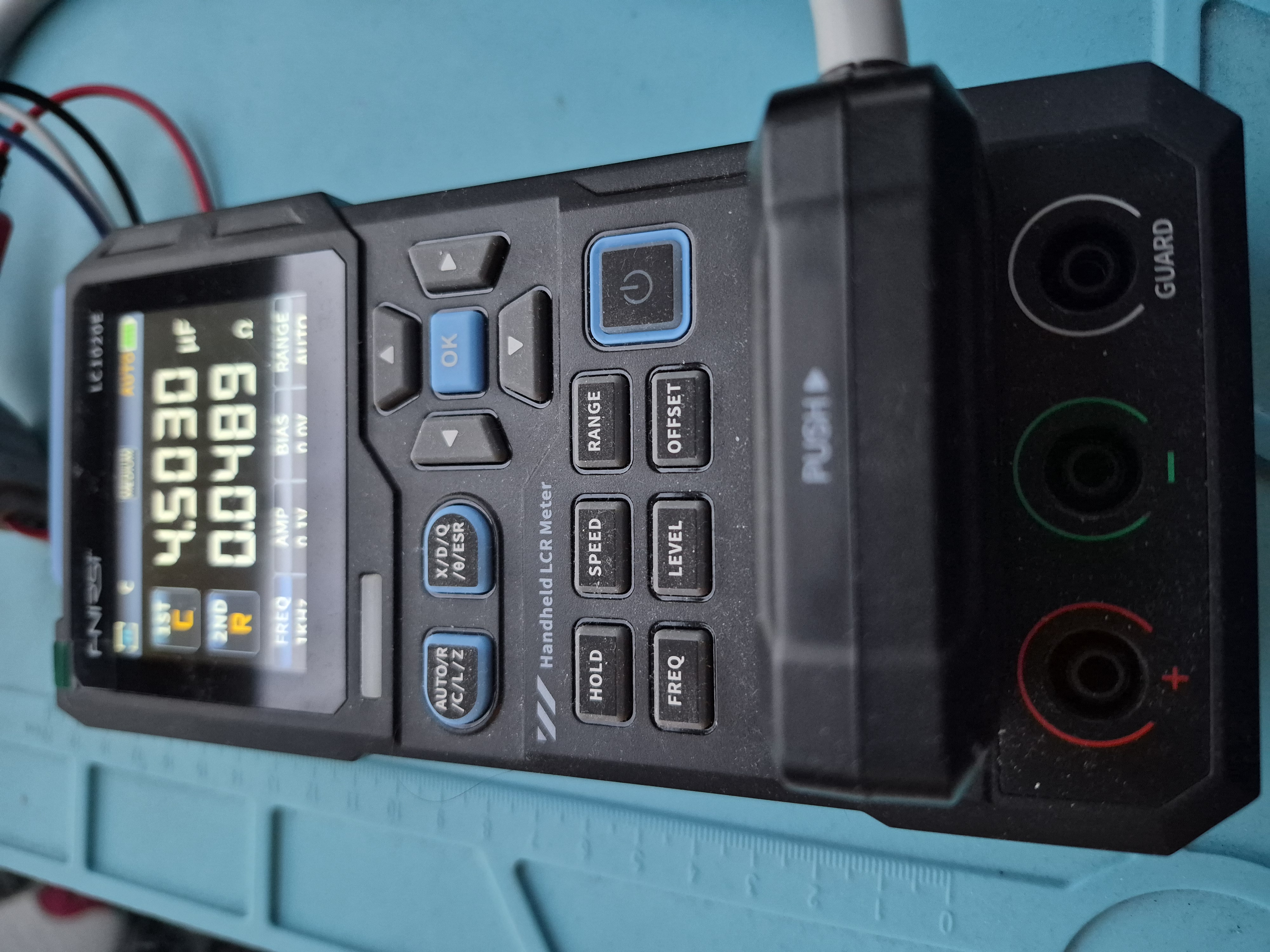
The FNIRSI LC1020E is a handheld digital bridge (LCR meter) designed for electronics hobbyists, makers, and repair technicians who need accurate component testing without breaking the bank. It represents a massive upgrade over basic multi-testers, packing professional-grade features into a highly portable format.
Key Specifications:
Parameters L, C, R, Z (Main) / X, D, Q, θ, ESR (Secondary)
Test Frequencies 100Hz, 120Hz, 1kHz, 10kHz, 100kHz
Basic Accuracy ±0.3%
Display 2.8″ Color TFT (19,999 counts)
Power 3000mAh Lithium Battery (USB-C Charging)
Input Ports 3-terminal slots + 5-terminal (4-wire Kelvin)
Measurement range
Inductance: 0 to 100H (min resolution 1 uH)
Capacitance: 0 to 100 000 uF (min resolution 1 pF)
Resistance/Impedance: 0 to 10 Mohms (min resolution 10 milliohms)
The Pros
- Excellent Accuracy: With 4.5-digit resolution and a basic accuracy of up to 0.3% (a few ranges and a measurement frequency of 1 kHz)
- High Frequency for Low Price: Finding 100kHz support in a handheld at this price point is rare. This is vital for testing modern switching power supply capacitors.
- Display shows two values for the measured component: at the top is the component’s main value (resistance, capacitance, or inductance) and below a secondary component quality value that can be set to be X (reactance), D (dissipation factor), Q (quality factor), phi (phase angle), or ESR (equivalent series resistance)
- Impedance masurement range: The LC1020E can be used to measure the circuit impedance at the different measurement frequencies.
- Two sets of measurement connection: three banana plug sockets for plugging in standard test leads and test slots for Kelvin clips cable connection
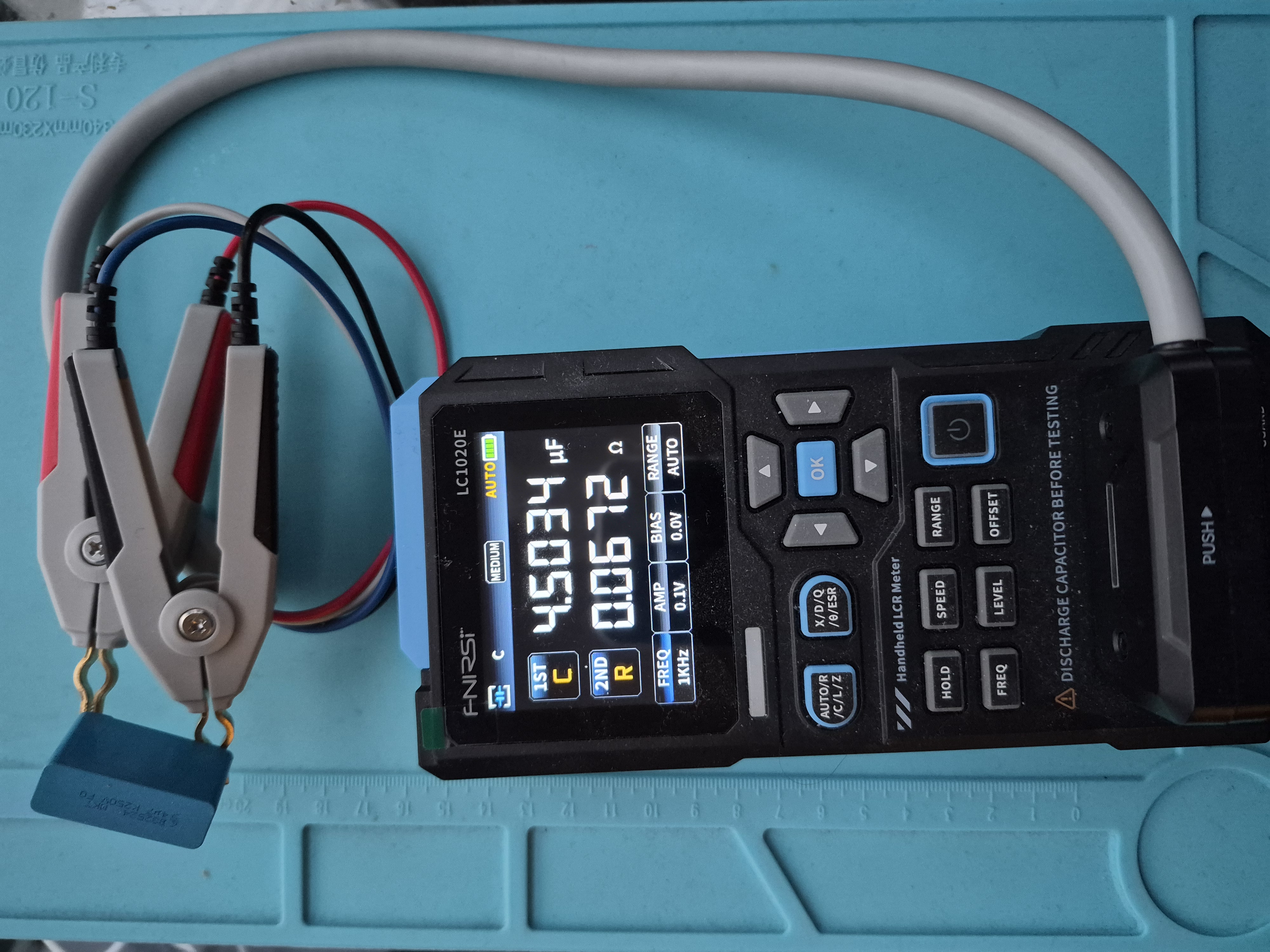
- Kelvin Clip Support: The meter package includes 4-wire Kelvin clips which help eliminate the resistance and capacitance of the test leads themselves—essential for low-value components. The meter supports supports 5-terminal (Kelvin) test configurations, which minimizes lead resistance and ensures highly precise measurements especially on low-impedance parts. Wired components can be easily measured using the included Kelvin clips, but they are not very suitable for SMDs.
- Versatile Test Settings: It offers 5 test frequencies (100 Hz, 120 Hz, 1 kHz, 10 kHz, and 100 kHz) and 3 test voltage levels (0.1V, 0.3V, 0.6V) (plus 0.5V DC bias option), allowing you to test capacitors, inductors. This allows testing components resistors under conditions that mimic actual circuit environments and allows doing in-circuit testing in many circuits (0.1V and 0.3V works well for in-circuit measurement because it is less than voltage that makes silicon semiconductor diodes to conduct).
- Smart Automation: The intelligent auto-recognition instantly detects whether you plug in a resistor, capacitor, or inductor, switching to the correct mode automatically. The “Auto” mode is surprisingly snappy, identifying whether you’ve plugged in a resistor, capacitor, or inductor without manual switching.
- Sorting Mode: A great “quality control” feature that lets you set a nominal value and tolerance (e.g., 5%) to quickly bin components with “Pass/Fail” indicators.
- Size: The meter itself has dimensions similar of a standard multimeter, measuring approximately 18x9x3.5 cm. The case is finished in black and light blue. On the back there is a fold-out stand to set the meter upright.
- Display: The 2.8-inch TFT color screen is crisp and easy to read
- Battery: The built-in 3000mAh rechargeable battery charges via USB-C. USB-C port works for charging and firmware upgrades.
- Price: LC1020E LCR Meter from FNIRSI costs around 60-70 EUR including shipping from China.
- Included accessories: a USB charging cable, multimeter test leads, a short-circuit plate for calibration, a manual, and a set of Kelvin test clips
FNIRSI LC1020E LCR Meter Review/Teardown, How does it Compare with Other LCR Meters?
FNIRSI LC1020E LCR Meter ⭐ Bang For Your Buck!
How to use an LCR meter (Fnirsi LC1020E)
The Bad: Where It Falls Short
- Calibration is Required: To get the best accuracy, you have to perform open/short calibrations when swapping leads, which adds a brief setup step. Especially in the the 100 kHz mode with the supplied test leads without calibrations the measurement results can vary a lot compared to the lower frequency results. For most accurate results the meter must be calibrated initially with the test leads you plan to use. The LC1020E has both a short and an open test (you have to select each one separately).
- Accuracy limitations: The best accuracy of 0.3% applies only to a few ranges and a measurement frequency of 1 kHz. In other ranges and frequencies, it can vary by a few percent for large component values. Especially at 100 kHz the results can vary considerably (unless you do calibration routines)
- Low-Value Accuracy: While it excels at mid-range values, the meter struggles with very small components (sub-10pF capacitors or sub-10µH inductors). The capacitance measurement can have a small “floor” or residual capacitance/inductance that is hard to calibrate out. The LC1020E’s inductor resolution does not seem to increase with test frequency (as with some other RLC meters) and as a result has very poor resolution for small inductors.
- Reading Stability: When measurements last few digits can “dance” or cycle slightly even with stable components, which can be distracting during precision work.
- Lead Interference: Stray capacitance or inductance from test clips causes erratic jumps. Avoid using general alligator probes and instead plug components directly into the front panel’s Kelvin sockets for critical 100 kHz testing.
- High-Impedance Resistors: At 100 kHz, the device suffers from degraded measurement accuracy for large resistances (e.g., measuring 1 MΩ as 5 MΩ). Test high-value resistors at 1 kHz instead.
- Build Quality: It feels light and a bit “plasticky” compared to more expensive instruments
- Sorting Mode Quirks: The software logic for the sorting/pass-fail mode can be slightly clunky if you are doing massive batches of component sorting.
Pro Tip: Always remember to discharge capacitors before testing! While the LC1020E has some protection, a charged high-voltage cap will fry the input stage instantly. When not using Kelvin clips, prefer short leads using banana plugs and mini alligator clips.
To eliminate accumulated zero-point errors, perform a manual calibration:
Enter the settings menu by holding the OK button.
Navigate to the Calibration function and press OK.
Select Open Circuit for high impedance (leave Kelvin clips completely separated in the air).
Select Short Circuit for low impedance (short the Kelvin clips together directly, or use the provided metal calibration plate).
Press OK and wait for the screen to display “Finish,” then long-press OK to exit
Final Verdict
The FNIRSI LC1020E offers incredible “bang for your buck.” If you are building radio circuits, sorting components, or diagnosing ESR on capacitors, this tool offers professional-tier multi-frequency LCR testing at a fraction of the cost of traditional bench meters. It is an absolute asset for any electronics workbench. You are a hobbyist, student, or repair tech working on general consumer electronics and power supplies. It provides far more insight than a $20 “transistor tester”.
Skip it if: You are doing high-precision RF work or need to match ultra-low value capacitors for filters. The DER DE-5000 LCR meter remains the gold standard for handhelds, though it usually costs significantly more. For years the DE-5000 was the least expensive quality LCR meter offering 100 kHz test frequency for hundreds of dollars less than the closest competition.
I am happy to have this instrument on my workbench.
Rating: 4.5 / 5 ★★★★☆
Links to more reviews:
https://community.element14.com/members-area/f/forum/56264/fnirsi-lc1020e-auto-magic-responsiveness
https://www.facebook.com/groups/theanalogthing/posts/1106539711568817/
https://groups.io/g/qrptech/topic/117888335
6 Comments
drywall installer says:
Thank you for showing this to us! I appreciate your effort.
design a custom wordpress plugin says:
Thank you for showing this to us! I appreciate your effort. Thank you!
Manage PayByPlate MA account says:
Great content! I picked up several useful insights from this post.
drywall insulator says:
The LC1020E has separate options for short and open tests.
graffiti creator says:
Solid review of the FNRSI LC1020E — the details on ESR readings and low-capacitance accuracy are exactly what I look for before trusting a bench meter. After a long session sorting old electrolytics, I usually switch to something creative to unwind, and lately I’ve been using a free graffiti creator to design labels for my parts drawers and tool cases.
Tomi Engdahl says:
https://hackaday.com/2026/10/19/an-lcr-meter-with-compromises/