When the Freezer Becomes an Oven: Europe’s Supermarket Refrigeration Attacks
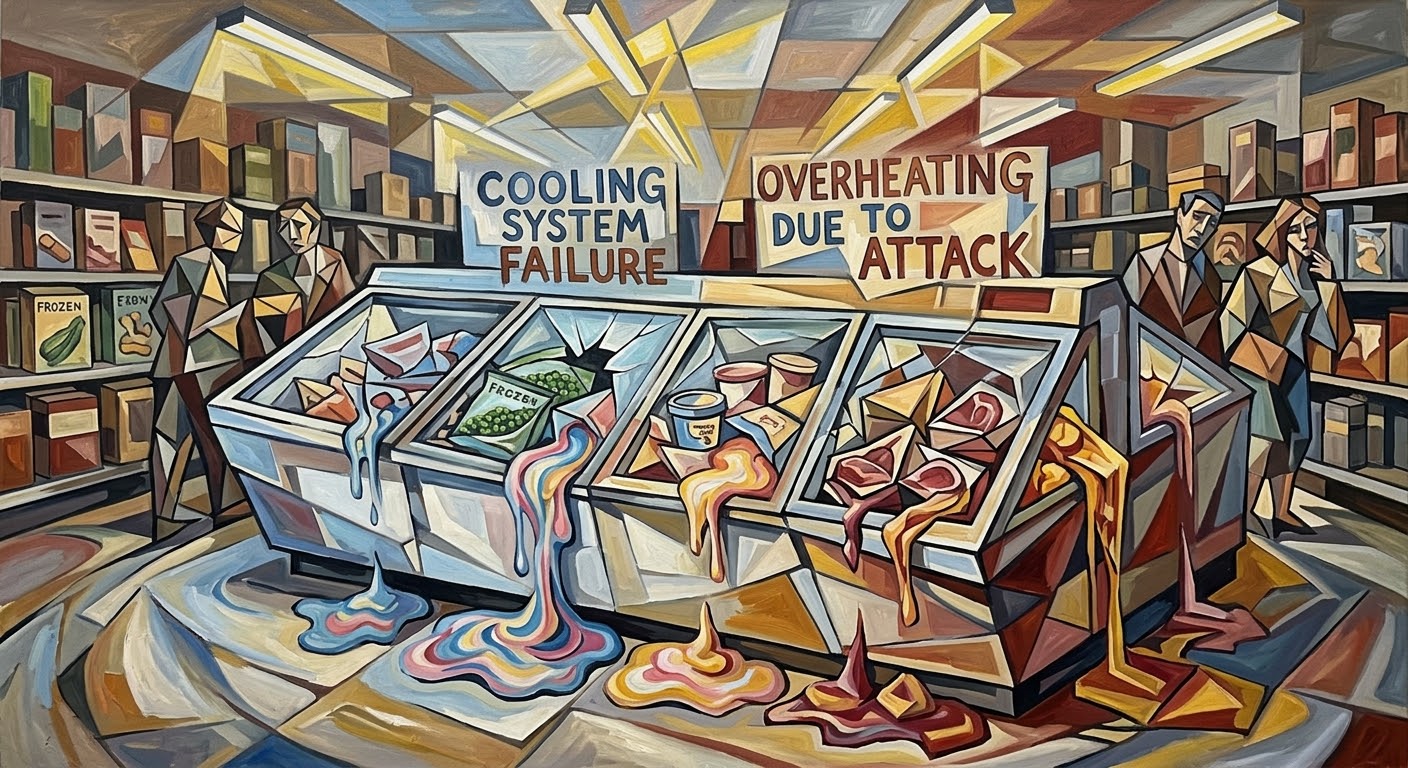
For the second time in about three weeks, attackers have remotely taken over refrigeration controllers in European supermarkets and turned fridges and freezers into warming cabinets. The first wave hit France and nearby countries on the night of 11–12 October. The second wave came overnight into Monday 2 November and reached somewhere between seven and ten European countries. In both waves the hardware involved was mostly made by Danfoss, the Danish company whose controllers run refrigeration in a large share of Europe’s grocery stores.
Large commercial supermarket refrigeration systems are connected to network management units (like Danfoss StoreView or AK-SM controllers) to monitor and control temperatures, automate defrost cycles, and manage food safety alarms remotely.
Nobody had broken into the stores themselves. The attackers reached small web-managed controllers that had been left reachable from the public internet, and they changed a few settings.
Wave one: France, 11–12 October
On the night of 11 October, refrigeration controllers in hundreds of French supermarkets were switched into defrost mode while the cabinets were still full. Defrost mode is normally a short, scheduled cycle that melts ice off the evaporator coils. Left running for hours, it heats the cabinet. Alarms reportedly did not go off, and few staff were in the stores overnight.
By morning, many cabinets had reached around 50 °C (122 °F), and one store in Normandy reported 80 °C. Estimates of the number of stores range started from about 150 and later was increased up to 700. Affected chains included Intermarché, Netto, Carrefour, Coopérative U, Monoprix and E.Leclerc. Food losses were estimated in the tens of millions of euros. Reports also placed affected sites in Belgium, the Netherlands, Spain, Portugal, Poland and Germany.
France’s national cyber agency ANSSI, through its response team CERT-FR, published an alert on 12 October and updated it on 13 and 16 October. The alert names four product families: Danfoss AK-SM series, Danfoss AK-SC series, Copeland XWEB and Dixell XWEB. Prime Minister Sébastien Lecornu told ANSSI to investigate and to coordinate with other European countries.
Wave two: Europe, 2 November
The second wave followed the same pattern on a wider scale. Overnight into Monday 2 November, supermarket fridges and freezers were again pushed into defrost mode, with temperatures reported at about 50 °C. Belgium, Luxembourg, the Netherlands, Sweden, Finland, Estonia, Ireland and Italy were affected, along with reported incidents in Greece. Reported victims included Coop and ICA in Sweden, Ahold Delhaize stores in Belgium, the Netherlands and Luxembourg, and Spar and Carrefour in Belgium. Small independent shops were also hit, including a butcher near Athens.
An ICA spokesperson said all of its affected stores were connected to an outside refrigeration control system supplied by Danfoss. EU agriculture commissioner Christophe Hansen called it “a deliberate attempt to disrupt our food supply chain.” A European Commission spokesperson said the incidents “are not isolated” but would not say who was behind them.
The equipment: two retired models and one current one
Reporting points to three Danfoss products:
| Model | Status | Why it was exposed |
|---|---|---|
| AK-SC355 | End of life (reportedly 2016) | No security updates. Danfoss has advised replacing it. |
| AK-SM800 | End of life (reportedly May 2021) | No security updates. Danfoss has advised replacing it. |
| AK-SM 800A | Current product | Units still running firmware older than R4.3.1, released in 2025 |
After the first wave, Danfoss confirmed that AK-SM800 and AK-SC355 systems were involved. The company described most of the affected equipment as “legacy” products that no longer get software or security updates, and said it had long urged customers to update firmware and move to current-generation systems.
The AK-SM 800A is a more uncomfortable case because it is still sold and supported. Its weaknesses are already public. In 2025 Danfoss published advisory DSA-2025-08-01, and CISA published ICS advisory ICSA-25-140-03 on an authentication flaw in AK-SM 800A system managers. In August 2026, Claroty’s Team82 described three vulnerabilities in detail:
CVE-2025-41450: an authentication bypass through a hidden “code of the day” mechanism (CVSS 8.2)CVE-2025-41451: an OS command injection in the alarm e-mail settings, giving remote code execution after login (CVSS 7.6)CVE-2025-41452: an Nginx configuration injection that can cause denial of service (CVSS 5.4)
For more details of those vulnerabilities, read those documents:
- Team 82: Freeze the Controller, Defrost the Food: Uncovering Vulnerabilities in Danfoss Refrigeration Controllers
- Censys: Frostbitten in France: A Danfoss StoreView Internet Exposure Report
Firmware R4.3.1 fixes these. According to the reporting, the AK-SM 800A units that were hit were the ones never updated to it. Claroty counted 2,765 AK-SM 800A devices exposed to the internet in a Censys scan, and other estimates put the number of reachable Danfoss controllers higher.
Security researcher Kevin Beaumont described the login logic on some of these devices as a password that is simply the current date. Claroty’s analysis of the same “code of the day” logic treats it as a hidden bypass rather than a default password. Either way, the result is the same: anyone who finds the controller online can log in.
No zero-day needed
Experts agree on one point: this was not sophisticated hacking. Darktrace’s Nicole Carignan said attackers got in through internet-facing controllers, end-of-life firmware and default passwords, and that no zero-day was used. Richard Horne of the UK’s NCSC said the French fridges had been connected directly to the internet with default passwords. UK cyber minister Liz Lloyd called the French attack exploitation of known vulnerabilities.
So far nobody has claimed responsibility or been named. Investigators have not established a motive. Some researchers have pointed out that the attack is simple enough for opportunistic hackers, while others note that state actors have the capability too. Both waves struck overnight, used the same technique and spread across borders, which looks more like a coordinated campaign than random vandalism.
What operators should do now
The CERT-FR alert has the clearest practical guidance:
- Take the controllers off the internet. Remove any direct internet exposure and any device with a public IP address.
- Use only secure remote access. Service contractors should connect through a VPN or protected network. Filtering contractor IP addresses on a firewall is acceptable as an emergency measure only, not as a permanent fix.
- Patch and harden. On current Danfoss systems, update the firmware (R4.3.1 or later for the AK-SM 800A), set the security level to Strict, and make sure default passwords have been changed.
- Check the configuration, especially defrost schedules, before putting a unit back into service.
- Don’t rely on a factory reset. A reset end-of-life device is still vulnerable. CERT-FR warns that leaving an unpatched EOL controller on the internet will very likely lead to compromise again.
- Plan to replace the AK-SC355, the AK-SM800 and any other unsupported controllers.
Retailers should also make sure temperature alarms are monitored independently of the controller that might be compromised. In both waves, the alarms that should have woken someone up apparently stayed silent.
The bigger lesson
Refrigeration is part of the food supply chain, and in hospitals and blood banks it can be safety-critical. Yet these controllers are often installed and maintained by outside contractors, connected to the internet for remote service, and then left alone for ten years or more. As Professor Aikaterini Mitrokotsa of the University of St. Gallen told AP, a fridge does not look like a security risk, and that is exactly why attackers like it.
The patches and guidance for these devices were already available before the attacks. What was missing was an inventory of the devices, a plan to retire old ones, and the habit of treating a fridge controller as an internet-connected computer. A third wave is likely, and every store with an exposed controller is a candidate.
Sources
- CERT-FR (ANSSI): CERTFR-2026-ALE-012 – Incident de sécurité ciblant les contrôleurs à distance des installations de réfrigération
- Facilities Dive: Hack of Danfoss refrigeration controllers in Europe causes tens of millions in food losses (13 Oct 2026)
- Facilities Dive: European grocery stores hit with second refrigeration system hack (3 Nov 2026)
- PBS NewsHour / Associated Press: Here’s what to know about another cyberattack on European supermarket fridges (3 Nov 2026)
- Claroty Team82: Freeze the Controller, Defrost the Food: Uncovering Vulnerabilities in Danfoss Refrigeration Controllers (9 Aug 2026)
- Danfoss: Security advisory DSA-2025-08-01
- CISA: ICS Advisory ICSA-25-140-03 (Danfoss AK-SM 800A)
- Wikipedia: 2026 French supermarket refrigerator hack (background and end-of-life dates)
- The Hacker News: New Wave of Refrigeration Cyberattacks Hits Supermarkets Across Europe
- CNN: What to know about the cyberattack that targeted supermarket refrigeration systems in France
115 Comments
Tomi Engdahl says:
https://www.city.fi/arki/hakkerit-kuumensivat-kaupan-kylmalaitteet-asiantuntija-varoittaa-venaja-voi-iskea-suomessa-kotien-lampopumppuihin/
Tomi Engdahl says:
From the Article Who keeps cooking Europe’s frozen peas? https://europeancorrespondent.com/en/r/who-keeps-cooking-europes-frozen-peas
Tomi Engdahl says:
An investigation into the hack remains ongoing.
Supermarket giant Coles confirms it was hacked in ‘cyber security incident’
An investigation into the hack remains ongoing.
https://7news.com.au/news/supermarket-giant-coles-confirms-it-was-hacked-in-cyber-security-incident-c-23166400?fbclid=IwdGRjcAVns79jbGNrBWeyB2V4dG4DYWVtAjExAHBkb2YFc3J0YwZhcHBfaWQMMzUwNjg1NTMxNzI4AAEfSHjKAIWtEof8CmA3Qb3Z78PEnFIZyjibiCO749j5sF3pexgedrEQE5NxR7U_aem_WiNEBox7969-opSce1jB9A
Supermarket giant Coles has been hacked and is investigating the “cyber security incident”.
The company issued a statement to the ASX on Monday confirming the incident and has engaged the Australian Cyber Security Centre.
“Coles Group Limited is currently investigating a cyber security incident,” the statement reads.
“Based on the findings of our investigation to date, we have not identified any evidence that customer, team or supplier data has been compromised or removed from Coles’ systems.”
Coles added it will be engaging with “appropriate agencies and regulators as investigations continue”.
“Coles is also working with global cyber security experts to contain and secure the Coles IT environment,” the company said.
“Operations continue and customers are able to shop as normal with Coles in stores and online.
It comes after hackers targeted fridges at dozens of supermarkets across Europe in recent months
“There has been a cyberattack and all our freezers reached 50C,” Engla Ingwall, sales manager at an ICA franchise store in Stockholm, told Reuters, adding the attack occurred at 2am on November 2, but was only noticed hours later.
A spokesperson at privately held ICA said in an emailed statement that the company was aware a “limited number of stores were affected by an incident overnight, which impacted their refrigeration and freezer systems”.
The latest incidents follow an attack in France last month in which police said hackers seized control of cooling units at hundreds of supermarkets, causing fires and food losses.
Three blood banks in regional France were also hit by a cyber incident, with the hackers attacking cold storage rooms.
The French Blood Establishment (EFS) confirmed the attack but said it had no impact on blood supplies.
“We have staff round the clock since blood can be needed at any time,” she said.
Tomi Engdahl says:
Koski noin kymmentä pienempää K-kauppaa Suomessa.
Yle TV1 16.11.2026 klo 18.24
Tomi Engdahl says:
KRP aloitti rikostutkinnan epäillyistä kylmälaiteiskuista
Suomessa poliisille on tehty muutamia rikosilmoituksia kauppojen kylmälaitteisiin kohdistuneista mahdollisista kyberhyökkäyksistä.
https://yle.fi/a/74-20257159
Suomessa havaittuja kauppojen kylmälaitteisiin kohdistuneita epäiltyjä kyberiskuja tutkitaan nyt rikoksina.
Keskusrikospoliisi (KRP) vahvistaa Ylelle aloittaneensa asiasta esitutkinnan. Tässä vaiheessa tapauksia tutkitaan törkeänä tietojärjestelmän häirintänä ja vahingontekona.
– Tapahtumatiedot ovat vielä niukat, joten rikosnimikkeet voivat tapahtumatietojen täsmentyessä vielä muuttua, KRP:n viestinnästä kerrotaan.
Kaksi viikkoa sitten esimerkiksi K-kauppojen kylmälaitteissa havaittiin häiriöitä. Kyberturvallisuuskeskus vahvisti jo aiemmin, että taustalla oli kyberhyökkäys.
K-kauppojen kylmälaitteissa ilmeni häiriötä samaan aikaan – hakkerointia ei voida poissulkea
https://yle.fi/a/74-20254613
Tomi Engdahl says:
https://www.uusiteknologia.fi/2026/11/13/traficomin-uusimmat-ohjeet-reitittimien-ja-alylaitteiden-suojaamiseen/
Tomi Engdahl says:
Hackers Probe Newly Disclosed Flaws in Copeland Refrigeration Controllers
Vulncheck disclosed 14 vulnerabilities affecting Copeland XWEB EVO controllers, including two that threat actors quickly targeted.
https://www.securityweek.com/hackers-probe-newly-disclosed-flaws-in-copeland-refrigeration-controllers/
Exploitation attempts against a vulnerability in Copeland’s XWEB EVO refrigeration controllers began less than two hours after the issue was made public last week, according to VulnCheck.
The security firm disclosed 14 vulnerabilities in XWEB EVO, a Dixell supervisory system now sold under the Copeland name. VulnCheck’s Valentin Lobstein said each flaw was shown to yield root privileges on test systems.
The product drew the researcher’s attention after the October 11-12 attack that triggered defrost cycles at roughly 700 French supermarkets. CERT-FR named Copeland and Dixell XWEB controllers among the compromised products, and France has blamed Iran for the campaign.
Nine of the flaws disclosed by VulnCheck only affect firmware builds that predate a 2021 rewrite. They include unauthenticated command execution, a hardcoded administrator password, and command injection via the login page.
The other five vulnerabilities also impact the latest firmware. Four of them involve predictable credentials: the administrator’s daily password is generated from the device’s MAC address and the current date, and the MAC address is exposed to unauthenticated users.
An attacker can calculate the password offline, enable SSH, and log in as root, since the root password is built from the same daily code. The fifth flaw is a command injection issue that requires authentication.
Tomi Engdahl says:
Mistakes in hacked supermarket fridges:
1. Monitoring, alarm and temperature control in same device
2. Lack of firewall
3. Many devices installed without changing default access password (same in all devices)
4. Device firmware not kept up to date (newer firmware fixes some problems)
5. Easy to hack service password
6. Other vulnerabilities
Tomi Engdahl says:
those individual fridges in supermarkets were connected (wired local connection typically) to a local control computer (a small embedded device) that offered local operation panel display and web management interface.
Hackers logged in to that web interface that was exposed to Internet to everybody (there should have been firewall). Some installers did not change even the default passwords. And if it was changed, if the software was not kept updated, there were vulnerabilities that allowed logging in without knowing the set admin password.
Tomi Engdahl says:
Kyberhyökkäyksen uhriksi joutunut kauppias kertoo soitosta aamuyöllä – tällaista minuuttipeliä kyberiskuista on tullut
Kyberhyökkäyksistä on tullut aiempaa nopeampia tekoälyn avulla. Tietoturva-asiantuntija pitää muutosta huolestuttavana.
https://yle.fi/a/74-20256414
Puhelin soi aamuyöstä. Soitto tuli turvallisuusyrityksestä.
Kauppias Mariia Jernmark lähti heti kaupalle. Paikan päällä selvisi, että kylmälaitteet olivat kuumentuneet, ja tuotteita oli mennyt pilalle erittäin suuria määriä. Helsingin Lauttasaaressa sijaitsevan K-market Oliivin kylmälaitteiden säädöt menivät vinksalleen marraskuun alussa.
– Tilanne luonnollisesti järkytti, Jernmark kertoo.
Jernmark ja kaupan henkilökunta ryhtyivät hävittämään pilaantuneita tuotteita ja täyttämään hyllyjä uudelleen. Kun selvisi, että kyseessä saattaa olla jonkinlainen kyberhyökkäys, tunne oli epätodellinen.
– Kurjaa, että tässä kärsivät yksittäiset ihmiset. Yrittäjät, henkilökunta sekä lähialueen asukkaat, Jernmark sanoo.
Mistä kylmälaiteiskuissa on kyse?
Hyökkääjät ottivat etäyhteydellä haltuunsa ruokakauppojen ja elintarviketoimijoiden kylmälaitteiden säätöjärjestelmiä.
Suuret määrät elintarvikkeita meni pilalle.
Hyökkäysaalto alkoi tiettävästi Ranskasta ja levisi nopeasti useisiin Euroopan maihin. Muutaman kaupan kylmälaitteissa ilmeni lämpötilahäiriöitä myös Suomessa.
Ranskan viranomaisten mukaan ensimmäisen hyökkäysaallon jäljet johtavat Iraniin. Sen jälkeen menetelmää ovat kopioineet muutkin hyökkääjät.
Kylmälaitteista lämpölaitteita
Tänä syksynä hyökkääjät ovat iskeneet ruokakauppojen kylmälaitteisiin useissa Euroopan maissa.
Kun kylmälaitehyökkäykset alkoivat ja niistä tuli tietoa julkisuuteen, tietoturvayritys Withsecurella nähtiin, että muutkin hyökkääjät aktivoituivat. Kun yksi porukka keksii tavan aiheuttaa laajaa hämminkiä, muut kopioivat.
– Meille näkyi ihan suoraan, että monet koputtelevat, löytyykö tällaista haavoittuvaa palvelua.
Tietoturva-aukko voi olla virhe ohjelmoinnissa, puute suunnittelussa, turvattomat asetukset tai inhimillinen virhe: esimerkiksi laitteen mukana tullutta salasanaa ei ole vaihdettu.
Kyberturvallisuuskeskuksen (KTK) mukaan kylmälaitteiden säätöjärjestelmiin kohdistuneet hyökkäykset laajenivat marraskuun alussa myös Suomeen.
Keskus havaitsi Suomessa 30 laitetta, jotka olivat olleet verkossa näkyvissä ja alttiina hyökkäykselle.
Keskusrikospoliisi kertoi maanantaina aloittaneensa aiheesta esitutkinnan. Tapauksia tutkitaan törkeinä tietojärjestelmän häirintänä ja vahingontekoina.
Tekoäly auttaa hyökkääjiä
Laajat ja paljon harmia aiheuttavat kyberhyökkäykset vaativat tekijöiltään yhä vähemmän taitoja.
Bergströmin mukaan kyberhyökkäykset ovat nousseet aivan uudelle tasolle tekoälyn ansiosta.
– Oikeilla työkaluilla keskinkertaisista pahiksista tulee aika hyviä hakkereita, Bergström sanoo.
Bergströmin mukaan tekoäly on nopeuttanut hyökkäyksiä huomattavasti. Vielä vuosi sitten keskimääräinen hyökkäys kesti useita tunteja. Nyt arvio on pudonnut 72 minuuttiin.
– Muutos on todella hurja, Bergström kuvaa.
Myös Kyberturvallisuuskeskuksen mukaan ohjelmistohaavoittuvuuksia hyödyntävät kyberhyökkäykset ovat nopeutuneet. Hyökkääjät käyttävät tekoälyä esimerkiksi hyökkäyskoodin tekemiseen.
Tomi Engdahl says:
A behind the scenes cyber-security operation has taken place to secure tens of thousands of fridges and freezers across the UK.
Read more: https://bbc.in/4zZH8WN
Tomi Engdahl says:
Don’t worry only 3% of UK consumers report owning a smart fridge, according to a YouGov study.
Tomi Engdahl says:
https://www.danfoss.com/en/about-danfoss/our-businesses/climate-solutions/cybersecurity/?utm_source=linkedin&utm_medium=social_paid&utm_campaign=cybersecurity_webinar_cid_7399102&utm_content=lead_form_thank_you&utm_id=52650114825871&utm_term=52650114826271&fbclid=IwT01FWAVv8PxleHRuA2FlbQIxMABwZG9mBXNydGMGYXBwX2lkDDM1MDY4NTUzMTcyOAABH0A2mzMxBXc_BgB9mi1x1rQQxgvcCS9GFiX6MZFRXYYHNX4c1fRIv79fZzfe_aem_Gf0V-R7J2Qc4BqAtWg73pw
Tomi Engdahl says:
Could hackers access my fridge? All you need to know after supermarket cyber attacks
Attacks on European supermarkets spread across the continent earlier this month
https://www.independent.co.uk/tech/fridges-cyber-attack-uk-europe-security-b3088710.html?fbclid=IwT01FWAVv8gRleHRuA2FlbQIxMABwZG9mBXNydGMGYXBwX2lkDDM1MDY4NTUzMTcyOAABH-tWrlH-LX2oQ1e0oo9p5-9K4igUCH2EJGBbXApqybZQ3GWZnFqGg9_54TRZ_aem_GlTflppe5kP3fB3HMw_S2Q
A slew of cyber attacks targeting refrigeration systems across Europe has prompted fresh concern about smart fridges found throughout many homes.
Attacks on European supermarkets spread across the continent earlier this month, hitting fridges and freezers from Sweden to Belgium, and forcing stores to throw away food.
It followed a similar incident in France in October, where police said hackers seized control of cooling units at hundreds of supermarkets, raising temperatures as high as 50C.
A British cybersecurity operation has since fixed a flaw in the operating systems of commercial fridges and freezers used by supermarkets, warehouses and restaurants, helping to protect them from hacks, as reported by the BBC.
But could Britons with internet-connected fridges be the next victims?
Could a hacker gain access to my fridge?
Fridges were once among the simplest of appliances, vulnerable to little more than someone leaving the door open. But in the era of smart technology, the fridge now sits alongside locks, thermostats and a host of other mechanical devices that are all connected to our WiFi.
Being able to monitor and control a fridge remotely can be convenient, particularly when you are away from home. But there are fears those same useful features could potentially be used in a cyber attack.
The reality is that any device that uses the internet can potentially be targeted by hackers. In 2015, researchers at a hacking conference in Las Vegas used a Samsung smart refrigerator to demonstrate how these devices could be compromised.
Whether a fridge is connected directly to your home’s internet, or via an app or cloud service, it could be at risk. Hackers are usually interested in stealing data, using devices to access a larger network, or disrupting services, which is why smart devices are targeted.
However, three-quarters of attacks were focused on routers rather than appliances, according to data from the security industry.
As the French supermarket hacks showed, accessing devices can give hackers control, allowing them to potentially cause chaos by raising temperatures and spoiling food.
Devices with cameras could pick up images and sound, while a compromised router could show any information that passes through the network.
More serious attacks could see hackers use poorly secured devices to access other systems on the network or steal personal information from online accounts.
Could hackers take over cars?
Cybersecurity researchers have demonstrated vulnerabilities in connected vehicles. In 2015, researchers remotely took control of a moving Jeep through its internet-connected entertainment system, forcing the recall of about 1.4 million vehicles and the deployment of software fixes.
Tomi Engdahl says:
https://www.facebook.com/share/p/1FuaE7mr4f/
A secret cyber-security operation has been carried out to protect tens of thousands of fridges and freezers across the UK from hackers.
The BBC revealed the operation on 20 November, saying it covered major supermarkets, warehouses, restaurants, petrol stations and stadiums.
In late October, ethical hackers at Omega Systems found a weakness in popular controllers made by British firm Resource Data Management, which are used to control the temperature of dozens of fridges and freezers at once. Experts at Pen Test Partners then found more problems.
It came after hackers attacked supermarket freezers in mainland Europe, including Belgium and Sweden. The National Cyber Security Centre, along with Defra and the Food Standards Agency, worked behind the scenes to warn companies and fix the problem.
It was kept quiet so criminals wouldn’t find the weakness first. ‘Our warehouses have millions of pounds worth of food that could have been spoiled,’ one company said.