I saw this circuit at
https://www.facebook.com/share/p/16HFEwzkcQ/
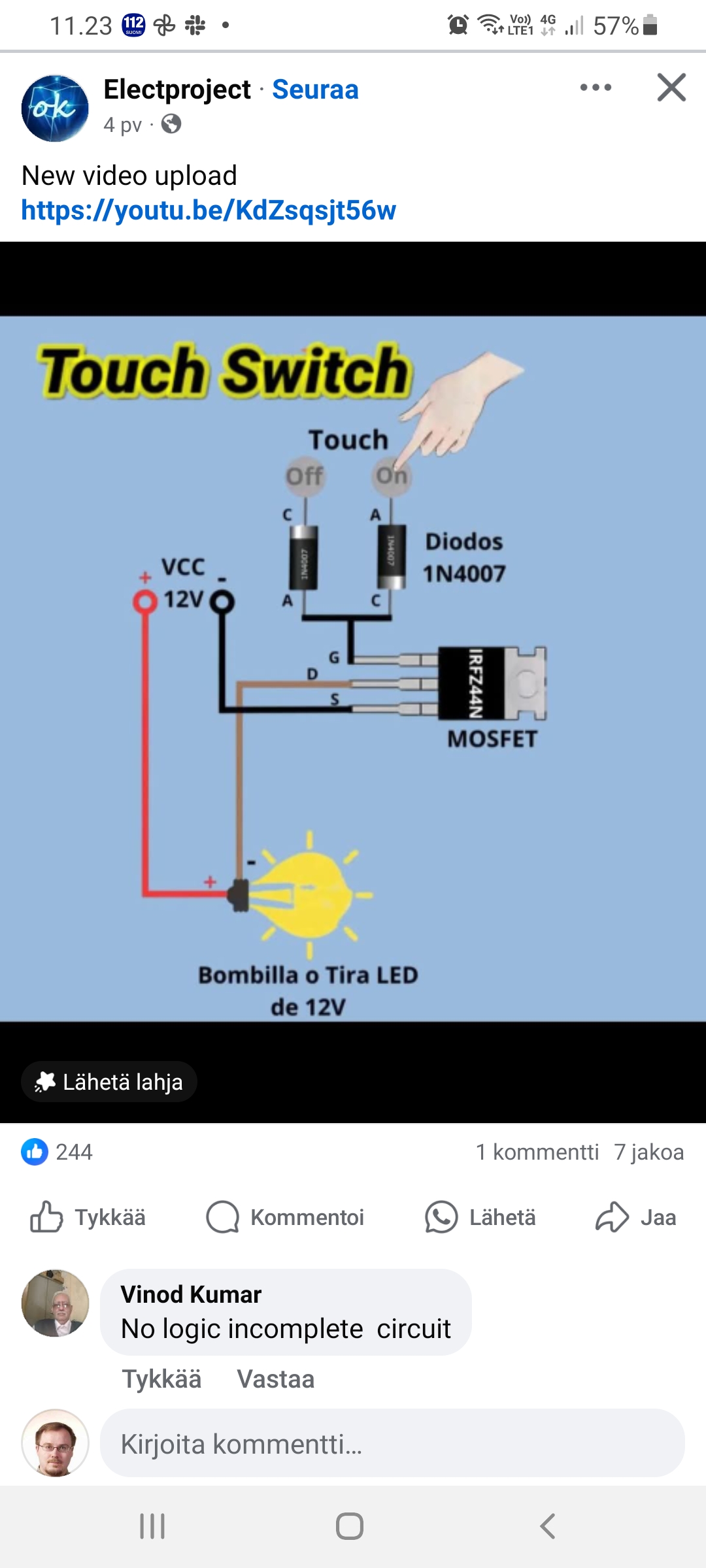
The diodes try to charge and discharge the mosfet gate based on static electricity of user touching. Depending on the amount of charge you happen have it might not work at all, might work or could fry the mosfet (they are static sensitive components).
FETs are extremely vulnerable to ESD. The datasheet can provide proof of that. When static electricity is applied to the gate, the gate oxide may be destroyed.
A typical way to protect a MOSFET is to inserting an ESD protection diode between the gate and source terminals. This circuit is lacking those protections, so I expect that it is not very reliable.
11 Comments
Tomi Engdahl says:
This looks like a recipe to try to kill the mosfet!
Mosfets are ESD sensitive devices, and in this circuit you feed the ESD from user to device gate.
Tomi Engdahl says:
MOSFETs are very sensitive to electrostatic charges and can be easily damaged by them. Here every touch sends smaller or bigger ESD pulse through diode to MOSFET gate. If gate voltage rises to too high voltage, MOSFET is fried. The IRFZ44N has a maximum gate-to-source voltage (VGS) of ±20V. Exceeding this limit can damage the component. The ESD pulse from person touching can easily be hundreds of volts or even several kilovolts.
Tomi Engdahl says:
The fix: Add protection like 15V zener diodes that keep G-S gate voltage at safe level.
I would also add a series resistor from user input to zener.
Tomi Engdahl says:
MOSFETs are highly sensitive to ESD because of the thin layer of silicon dioxide that insulates the gate, which can be damaged by voltage spikes that exceed its breakdown voltage. Always use an anti-static workbench and wrist strap when handling bare MOSFETs. This circuit is pushing ESD directly from finger to FET.
Tomi Engdahl says:
Touch switch
https://youtu.be/lKN9Xs4_S4g?si=7MO3GFsPCHVz1C_D
Tomi Engdahl says:
Eduardo Romaneli it could operate on linear region, full on region or be fried due too high gate voltage depending on how big electrical charge the person touching on has.
Tomi Engdahl says:
the fundamental problem: ESD from finger will gey get to mosfet gate, and can easily fry it.
I can see four cases with increasing voltage from finger (analyzing turn on case)
1. Mosfet does not turn on
2. Mosfet turns partially on – motor will not reach full speed and mosfet heats up
3. Mosfet turns fully on – everything fine
4. Mosfet allowed maximum gate voltage is exceeded – mosfet is fried and does not work anymore
Tomi Engdahl says:
https://www.facebook.com/share/p/18R7B5T5kS/
When you touch it either does not work, works or fries the MOSFET. Just matter of luck, weather and what you wear.
Tomi Engdahl it’s not matter of luck. You can try it.
Circuit Stories I have built this circuit idea. It somewhat works, but I would not call it reliable. I have also experience how easily touching MOSFET with finger can fry it, so this type of design is just a disaster waiting to happen sooner or later.
IRFZ44 requires a gate-source voltage between 10 V and 12 V for best performance. Maximum Gate Voltage: ± 20 V. Applying a voltage higher than this will permanently destroy the gate oxide layer, damaging the device. Human fingers can easily carry thousands of volts of static electricity (Electrostatic Discharge).
Tomi Engdahl says:
A classic “social media clickbait” circuit. While this looks neat and technically can work in a highly unstable, theoretical way for a brief moment, it is fundamentally flawed and terrible practice for actual electronics.
The circuit will:
It relies entirely on ambient static charge, making it highly unpredictable depending on your footwear, the flooring, and humidity.
Can turn on or off randomly just by waving your hand near it.
Pick up ambient 50Hz/60Hz mains hum from the air and oscillate rapidly.
Easily get destroyed by Electrostatic Discharge (ESD) from your finger, punching a hole straight through the microscopic oxide layer of the gate.
If your finger doesn’t deliver a clean, decisive voltage to fully saturate the gate (ideally > 10\text{V} for a standard-threshold MOSFET like the IRFZ44N), the MOSFET will enter its linear (ohmic) region.
Instead of acting like a sharp switch, it acts like a resistor. It will start dropping voltage across itself while conducting current to the lamp, causing the MOSFET to generate massive amounts of heat and potentially burn out rapidly—especially with a beefy automotive bulb
Tomi Engdahl says:
https://www.facebook.com/share/p/1BToEZMups/
Tomi Engdahl says:
some enhancements:
- use a resistor between gate and diodes
- use TVS between gate and source
This way we remove the explosive part of the device, but still, it is able to electrocute when used unwisely