Innovation is about finding a better way of doing something. Like many of the new development buzzwords (which many of them are over-used on many business documents), the concept of innovation originates from the world of business. It refers to the generation of new products through the process of creative entrepreneurship, putting it into production, and diffusing it more widely through increased sales. Innovation can be viewed as t he application of better solutions that meet new requirements, in-articulated needs, or existing market needs. This is accomplished through more effective products, processes, services, technologies, or ideas that are readily available to markets, governments and society. The term innovation can be defined as something original and, as a consequence, new, that “breaks into” the market or society.
Innoveracy: Misunderstanding Innovation article points out that there is a form of ignorance which seems to be universal: the inability to understand the concept and role of innovation. The way this is exhibited is in the misuse of the term and the inability to discern the difference between novelty, creation, invention and innovation. The result is a failure to understand the causes of success and failure in business and hence the conditions that lead to economic growth. The definition of innovation is easy to find but it seems to be hard to understand. Here is a simple taxonomy of related activities that put innovation in context:
- Novelty: Something new
- Creation: Something new and valuable
- Invention: Something new, having potential value through utility
- Innovation: Something new and uniquely useful
The taxonomy is illustrated with the following diagram.
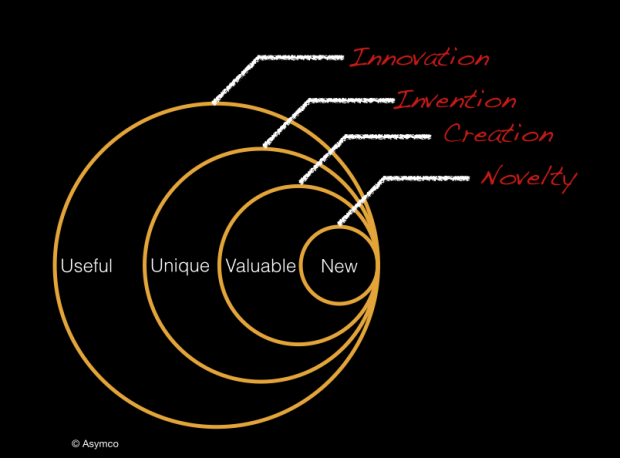
The differences are also evident in the mechanisms that exist to protect the works: Novelties are usually not protectable, Creations are protected by copyright or trademark, Inventions can be protected for a limited time through patents (or kept secret) and Innovations can be protected through market competition but are not defensible through legal means.
Innovation is a lot of talked about nowdays as essential to businesses to do. Is innovation essential for development work? article tells that innovation has become central to the way development organisations go about their work. In November 2011, Bill Gates told the G20 that innovation was the key to development. Donors increasingly stress innovation as a key condition for funding, and many civil society organisations emphasise that innovation is central to the work they do.
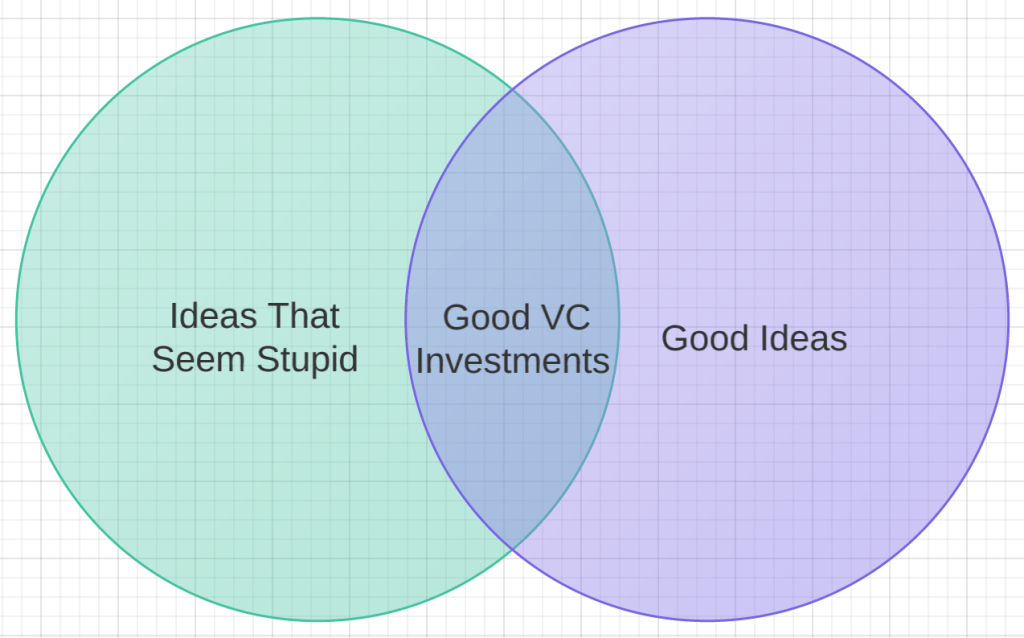
Some innovation ideas are pretty simple, and some are much more complicated and even sound crazy when heard first. The is place for crazy sounding ideas: venture capitalists are gravely concerned that the tech startups they’re investing in just aren’t crazy enough:
Not all development problems require new solutions, sometimes you just need to use old things in a slightly new way. Development innovations may involve devising technology (such as a nanotech water treatment kit), creating a new approach (such as microfinance), finding a better way of delivering public services (such as one-stop egovernment service centres), identifying ways of working with communities (such as participation), or generating a management technique (such as organisation learning).
Theorists of innovation identify innovation itself as a brief moment of creativity, to be followed by the main routine work of producing and selling the innovation. When it comes to development, things are more complicated. Innovation needs to be viewed as tool, not master. Innovation is a process, not a one time event. Genuine innovation is valuable but rare.
There are many views on the innovation and innvation process. I try to collect together there some views I have found on-line. Hopefully they help you more than confuze. Managing complexity and reducing risk article has this drawing which I think pretty well describes innovation as done in product development:

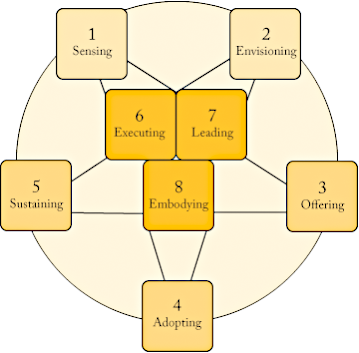
8 essential practices of successful innovation from The Innovator’s Way shows essential practices in innovation process. Those practices are all integrated into a non-sequential, coherent whole and style in the person of the innovator.
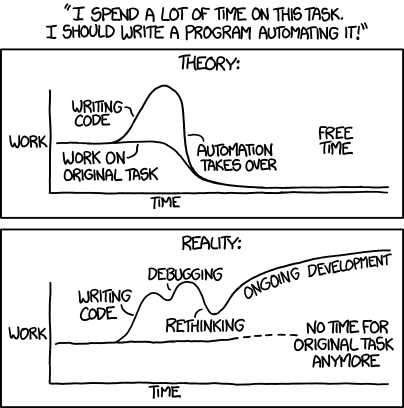
In the IT work there is lots of work where a little thinking can be a source of innovation. Automating IT processes can be a huge time saver or it can fail depending on situation. XKCD comic strip Automation as illustrates this:
System integration is a critical element in project design article has an interesting project cost influence graphic. The recommendation is to involve a system integrator early in project design to help ensure high-quality projects that satisfy project requirements. Of course this article tries to market system integration services, but has also valid points to consider.

Core Contributor Loop (CTTDC) from Art Journal blog posting Blog Is The New Black tries to link inventing an idea to theory of entrepreneurship. It is essential to tune the engine by making improvements in product, marketing, code, design and operations.

6,152 Comments
Tomi Engdahl says:
Pick Of The Litter
Parasite That Affects Cognition Has Quietly Infected Billions of People
“There is no drug that cures it at this point.”
https://futurism.com/health-medicine/parasite-cognition-infected-billions?fbclid=IwdGRjcAVMKvFjbGNrBUwqr2V4dG4DYWVtAjExAHBkb2YFc3J0YwZhcHBfaWQMMzUwNjg1NTMxNzI4AAEeuZAv4FNzRZQ96OXiBjapmoQ19ElrTvzjSEjRul8rhaPy12rHP7FLgl3F2Hw_aem_EZzoy197Q9qH0sDU44341g
One of the world’s most effective parasites doesn’t spread through mosquito bites or undercooked snails — but through the common house cat.
Called toxoplasma gondii, the parasite is a single-cell organism that primarily spreads to humans via cat turds, but also through raw or undercooked meat, contaminated water, and from a mother to her fetus. Its symptoms range from mild aches and pains to debilitating neural impairment, which makes it all the more horrifying to learn that it currently has no cure.
Tomi Engdahl says:
Electric shocks to the brain stop people objectifying women, study finds
Researchers say although findings are no cure for sexism, they give an insight into how objectification works
https://www.independent.co.uk/news/uk/home-news/electrical-shocks-objectifying-women-study-university-of-exeter-b3073370.html?fbclid=IwdGRjcAVMoKZjbGNrBUyghGV4dG4DYWVtAjExAHBkb2YFc3J0YwZhcHBfaWQMMzUwNjg1NTMxNzI4AAEex228xy-hjt7vt-nukQCLu_z1dYxOvaP5lVuIuM-F-UI6sr79HFCOqWDMj1o_aem_nRpiiRQmsH9eqoNg01PaIw