Searching for innovation

Innovation is about finding a better way of doing something. Like many of the new development buzzwords (which many of them are over-used on many business documents), the concept of innovation originates from the world of business. It refers to the generation of new products through the process of creative entrepreneurship, putting it into production, and diffusing it more widely through increased sales. Innovation can be viewed as t he application of better solutions that meet new requirements, in-articulated needs, or existing market needs. This is accomplished through more effective products, processes, services, technologies, or ideas that are readily available to markets, governments and society. The term innovation can be defined as something original and, as a consequence, new, that “breaks into” the market or society.

Innoveracy: Misunderstanding Innovation article points out that  there is a form of ignorance which seems to be universal: the inability to understand the concept and role of innovation. The way this is exhibited is in the misuse of the term and the inability to discern the difference between novelty, creation, invention and innovation. The result is a failure to understand the causes of success and failure in business and hence the conditions that lead to economic growth. The definition of innovation is easy to find but it seems to be hard to understand.  Here is a simple taxonomy of related activities that put innovation in context:

  • Novelty: Something new
  • Creation: Something new and valuable
  • Invention: Something new, having potential value through utility
  • Innovation: Something new and uniquely useful

The taxonomy is illustrated with the following diagram.
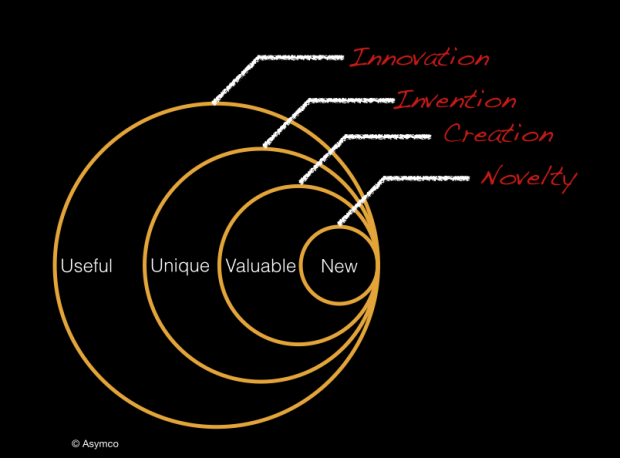
The differences are also evident in the mechanisms that exist to protect the works: Novelties are usually not protectable, Creations are protected by copyright or trademark, Inventions can be protected for a limited time through patents (or kept secret) and Innovations can be protected through market competition but are not defensible through legal means.

Innovation is a lot of talked about nowdays as essential to businesses to do. Is innovation essential for development work? article tells that innovation has become central to the way development organisations go about their work. In November 2011, Bill Gates told the G20 that innovation was the key to development. Donors increasingly stress innovation as a key condition for funding, and many civil society organisations emphasise that innovation is central to the work they do.

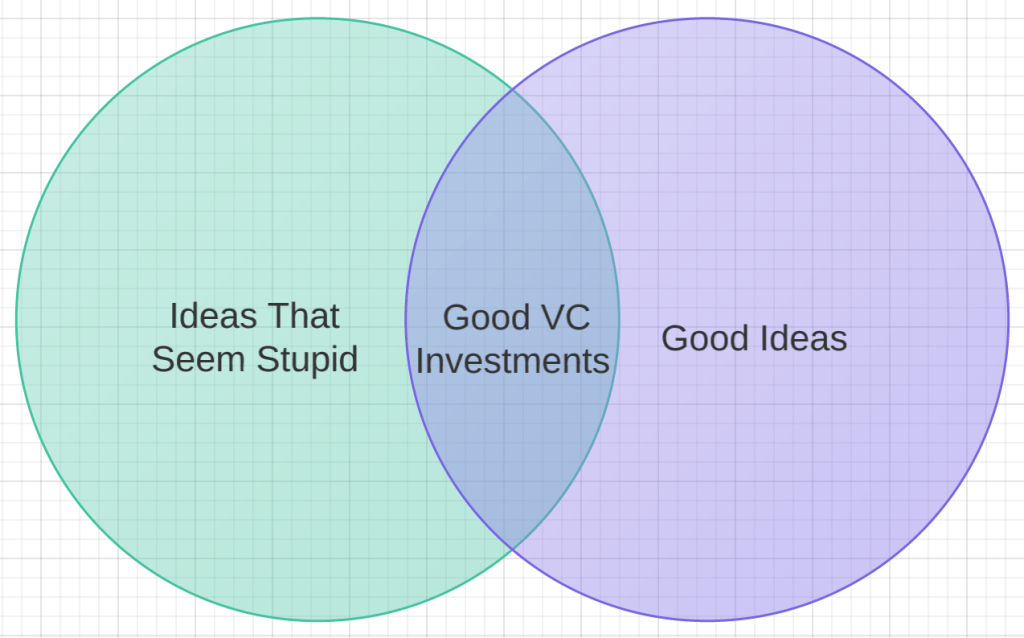
Some innovation ideas are pretty simple, and some are much more complicated and even sound crazy when heard first. The is place for crazy sounding ideas: venture capitalists are gravely concerned that the tech startups they’re investing in just aren’t crazy enough:
 

Not all development problems require new solutions, sometimes you just need to use old things in a slightly new way. Development innovations may involve devising technology (such as a nanotech water treatment kit), creating a new approach (such as microfinance), finding a better way of delivering public services (such as one-stop egovernment service centres), identifying ways of working with communities (such as participation), or generating a management technique (such as organisation learning).

Theorists of innovation identify innovation itself as a brief moment of creativity, to be followed by the main routine work of producing and selling the innovation. When it comes to development, things are more complicated. Innovation needs to be viewed as tool, not master. Innovation is a process, not a one time event. Genuine innovation is valuable but rare.

There are many views on the innovation and innvation process. I try to collect together there some views I have found on-line. Hopefully they help you more than confuze. Managing complexity and reducing risk article has this drawing which I think pretty well describes innovation as done in product development:

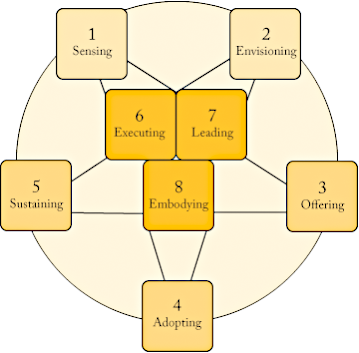
8 essential practices of successful innovation from The Innovator’s Way shows essential practices in innovation process. Those practices are all integrated into a non-sequential, coherent whole and style in the person of the innovator.
In the IT work there is lots of work where a little thinking can be a source of innovation. Automating IT processes can be a huge time saver or it can fail depending on situation. XKCD comic strip Automation as illustrates this:

XKCD Automation

System integration is a critical element in project design article has an interesting project cost influence graphic. The recommendation is to involve a system integrator early in project design to help ensure high-quality projects that satisfy project requirements. Of course this article tries to market system integration services, but has also valid points to consider.

Core Contributor Loop (CTTDC) from Art Journal blog posting Blog Is The New Black tries to link inventing an idea to theory of entrepreneurship. It is essential to tune the engine by making improvements in product, marketing, code, design and operations.


5,862 Comments

  1. Tomi Engdahl says:

    Esteitä väärän tiedon valtatielle – tutkimustieto vahvistaa nuorten kykyä torjua disinformaatiota
    Väärän tiedon tunnistamisessa auttaa kriittinen ajattelu. Some ei aina anna aikaa ajatella – siksi tarvitaan myös nopeaa tunnistamista. Disinformaation tunnistaminen ja torjunta kiinnostaa nyt niin tutkijoita kuin viranomaisiakin. Jyväskylän yläkouluista alkaa pian kertyä maailmanlaajuisesti arvokasta tietoa nuorten kyvystä tunnistaa epäluotettavaa tietoa.
    https://www.jyu.fi/fi/artikkeli/esteita-vaaran-tiedon-valtatielle-tutkimustieto-vahvistaa-nuorten-kykya-torjua-disinformaatiota

    Reply
  2. Tomi Engdahl says:

    Scientists create ultra-low loss optical device that traps light on a chip
    Date:
    February 24, 2026
    Source:
    University of Colorado at Boulder
    Summary:
    CU Boulder researchers have designed microscopic “racetracks” that trap and amplify light with exceptional efficiency. By using smooth curves inspired by highway engineering, they reduced energy loss and kept light circulating longer inside the device. Fabricated with sub-nanometer precision, the resonators rank among the top performers made from chalcogenide glass. The technology could lead to compact sensors, microlasers, and advanced quantum systems.
    https://www.sciencedaily.com/releases/2026/02/260224015540.htm

    Reply
  3. Tomi Engdahl says:

    Top Tech YouTuber Blows the Whistle on an Audiophile PC Solution Scam: A Controversy Recap
    https://www.headphonesty.com/2024/07/audiophile-power-filters-pc-audio-noisy-scam/?utm_source=fb&utm_medium=comment&fbclid=IwdGRjcAQ_A-ljbGNrBD8Dh2V4dG4DYWVtAjExAHNydGMGYXBwX2lkDDM1MDY4NTUzMTcyOAABHhzNrWd7abVWqmgkeKCV2ZYsS6z0rhZPUBu5TYLdEIEhIJ7DohkhDYAeZMd0_aem_yh7mAGmYDrUNlOeVkrh32g

    As the saying goes, if it seems too good to be true, it probably is.

    Many of us want the best listening experience possible, so we turn to gadgets that promise to make sound better. So, when a brand told us that there are ‘power filters’ that can get rid of electrical noise and make audio clearer, a lot of us got curious.

    But not everything a manufacturer claims is always true.

    Enter Linus Sebastian and his team at Linus Tech Tips.

    Through tests done in 2020 and 2023, they found that these “power filters” not only fail to deliver on their promises but may actually make audio quality and system performance worse.

    Elfidelity offers a range of affordable ‘power filtering devices’ for various PC components, with price tags ranging from a mere $10 to $40.

    These products claim to be the holy grail of PC audio, promising to remove interference, reduce electrical noise, and even make your system more stable.

    But that’s not all. Elfidelity also says their devices can help with CPU and memory overclocking, make hard drives last longer, and protect against power drops.

    We’ve all dealt with annoying electrical noise that turns our dreams of clear audio into a buzzing, static-filled mess. It’s enough to drive any gamer, content creator, or fellow audiophile up the wall.
    Elfidelity’s products promise an easy and cheap fix for these common issues

    The first red flag? The device’s internal circuitry was a far cry from what was advertised.

    The circuit board paths weren’t arranged in a way that could actually filter or process signals. Some paths did nothing useful, while others weren’t connected to anything at all.

    But, the team still proceeded with their tests.

    The results were shocking. Not only did the filters fail to reduce noise as claimed, but in many cases, they actually increased it.

    “I thought at best these wouldn’t do anything, but I also thought that at worst, they wouldn’t do anything,” said Linus during the test.

    “How did they manage to make the performance worse?”

    Unintended Consequences
    Based on the test, most of Elfidelity’s products were about as impactful as a screen door on a submarine. But, the team also found some ways that the device can actually negatively affect the PC’s performance.

    For one, the fan filters managed to slightly reduce fan speeds. This might not sound like much, but over time, it could make your system run hotter than it should.

    But here’s where it gets really dicey.

    The extra capacitance from these devices could potentially mess up the carefully balanced power delivery systems in modern motherboards.

    As one commenter pointed out, “More capacitors make it worse because the regulators in the motherboard are calibrated for a specific total capacitance. Adding too much moves them from their optimal operation region, and could even make them unstable.”

    The tests also raised specific issues with the DDR4 module, a power filter meant to fit into a memory slot. Sebastian explained that using capacitors and inductors to reduce noise in devices that require a lot of power makes sense.

    But applying this to a DDR4 memory slot doesn’t. This is because the DDR4 slot doesn’t draw enough power to need such filtering, making the module unnecessary.

    According to Linus, Elfidelity sold a similar ineffective product before, raising concerns about why they continue to sell such devices.

    Plus, further digging showed that some of the capacitors used in the Elfidelity products appear to be counterfeit.

    For example, the Rubycon capacitors on the SATA filter looked about as real as a three-dollar bill. Sebastian noticed the poor printing quality on the labels, which doesn’t match genuine Rubycon products.

    They also found that Elfidelity’s products seem to be copies of filters made by a Korean company called SOtM, which even makes an audio-focused motherboard.

    The Dangers of Snake Oil in Audio
    The Elfidelity issue shows a ongoing problem in the audiophile world: the spread of fake scientific products that take advantage of consumers’ desire for better sound quality.

    These “snake oil” solutions often come with scientific-sounding explanations and good user reviews, making it hard for the average buyer to tell fact from fiction.

    “I hope that people aren’t buying this. But the fact that these guys are still around all these years later, still selling this stuff, would indicate to me that someone is buying it.” said Linus.

    “I don’t want this video to be about mocking people for buying this stuff. I want it to be about educating them.”

    The best way to avoid this is to really spend some time educating yourself on something before you buy it.

    For example, modern motherboards are already pretty good at handling audio. They already have capacitors designed to filter noise for internal audio.

    So, most people don’t really need such devices.

    If you want to still improve your listening experience, however, you can’t go wrong by buying good headphones, external DACs (Digital-to-Analog Converters), amplifiers, or even a better power supply.

    Reply
  4. Tomi Engdahl says:

    Using electricity to put out a fire. Would this work on a smaller scale?

    Edit: to all detractors and people who believe this video is ai slop;
    At the end of this report from an experiment done by the military in 2000, there are eletrical circuit diagrams for the creation of the devices that were used in their experiments.
    Thank you all for your kind words.
    https://apps.dtic.mil/sti/tr/pdf/ADA386379.pdf

    Reply
  5. Tomi Engdahl says:

    Nutritionally speaking, it’s *almost* the same as regular meat. Almost.

    Is ‘lab-grown’ meat actually safe?
    It isn’t identical to regular meat, but that might be a good thing.
    https://www.popsci.com/health/is-lab-grown-meat-safe/

    n 2023, the U.S. government approved the sale of “lab-grown” chicken after it passed food safety tests.

    Lab-grown meat, also called “cultivated” or “cultured” meat, is meat grown in a lab instead of on a farm. Scientists take a few cells from an animal and put them in a tank called a bioreactor with nutrients like vitamins, minerals, and amino acids. The cells grow and multiply until they form muscle tissue—the same stuff that makes up the meat people eat.

    Because no animal has to be killed, cultivated meat is better for animal welfare. The environmental impact is still debated: cultivated meat could be better or worse for the planet depending on the type of energy used to power the factories that make it.

    But what about the big question: Is it actually healthy to eat?

    Lab-grown meat is nutritionally similar—but not identical—to conventional meat

    Conventional meat contains all nine essential amino acids (protein building blocks), which the human body cannot produce on its own, as well as various non-essential amino acids. It is also a source of B vitamins and several mineral nutrients, including iron and zinc.

    According to Dr. Tim Spector, an epidemiologist at King’s College London and co-founder of the nutrition science company ZOE, “the protein quality and amino acid profile of cultivated meat is generally similar to conventional meat, with all essential amino acids present but with varying ratios.”

    Early research suggests that some nutrients may be lower in lab-grown meat, while others could be equal—or even higher

    One study found that, compared with regular chicken meat, lab-grown chicken had less protein, lower amounts of most essential amino acids, less magnesium, and less vitamin B3. However, it had more total fat, more saturated fat, more cholesterol, and higher levels of vitamins B5, B6, and A. Lab-grown chicken also contained higher amounts of several minerals, including calcium, copper, iron, potassium, manganese, sodium, phosphorus, selenium, and zinc.

    Lab-grown meat could be healthier than conventional meat
    One of the biggest promises of lab-grown meat is that, unlike conventional meat, its nutritional content can potentially be fine-tuned during production.

    “In practice, this might mean aiming for less saturated fat and more unsaturated fat and enriching the product with beneficial fatty acids such as omega-3,” says Spector. This may come with a few trade-offs, as fat plays a major role in how meat tastes and feels, he says.

    Another benefit of cultivated meat comes from the way it’s produced—in a sterile lab environment. This contrasts with traditional meat farming where manure is present and can—potentially—come into contact with meat.

    Lab-grown meat falls under the ‘ultra-processed food’ umbrella
    Because of how lab-grown meat is made—through an industrial process, and with added ingredients—it would probably count as an ultra-processed food, says Spector.

    “But ‘processed’ doesn’t automatically mean unhealthy,” he says. “What matters is the quality of the final product, what’s added, how it affects the gut microbiome, and what it replaces in the diet.”

    Nutritionally, lab-grown meat is much like regular meat: low in fiber and high in saturated fat. “But in theory, it could be designed to have an improved nutrient profile,” Spector says, for instance with more iron or vitamin B12 and less saturated fat.

    Still, tweaking the nutrient mix doesn’t erase the health concerns linked to eating meat.

    Its long-term impact on health is unknown
    At the moment, we don’t yet know how eating lab-grown meat affects health in the long run.

    The bottom line
    Nutritionally, lab-grown meat is much like regular meat, though it isn’t an exact copy.

    Reply

Leave a Comment

Your email address will not be published. Required fields are marked *

*

*