The Intergovernmental Panel on Climate Change (IPCC) has unleashed their Special Report on the impact of global warming reaching 1.5°C above pre-industrial levels.
“This IPCC report is set to outline a rescue plan for humanity,”
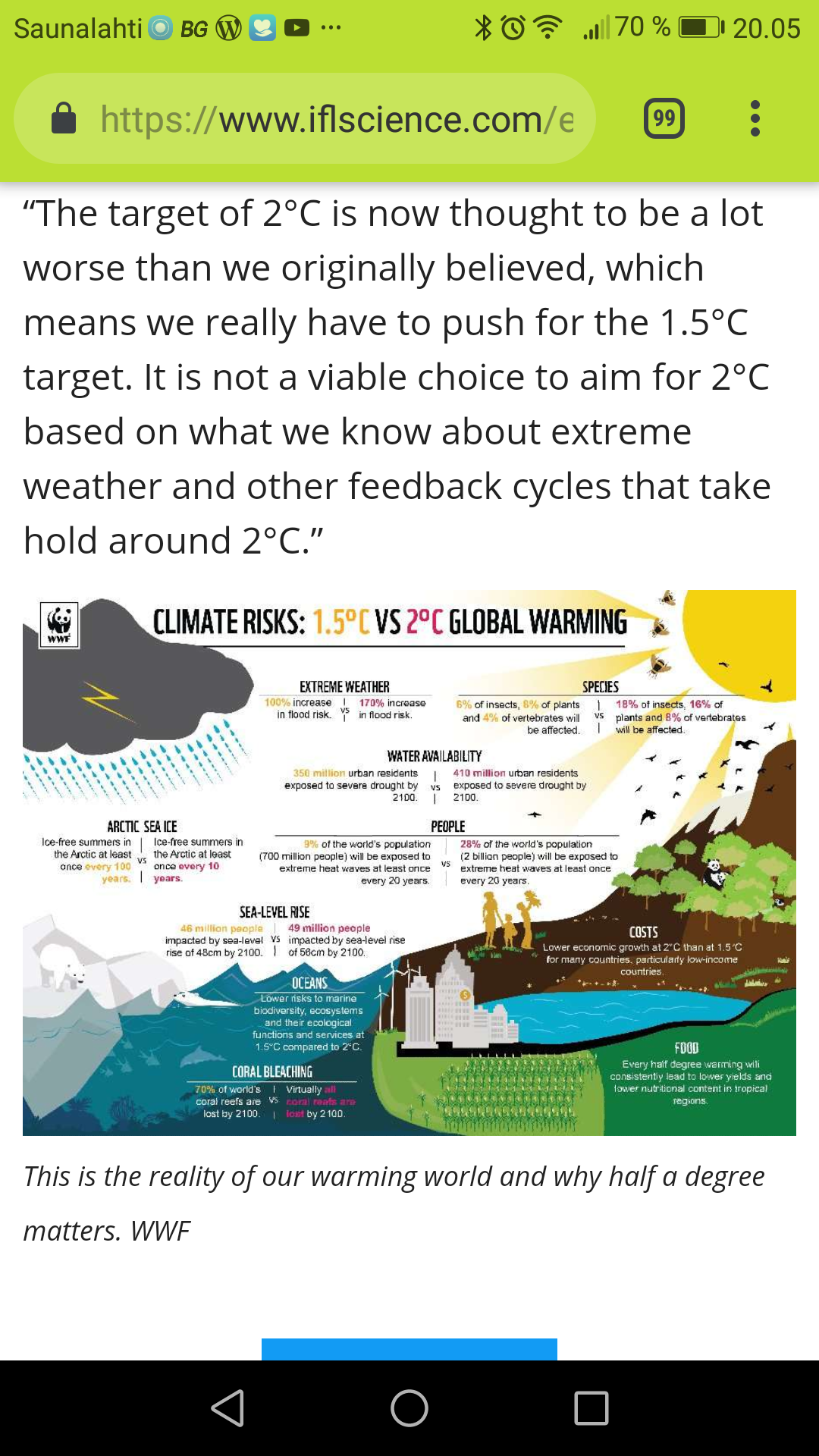
“1.5°C is the new 2°C,”
If we stick to Paris Climate Agreement commitments, we could still see a global warming of about 3°C by 2100.
1,378 Comments
Tomi Engdahl says:
Weeble Wobble
Earth on Track to Become Uninhabitable, Scientists Say
“Policymakers and the public remain largely unaware of the risks posed by what would effectively be a point-of-no-return transition.”
https://futurism.com/science-energy/earth-uninhabitable-climate-change?fbclid=IwVERDUARhHMtleHRuA2FlbQIxMABzcnRjBmFwcF9pZAwzNTA2ODU1MzE3MjgAAR65LgytLnpzeOboZMNPY0FUoIJbxB68KMnwq1WfT64odMQLc2qjWR6-JsA-wQ_aem_g-zdpdztUNLYCm8uUVG6LQ
Tomi Engdahl says:
https://phys.org/news/2026-05-climate-scientist-large-errors-global.html
Tomi Engdahl says:
Heat Death
In Irony-Soaked Incident, Amazon Data Center Shuts Down Due to High Temperatures
It’d be funny if it wasn’t so dark.
https://futurism.com/artificial-intelligence/amazon-data-center-temperatures
Tomi Engdahl says:
Brace Yourselves
Last Time an El Niño Was This Bad, It Killed 50 Million People
“It was arguably the worst environmental disaster to ever befall humanity.”
https://futurism.com/science-energy/el-nino-killed-50-million?fbclid=IwdGRjcARy2ydjbGNrBHLa3mV4dG4DYWVtAjExAHNydGMGYXBwX2lkDDM1MDY4NTUzMTcyOAABHiru0fFNVTOKAFqJYEa4tcnGCQqC7WEdFED8rdSYPuQ0dxTqxYkC6aukbWfH_aem_OK9x8OjRlhGHX8YiJBRwCA
As if oil shortages, perpetual wars, and the existential angst of AI weren’t stressful enough, there’s an El Niño brewing — and it’s looking like it’ll be one of the most severe in over a century.
According to numerous weather models, this year’s El Niño — a prolonged climate event featuring unusually warm temperatures, which pops up every couple of years — could easily be the most severe we’ve ever experienced in the modern age. This year’s warm spell could supercharge ocean temperatures by as much as 5.4 degrees Fahrenheit, the Wall Street Journal reports, resulting in widespread droughts for some, floods for others, and perhaps most chillingly, chaos for global food supplies.
Tomi Engdahl says:
UK warned to prepare for 40C summers threatening British way of life
The Climate Change Committee warned that 92 per cent of homes are expected to overheat by 2050
https://www.independent.co.uk/news/uk/home-news/uk-weather-40c-summer-climate-change-committee-b2980104.html?fbclid=IwdGRjcAR6pCpjbGNrBHqj7WV4dG4DYWVtAjExAHNydGMGYXBwX2lkDDM1MDY4NTUzMTcyOAABHkYW2NPXblR8QatXurhL8flzOB3qxaDfd6W3iysbvpE1H8r0UjpxNsVQ1ycF_aem_bpIVyjvMVjH1HWMQckZp-g
Tomi Engdahl says:
Need a Breather
Remember How Sucking Carbon Out of the Air Was Going to Save the Planet? We Have Terrible News
To say we’re way behind schedule is an understatement.
https://futurism.com/science-energy/carbon-capture-update?fbclid=IwdGRjcASSu9xjbGNrBJK7aWV4dG4DYWVtAjExAHNydGMGYXBwX2lkDDM1MDY4NTUzMTcyOAABHo1UnBerFLNjmwsflYbVSwLeJKxDBsxzvMAO-Wurq7GtdbYCEGs-dn6Oaa1__aem_QYZzuG5im-i7ruxZvni71A
The idea of sucking CO2 out of the atmosphere to combat climate change might be a necessary intervention, but it always sounded like a longshot.
Unfortunately, it seems like the strategy is already hitting a wall. A new report published this week found that ongoing carbon dioxide removal (CDR) efforts are barely putting a dent in the fight against global warming — and that for them to start making an impact, they would need to be scaled up at a rate that rivals the adoption of solar panels.
In other words, we’re not doing it big enough, and we’re not doing it fast enough. And the longer we wait to get the ball rolling, the more carbon removal we’ll need to do to mitigate climate impacts.
“Countries have pledged around 2.7 billion [metric tons] of carbon removal by 2035 and about 3.6 billion by 2050, but climate pathways require much more, especially in the long term,” report coauthor William Lamb, a scientist at the Potsdam Institute for Climate Impact Research, told The Guardian. “This leaves a gap that grows significantly over time.”
Scientists generally agree that CDR efforts will play a small but necessary role in limiting global warming to within 1.5 degrees Celsius, or 2.7 degrees Fahrenheit — but only as a complement to the primary goal of aggressively reducing our emissions, and eventually hitting net zero emissions by 2050. The International Panel on Climate Change considers carbon removal to be “unavoidable,” or essential to achieving climate targets,
Tomi Engdahl says:
https://futurism.com/science-energy/el-nino-situation-noaa-brutal-climate?fbclid=IwVERDUASbIgxleHRuA2FlbQIxMABzcnRjBmFwcF9pZAwzNTA2ODU1MzE3MjgAAR4j4eckUMVhsxRzBUWOhxYwQoAQB61cIOiHj8ZXgYj-xBA1VcE6hTfY6mMK9g_aem_fUJejqVU-02L4aODcbmwyg
Tomi Engdahl says:
https://futurism.com/advanced-transport/mit-study-investigates-environment-gas-electric-cars?fbclid=IwdGRjcASlohxjbGNrBKWhfGV4dG4DYWVtAjExAHNydGMGYXBwX2lkDDM1MDY4NTUzMTcyOAABHvQdOOj8e501NvdnKWkHb6QVQRw6H0Kd69v5JOiagNdJDUwhk7wN5DQonbju_aem_Zqa1D7YlC1zekaZ5vRGJig
Tomi Engdahl says:
https://www.reuters.com/sustainability/extreme-heat-panel-cancelled-due-extreme-heat-2026-06-25/
Tomi Engdahl says:
https://metro.co.uk/2026/06/24/extreme-heat-conference-london-cancelled-extreme-heat-28909021/
Tomi Engdahl says:
Somehow they proved their own point.
Tomi Engdahl says:
“Trusted climate information should not disappear when politics change.” https://trib.al/uTJwFD7
Grass Roots
Government Scientists Fired by Trump Launch New Website for Sharing Climate Data
“Trusted climate information should not disappear when politics change.”
https://futurism.com/science-energy/government-scientists-noaa-trump-climate-data?fbclid=IwdGRjcASq5sRjbGNrBKrmtGV4dG4DYWVtAjExAHNydGMGYXBwX2lkDDM1MDY4NTUzMTcyOAABHoaD4mCCpBkjjw7Pj1asBmdhr3PAi0ORScSzfMbXalVrhJKo-gWwTWpKs4K2_aem_eDKRrQ-Cl8x4UKLsZkJBug
Since September of 2024, federal science agencies in the US have axed nearly 120,000 employees, in a stinging loss for public research. Some of the heaviest impact was felt by scientists studying the climate, at bureaus like the Environmental Protection Agency and the National Oceanic and Atmospheric Administration.
Luckily for us, climate scientists are a resourceful bunch. A recent initiative pushed by former NOAA staffers has led to the creation of a non-profit website to share trusted climate data with the public.
Called climate.us, the new site is is built by former staffers behind climate.gov, the NOAA site which researchers, environmental journalists, and insurance underwriters alike have long trusted for accurate climate data — a public service eviscerated by the Trump administration.
The new site recently went “fully active” as a clone of climate.gov on Tuesday, managing director Rebecca Lindsey told the New York Times. It contains some 15 years of raw data on climate and weather, articles, illustrated reports, as well as access to government mandated climate assessments.
“Trusted climate information should not disappear when politics change,” Lindsey said in a statement published on the new site. “Climate.us is building an independent, durable platform so people can continue to find the data and information they need to understand and talk about climate, and to teach, report, plan, prepare, and make informed decisions.”
The new initiative comes nearly a year after the Trump administration “hid the front door” to climate.gov, as Lindsey put it, by redirecting the web address to a different NOAA website after firing almost all the staff.
Tomi Engdahl says:
https://www.euronews.com/2026/06/28/a-strategic-mistake-of-colossal-proportions-why-trump-is-losing-the-war-on-renewables?fbclid=IwVERDUASuXDhleHRuA2FlbQIxMABzcnRjBmFwcF9pZAwzNTA2ODU1MzE3MjgAAR4HEB_IDCfE5nSlUc1IdU-yBwnMyYMd_3RFca12PE9GPlHMtv1ZQMiowTo8bQ_aem_3fmlw9E99ax9qaLaVL2PRw
Tomi Engdahl says:
https://www.independent.co.uk/news/world/europe/france-us-europe-heatwave-air-conditioning-deaths-b3005635.html?fbclid=IwdGRjcASxD19jbGNrBLEPSWV4dG4DYWVtAjExAHNydGMGYXBwX2lkDDM1MDY4NTUzMTcyOAABHv2PFCpFNAYefdHohC9LJmKrpKLT_fiiv4DhGOxE2FAxjBUMxYOIxDqnoecj_aem_nFGFRKHyZo3SHxbmFWt9hA
Tomi Engdahl says:
Throwing cold water on your hopes of a better tomorrow. https://trib.al/4JhmcrB
Tomi Engdahl says:
https://futurism.com/science-energy/air-conditioning-climate-change-france-killing-people?fbclid=IwdGRjcASyYfZjbGNrBLJh3mV4dG4DYWVtAjExAHNydGMGYXBwX2lkDDM1MDY4NTUzMTcyOAABHgzbhStrGI8BxWWDRDu8j4dK-_vu64gC9zBIJRJ_m12vA0GXmgWIOCkorr04_aem__BegFVMf2TSDaSzPNhQTrg
Tomi Engdahl says:
Financial Times:
An EU draft proposal dated June 30 shows the bloc is weighing weaker climate impact rules for gas-powered data centers, after heavy lobbying from tech groups
https://www.ft.com/content/21358a9a-b93b-443c-8a68-6fed89c8b3a6
Tomi Engdahl says:
https://futurism.com/science-energy/scientists-huge-heatwave-antarctica-glacier?fbclid=IwdGRjcAS62OZjbGNrBLrYSmV4dG4DYWVtAjExAHNydGMGYXBwX2lkDDM1MDY4NTUzMTcyOAABHsX6GE4M2aEnfgct35hveQtYWc7Sz8E3IHlT0_4Vda7cXcw96dTKyqye-nxR_aem_LaQZtkkHfcuAG4ErPDsDXQ
Tomi Engdahl says:
It’s doing almost *nothing.* https://trib.al/mFssqdI
Need a Breather
Remember How Sucking Carbon Out of the Air Was Going to Save the Planet? We Have Terrible News
To say we’re way behind schedule is an understatement.
https://futurism.com/science-energy/carbon-capture-update?fbclid=IwdGRjcAS9eVJjbGNrBL15OWV4dG4DYWVtAjExAHNydGMGYXBwX2lkDDM1MDY4NTUzMTcyOAABHsdb0uYuBv9xkgJixtIRoR0GWxYzmoosDXIkgDJnbosw3njrBy_LM2XsYAZp_aem_RTEEnB1P8VOB9ztUwRhnFA
The idea of sucking CO2 out of the atmosphere to combat climate change might be a necessary intervention, but it always sounded like a longshot.
Unfortunately, it seems like the strategy is already hitting a wall. A new report published this week found that ongoing carbon dioxide removal (CDR) efforts are barely putting a dent in the fight against global warming — and that for them to start making an impact, they would need to be scaled up at a rate that rivals the adoption of solar panels.
In other words, we’re not doing it big enough, and we’re not doing it fast enough. And the longer we wait to get the ball rolling, the more carbon removal we’ll need to do to mitigate climate impacts.
“Countries have pledged around 2.7 billion [metric tons] of carbon removal by 2035 and about 3.6 billion by 2050, but climate pathways require much more, especially in the long term,” report coauthor William Lamb, a scientist at the Potsdam Institute for Climate Impact Research, told The Guardian. “This leaves a gap that grows significantly over time.”
Scientists generally agree that CDR efforts will play a small but necessary role in limiting global warming to within 1.5 degrees Celsius, or 2.7 degrees Fahrenheit — but only as a complement to the primary goal of aggressively reducing our emissions, and eventually hitting net zero emissions by 2050. The International Panel on Climate Change considers carbon removal to be “unavoidable,” or essential to achieving climate targets, because some industries will be difficult to completely decarbonize, such as agriculture.
That said, there’s a risk of overstating its importance to the public, letting us off the hook from actually having to revolutionize energy production and consumption. Scientists are wary of advocating for geoengineering efforts, like dimming the Sun, for the same reason, even if they do prove necessary.
In any case, progress is meager. According to the report, deliberate human interventions currently remove around 2.2 billion metric tons of Co2 per year, which is about five percent of global annual emissions. The bulk of this is achieved through interventions like planting trees. But novel high tech solutions, such as using machines to suck greenhouse gases straight from the atmosphere — direct air capture — made up just 0.1 percent of that multibillion ton total.
Tomi Engdahl says:
Chilling. https://trib.al/LWMWEWL
Tomi Engdahl says:
https://www.facebook.com/share/1BhC5e9iGU/
Air conditioning is essential for protecting people during dangerous heat waves, but it also has a significant environmental impact. Cooling buildings uses about 7% of the world’s electricity and produces roughly 3.2% of global greenhouse gas emissions.
In the United States, air conditioners emit an estimated 150 million metric tons of CO₂ each month during summer, an amount comparable to the Netherlands’ total annual carbon emissions. This highlights the large energy demand associated with cooling.
As global temperatures rise, more people rely on air conditioning to stay safe. However, if that electricity comes from fossil fuels, it increases greenhouse gas emissions, creating a cycle where hotter weather leads to greater cooling demand and even more warming.
Millions of people in developing countries still lack access to reliable cooling despite facing extreme heat. Expanding access to air conditioning is vital for saving lives, but it must be done in a way that minimizes environmental impact.
Experts say the solution is not to stop using air conditioning, but to make it cleaner and more efficient through renewable energy, energy-efficient cooling systems, better building insulation, passive cooling designs, reflective roofs, and greener cities with more trees and shade.
#heatwave #airconditioning
Tomi Engdahl says:
It’s a controversial proposal. https://trib.al/SyTs1Zv
Simmer Down Boy
Scientists Propose Dimming Sun to Combat El Niño
It’s a controversial proposal.
https://futurism.com/science-energy/dimming-sun-combat-el-nino?fbclid=IwdGRzaATAtDpjbGNrBMCz-WV4dG4DYWVtAjExAHNydGMGYXBwX2lkDDM1MDY4NTUzMTcyOAABHkLytwMzlkpD1rY6kkYqII0tu7kA009lXvmswrvZ0uOGJWT3xfJBR2adas-0_aem_-_bEo-OcjpPsQZZTLG7hmA
Last month, the United Nations warned that this year’s El Niño, a naturally occurring climate pattern characterized by unusually warm ocean surface temperatures throughout the Pacific, would be particularly extreme.
“The world must treat it as the urgent climate warning it is,” the World Metereological Organization cautioned at the time. “El Niño conditions will pour fuel on the fire of a warming world.”
Indeed, the National Oceanic and Atmospheric Administration (NOAA) confirmed that there was a rising chance of a “very strong” El Niño, triggering drastic temperature swings and more frequent extreme weather events, from severe storms to major flooding. Meanwhile, human-driven climate change will only amplify these effects, making this summer particularly precarious.
Tomi Engdahl says:
Fuel The Fire
You’ll Never Guess Which Country Is Causing the Most Global Warming
“Many people assume that if solar and wind are growing quickly, fossil fuels must be shrinking.”
https://futurism.com/science-energy/country-global-emissions-warming-climate-united-states?fbclid=Iwb21leAS8voBleHRuA2FlbQIxMQBzcnRjBmFwcF9pZAwzNTA2ODU1MzE3MjgAAR5yh5TQ8YtEc4hRANmGoVTlXhGWlXL_8hR1QbKBFp1GdjMzjdX9idEiwS408A_aem_URg72vIxvf6XJsDdxuS42g
Tomi Engdahl says:
Scientists fired by Trump launch their own independent site to save 15 years of vital data
The scientists were previously part of the a vital climate organization
https://www.uniladtech.com/science/news/scientists-publish-website-data-after-fired-trump-826807-20260710?utm_content=tech&utm_medium=Social&utm_source=facebook&fbclid=IwdGRjcATDnaxjbGNrBMOdZWV4dG4DYWVtAjExAHNydGMGYXBwX2lkDDM1MDY4NTUzMTcyOAABHpwL5T5LL-rC4VV-Z5qda6xKGsRMPWHomz66_rDxdUk5_nZmPXW2zUZHJUgo_aem_k4hBySFvm-aXd3IGCUlQxg
After being laid off by the Trump administration as part of DOGE-era job cuts, a group of scientists previously part of the National Oceanic and Atmospheric Administration (NOAA) have set up their own independent website to preserve more than 15-years worth of vital climate data.
The site itself, named Climate.us, doesn’t just provide data – although there’s plenty of that to go around – as it has already released potentially vital news and features, alongside various teaching resources to help people better understand the climate.
Tomi Engdahl says:
https://www.npr.org/2026/06/26/nx-s1-5869615/climate-noaa-data-trump-doge?fbclid=IwVERDUATDnfdleHRuA2FlbQIxMABzcnRjBmFwcF9pZAwzNTA2ODU1MzE3MjgAAR6hztJIiKxKhXxKTPwU_5dB3PfQyjrp4F9Njfuh9Fgv7fsAYggXA5vRmriZhg_aem_RJLiH0sAUL30Yr9NLstv3A
Tomi Engdahl says:
https://futurism.com/science-energy/something-weird-china-tree-wall?fbclid=IwdGRjcATGrIhjbGNrBMasHWV4dG4DYWVtAjExAHNydGMGYXBwX2lkDDM1MDY4NTUzMTcyOAABHsWRIwTCBGhdNfIBj2UOLzPJ1HDt8fxQtJ7jAzzHUrQESG7_FcmvOt13CzLW_aem_A6zjJ4ZK7YAzg6Uv2O3Oiw
“Planted forests can be a powerful short-term tool for carbon uptake, but this advantage is temporary,” Luo told Live Science. “For long-term carbon storage and resilience, natural forests remain irreplaceable.”
Tomi Engdahl says:
EU keventää päästökauppaa: ”Epäreilua maille, jotka ovat jo siirtymässä vähäpäästöiseen teknologiaan”
Greenpeacen apulaismaajohtaja pitää kevennyksiä huonona asiana ilmastonmuutokselle. EK:n asiantuntija katsoo, että päästöjä vähennetään jatkossakin kunnianhimoisesti.
https://yle.fi/a/74-20236880?fbclid=IwdGRjcATHjaljbGNrBMeNe2V4dG4DYWVtAjExAHNydGMGYXBwX2lkDDM1MDY4NTUzMTcyOAABHvzXax8u6-yem1fObn7Z1Ppa35tU5-bwpKkS-jkJwEYLt8Enxb7vDGoo939Y_aem_SV-CQrWbuf9KcD8uOhfjYQ
Juttu tiivistettynä
EU-komissio esittää kevennyksiä päästökauppaan ja aikoo hidastaa päästövähennystavoitetta.
Greenpeacen Juha Aromaa vastustaa, koska ilmastokriisi on pidemmällä kuin kuviteltiin.
EK:n Kati Ruohomäki pitää esitystä hyvänä ja tasapainoisena.
Päästökaupan oli määrä loppua 2039, nyt se jatkuu. Suomi vastustaa, koska on jo siirtynyt vähäpäästöiseen teknologiaan.
Tomi Engdahl says:
Päästökauppa on markkinaehtoinen järjestelmä, jonka avulla järjestelmän piirissä ovat yritykset voivat päättää, vähentävätkö itse päästöjään vai maksavatko saastuttamisesta ostamalla päästöoikeuksia. Päästökauppa on vähentänyt päästöjä tehokkaasti, ja sillä on merkittävä rooli EU:n ilmastotoimissa.