The Intergovernmental Panel on Climate Change (IPCC) has unleashed their Special Report on the impact of global warming reaching 1.5°C above pre-industrial levels.
“This IPCC report is set to outline a rescue plan for humanity,”
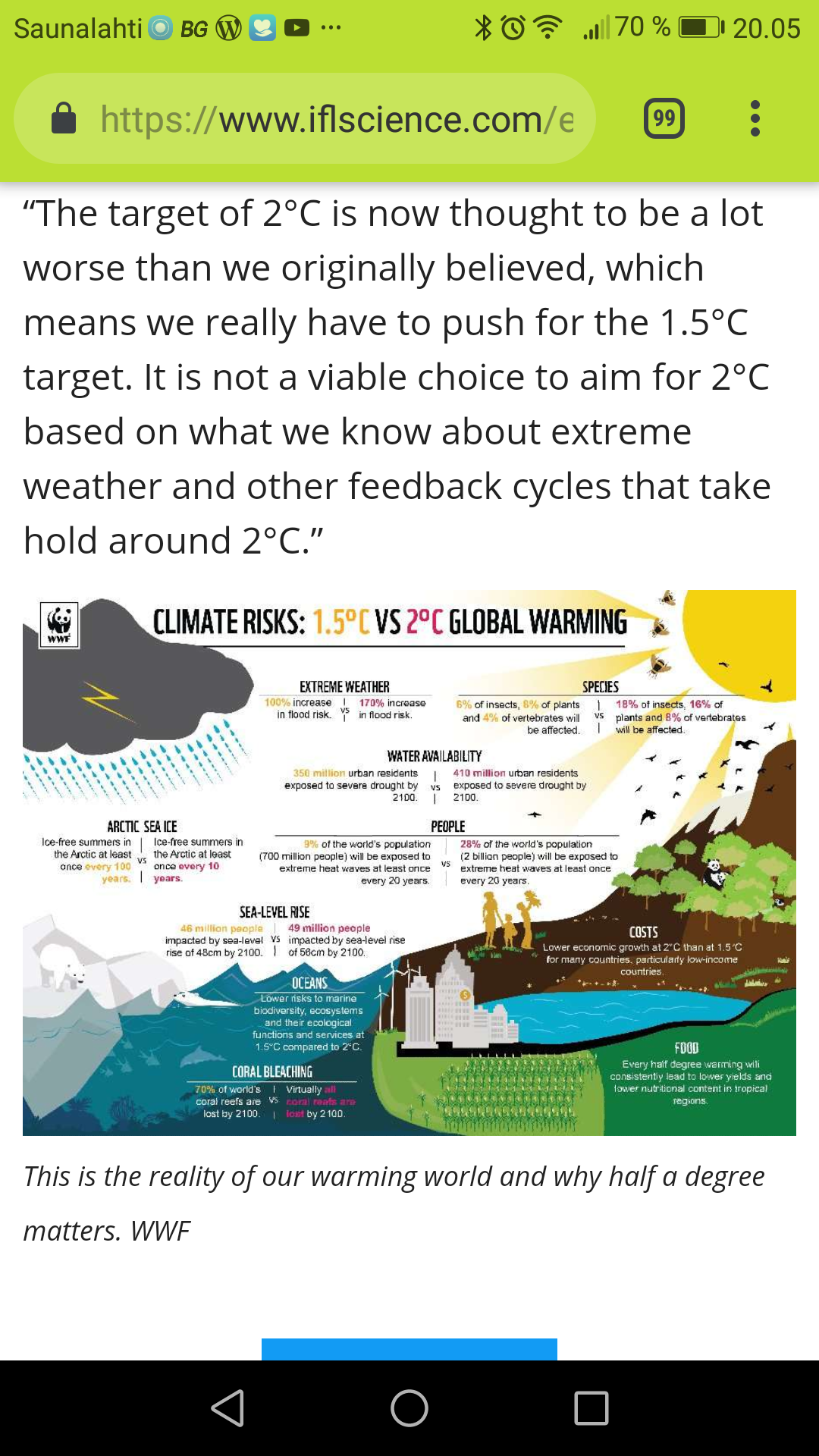
“1.5°C is the new 2°C,”
If we stick to Paris Climate Agreement commitments, we could still see a global warming of about 3°C by 2100.
1,412 Comments
Tomi Engdahl says:
https://www.facebook.com/share/1S29AeLqa2/
Elon Musk has proposed using AI-controlled satellites to help regulate Earth’s temperature. The spacecraft could be positioned near Earth-Sun Lagrange points to slightly reduce the sunlight reaching Earth.
The idea resembles scientific proposals for giant space-based sunshades near the Sun-Earth L1 point, about 1.5 million kilometers from Earth. Such a system could theoretically reduce solar radiation and help offset some effects of global warming.
However, building and operating a planetary-scale space shield would require enormous engineering capabilities. It could also produce unpredictable environmental consequences and raise major questions about who would control such a powerful climate-modification system.
Tomi Engdahl says:
“Some of these abrupt changes will be difficult to stop.” https://trib.al/Ek8CZTL
Ice Ice Baby
The Climate Is Officially Getting So Bad That It’s Unrecoverable
“The tipping point for unstoppable ice loss…”
https://futurism.com/climate-officially-unrecoverable?fbclid=IwdGRjcAUl98ZjbGNrBSX3SmV4dG4DYWVtAjExAHBkb2YFc3J0YwZhcHBfaWQMMzUwNjg1NTMxNzI4AAEe-SppUaf78YQojgRh_28BrGcjcX-gjV0ckggCA6UvWVwduhTXNfoLdROtoW4_aem_LTTG5aaqYgjJ4rkylRYm6A
The melting of Antarctic sea ice may be even worse than we realized.
New research suggests that the region is experiencing rapid and abrupt disruptions that could represent a global climate “tipping point,” past which the effects of climate change become irreversible and accelerate in intensity.
“Antarctica is showing worrying signs of rapid change across its ice, ocean and ecosystems,” Nerile Abram, a professor at the Australian National University and lead author of a new study published in the journal Nature, told Agence France-Presse. “Some of these abrupt changes will be difficult to stop.”
The ice melt directly contributes to rising sea levels, but that’s only one part of the problem. Ice sheets reflect a significant amount of sunlight, and once they shrink or disappear, more solar radiation gets trapped in the ocean, contributing to warming (not to mention endangering marine life). That creates a deadly feedback loop: more warming means more melting, and the cycle goes on, threatening to snowball out of control.
Tomi Engdahl says:
”Kysymys ei enää kuulu tapahtuuko ruokakriisi, vaan milloin se alkaa”, IMF:n asiantuntijat konkretisoivat tilanteen.
Ruokakriisiä pidetään jo lähes varmana – IMF kertoo, miten nyt kannattaa toimia
https://www.uusisuomi.fi/uutiset/a/de7f63c2-4cbc-4e90-9f5a-d22e16b5f348?utm_medium=Social&utm_source=Facebook#Echobox=1790586686
Elintarvikkeiden hinnat uhkaavat nousta jopa kestämättömän korkeiksi kaikkialla poikkeuksellisen voimakkaan El Niño -sääilmiön mahdollisuus ja Lähi-idän sodan kärjistymisen takia. Kansainvälisen valuuttarahaston IMF:n finanssiosaston osastopäällikkö David Amaglobeli, julkisen talouden osaston menopolitiikkayksikön päällikkö Rodrigo Cerda, senioriekonomisti Tewodaj Mogues ja julkisen talouden osaston apulaisjohtaja Patrizia Tumbarello arvioivat raportissaan, että tilanne uhkaa pahimmillaan miljoonien ihmisten, erityisesti pienitulois
Tomi Engdahl says:
An inconvenient truth. https://trib.al/w7wOj15
Drumroll Please
Scientists Just Found Who’s Causing Global Warming
You might want to sit down for this one.
https://futurism.com/scientists-wealthy-global-warming?fbclid=IwdGRjcAUq-rhjbGNrBSr6lWV4dG4DYWVtAjExAHBkb2YFc3J0YwZhcHBfaWQMMzUwNjg1NTMxNzI4AAEepueuLlxCN3OmAvaC_EUPEFHFZBhojJfUmg9MoiHQT7O7COgB1Vz4Ivs0QcM_aem_jeRb76Q_A_wIW94K8NbJGg
Are you sitting down? Because there’s some news that might shock you.
A recent study published in the journal Nature Climate Change has found that the richest 10 percent of the world population are responsible for an astonishing two-thirds of observable climate warming since 1990. Basically, that small minority of the wealthiest among us contribute nearly seven times as much to extreme climate change as the entire lower-earning 90 percent of the planet.
Tomi Engdahl says:
“If everyone had emitted like the bottom 50 percent of the global population, the world would have seen minimal additional warming since 1990,”
Tomi Engdahl says:
India warns of major ‘food crisis’ in coming months amid El Nino and global conflicts
Foreign minister’s warning comes as oil prices climb sharply this month and El Nino breaks records
https://www.independent.co.uk/asia/india/el-nino-iran-ukraine-war-food-crisis-jaishankar-b3058979.html?fbclid=IwdGRjcAUrDS5jbGNrBSsND2V4dG4DYWVtAjExAHBkb2YFc3J0YwZhcHBfaWQMMzUwNjg1NTMxNzI4AAEej7pZ9XolZ5HDQbCxW-HTXm0D8M9calDJkReMdfHJsvNzQH6Deh_Kw972ev0_aem_uxNjsMuyDlnOTMWhOBlmNg
India’s foreign minister S Jaishankar has warned that the world faces a “major food crisis” in the coming months, as wars in Ukraine and the Middle East compound the effects of a super El Nino.
Speaking at an event organised by the Asia Society in New York, Mr Jaishankar said the two conflicts had “a devastating impact” on the economies of the Global South, and that energy, food, fertiliser and finance were all under strain at once.
Tomi Engdahl says:
Rising temperatures now allow coffee to be grown in Italy. In Sicily, the Morettino family has completed its first harvest, showing how climate change is reshaping crops worldwide.
https://l.euronews.com/o4Rs
Tomi Engdahl says:
https://www.facebook.com/share/p/1Dmz3zfR9L/
A United Nations report argues that the world has entered an era of “global water bankruptcy,” meaning some water systems have been depleted or degraded so severely that returning to their historical condition may no longer be possible.
The report defines water bankruptcy as the persistent overuse of rivers, aquifers, wetlands, and other freshwater systems beyond what can safely be replenished. That means a region can still experience occasional floods or wet years while remaining fundamentally water bankrupt.
The scale is already enormous: about 2.2 billion people lack safely managed drinking water, 3.5 billion lack adequate sanitation, and nearly 4 billion experience severe water scarcity for at least part of the year.
Researchers point to hotspots including the Middle East and North Africa, South Asia, and the American Southwest, but stress that the consequences extend far beyond those regions through food systems, trade, migration, and political instability. Rather than treating water shortages as temporary emergencies, they argue governments need to manage them as long-term structural problems — reducing further damage, reshaping water-intensive industries, and adapting to a future with less water.
Tomi Engdahl says:
https://www.facebook.com/share/p/1CGFrnMJuM/
United Nations is warning that water shortages are becoming a long-term global challenge rather than a series of temporary crises.
The term “global water bankruptcy” describes situations where rivers, aquifers, wetlands and other freshwater systems are being used or degraded faster than they can naturally recover. A region can still experience heavy rainfall or flooding while its underlying freshwater resources remain severely depleted.
The scale is already significant. According to the figures provided, around 2.2 billion people lack safely managed drinking water, while 3.5 billion lack adequate sanitation and nearly 4 billion experience severe water scarcity during at least part of the year.
The risks are especially serious in water-stressed regions such as the Middle East and North Africa, South Asia and the American Southwest. But the effects can spread globally through agriculture, food prices, trade, migration and economic disruption.
The report argues that governments need to treat water management as a long-term structural issue by reducing overuse, protecting freshwater ecosystems and adapting industries to a future where reliable water supplies may be more limited.
#fblifestyle #Polarbear #WaterCrisis #Climate #Environment
Tomi Engdahl says:
https://www.facebook.com/share/p/1dhtUv2gVP/
The United Nations is warning that humanity’s water problem is becoming something more permanent than a series of droughts and temporary shortages.
A new United Nations University report uses a striking term for the situation: “global water bankruptcy.” The idea is that in many regions, humanity is drawing down its freshwater “savings” faster than natural systems can replenish them.
That includes more than the water we see in rivers and reservoirs. Groundwater aquifers, lakes, wetlands and other freshwater ecosystems are also being depleted or degraded. A region can experience a major rainfall event or even severe flooding while its long-term freshwater reserves continue to decline.
The numbers are already enormous.
Around 2.2 billion people still lack safely managed drinking water, while roughly 3.5 billion lack safely managed sanitation. The UN report also says about 4 billion people experience severe water scarcity for at least one month every year.
And the problem isn’t simply that there isn’t enough rain.
The report points to overuse, pollution, climate change and the degradation of natural water systems. More than half of the world’s large lakes have declined since the early 1990s, around 35% of natural wetlands have been lost since the 1970s, and roughly 70% of major aquifers show long-term declines.
The consequences don’t remain confined to the places where water disappears.
Agriculture depends on reliable freshwater. When supplies become less predictable, food production can be affected, potentially pushing up prices and disrupting trade. Water shortages can also increase pressure on communities, economies and migration patterns.
The challenge, according to the report, is therefore not simply finding more water. It is changing how societies use, manage and protect the water that already exists.
That means reducing chronic overuse, protecting wetlands and other freshwater ecosystems, managing groundwater more carefully, improving water efficiency and preparing agriculture and other industries for less reliable supplies.
Water doesn’t have to disappear completely for a society to face a water crisis.
Sometimes the warning sign is that we’re using the account faster than nature can refill it.
Tomi Engdahl says:
https://www.facebook.com/share/p/1BmGJF1wVf/
Norway is adding carbon capture to Klemetsrud, the country’s largest waste-to-energy plant, sitting just outside the Norwegian capital city Oslo.
The plant burns about three hundred fifty thousand tonnes of rubbish a year, waste that cannot be recycled. From twenty twenty-nine, new capture equipment will trap around four hundred thousand tonnes of carbon dioxide annually, nearly all of the plant’s emissions.
The captured carbon will be compressed, shipped and buried permanently under the North Sea seabed. Tech giant Microsoft has already bought one point one million tonnes of carbon removal credits from the project, betting that waste plants can become climate assets.
Burning rubbish already beats landfilling it, since rotting waste leaks powerful methane gas into the air. Adding capture goes one step further, turning a disposal necessity into a machine that actively pulls carbon from the cycle and locks it away for good.
Klemetsrud is part of Norway’s Longship project, the country’s flagship carbon capture and storage program. If it works as planned, every major waste burner in Europe will have a proven template for cleaning up its smoke for good. That would turn a dirty necessity into a climate tool.
Tomi Engdahl says:
More than two dozen lawsuits have accused the industry of deceiving the public about climate change, with claims seeking potentially billions in damages to help pay the costs imposed by climate-related extreme weather.
Big Oil asks Supreme Court to kill climate lawsuits before trial
Oil companies say federal law should block state climate deception claims.
https://arstechnica.com/tech-policy/2026/10/big-oil-asks-supreme-court-to-kill-climate-lawsuits-before-trial/?utm_source=facebook&utm_medium=social&utm_campaign=dhfacebook&utm_content=null&fbclid=IwdGRjcAUyPsJleHRuA2FlbQIxMQBwZG9mBXNydGMGYXBwX2lkDDM1MDY4NTUzMTcyOAABHtENMwIfe08qoxyL9uK7TKAA_OaVHE2nzubS-Qp_lWi91TJX8jifqR2O-wPh_aem_trycxYzI6tZVNdUKO57YZw