Greenpeace report How Clean is Your Cloud? I saw mentioned in 3T magazine news is actually quite interesting reading. This year’s report provides a look at the energy choices some of the largest and fastest growing IT companies. The report analyzes the 14 IT companies and the electricity supply chain in more than 80 data center cases.

The report contains also lots of interesting background information on both IT and telecom energy consumption. I recommend checking it out. Here are some points picked from How Clean is Your Cloud? report:
Facebook, Amazon, Apple, Microsoft, Google, and Yahoo – these global brands and a host of other IT companies are rapidly and fundamentally transforming the way in which we work, communicate, watch movies or TV, listen to music, and share pictures through “the cloud.”
The growth and scale of investment in the cloud is truly mind-blowing, with estimates of a 50-fold increase in the amount of digital information by 2020 and nearly half a trillion in investment in the coming year, all to create and feed our desire for ubiquitous access to infinite information from our computers, phones and other mobile devices, instantly.
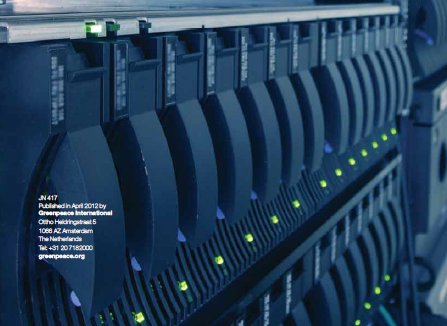
The engine that drives the cloud is the data center. Data centers are the factories of the 21st century information age, containing thousands of computers that store and manage our rapidly growing collection of data for consumption at a moment’s notice. Given the energy-intensive nature of maintaining the cloud, access to significant amounts of electricity is a key factor in decisions about where to build these data centers. Industry leaders estimate nearly $450bn US dollars is being spent annually on new data center space.
Since electricity plays a critical role in the cost structure of companies that use the cloud, there have been dramatic strides made in improving the energy efficiency design of the facilities and the thousands of computers that go inside. However, despite significant improvements in efficiency, the exponential growth in cloud computing far outstrips these energy savings.
How much energy is required to power the ever-expanding online world? What percentage of global greenhouse gas (GHG) emissions is attributable to the IT sector? Answers to these questions are very difficult to obtain with any degree of precision, partially due to the sector’s explosive growth, a wide range of devices and energy sources, and rapidly changing technology and business models. The estimates of the IT sector’s carbon footprint performed to date have varied widely in their methodology and scope. One of the most recognized estimates of the IT sector’s footprint was conducted as part of the 2008 SMART 2020 study, which established that the sector is responsible for 2% of global GHG emissions.
The combined electricity demand of the internet/cloud (data centers and telecommunications network) globally in 2007 was approximately 623bn kWh (if the cloud were a country, it would have the fifth largest electricity demand in the world). Based on current projections, the demand for electricity will more than triple to 1,973bn kWh (an amount greater than combined total demand of France, Germany, Canada and Brazil).
The report indicates that, due to the economic downturn and continued energy efficiency and performance improvements, global energy demand from data centers from 2005-2010 increased by 56%. Estimates of data center electricity demand come in at 31GW globally, with an increase of 19% in 2012 alone. At the same time global electricity consumption is otherwise essentially flat due to the global recession is still a staggering rate of growth.
Given the scale of predicted growth, the source of electricity must be factored into a meaningful definition of “green IT”. Energy efficiency alone will, at best, slow the growth of the sector’s footprint. The replacement of dirty sources of electricity with clean renewable sources is still the crucial missing link in the sector’s sustainability efforts according to the report.
The global telecoms sector is also growing rapidly. Rapid growth in use of smart phones and broadband mobile connections mean mobile data traffic in 2011 was eight times the size of the entire internet in 2000. It is estimated that global mobile data traffic grew 133% in 2011, with 597 petabytes of data sent by mobiles every month. In 2011, it is estimated that 6 billion people or 86.7% of the entire global population have mobile telephone subscriptions. By the end of 2012, the number of mobile connected devices is expected to exceed the global population. Electronic devices and the rapidly growing cloud that supports our demand for greater online access are clearly a significant force in driving global energy demand.
What about telecoms in the developing and newly industrialized countries? The report has some details from India (by the way it is expected that India will pass China to become the world’s largest mobile market in terms of subscriptions in 2012). Much of the growth in the Indian telecom sector is from India’s rural and semi-urban areas. By 2012, India is likely to have 200 million rural telecom connections at a penetration rate of 25%. Out of the existing 400,000 mobile towers, over 70% exist in rural and semi-urban areas where either grid-connected electricity is not available or the electricity supply is irregular. As a result, mobile towers and, increasingly, grid-connected towers in these areas rely on diesel generators to power their network operations. The consumption of diesel by the telecoms sector currently stands at a staggering 3bn liters annually, second only to the railways in India.
What is the case on other developing and newly industrialized countries? I don’t actually know.
NOTE: Please note that that many figures given on the report are just estimates based on quite little actual data, so they might be somewhat off the actual figures. Given the source of the report I would quess that if the figures are off, they are most probably off to direction so that the environmental effect looks bigger than it actually is.
1,274 Comments
Tomi Engdahl says:
Dave Kesler “If data centers use water for cooling that means the same volume of water goes in a pipe at one end and out the other. Yes, it’s going to be some degree warmer but it doesn’t dissappear.”
There are some data centers that use the method you described. They use river/lake/sea water for cooling like that. This type of data centers are minority in USA.
Most data centers in USA do not work like that.
Old evaporative cooled data centers (those whic use lots of water) vaporize most of the water they take it. It goes to the sky where it comes back down about week later typically few hundred mails away. Same happens to water used for growing crops and when you water your lawn.
Many new data centers use closed loop cooling where pipes are filled once (few swimming pools of water) and that same water circulates on the data center for few years. After that it might need to be replaced with new water (and old water needs to be cleaned/ treated).
“Is the location such that the water can’t be used downstream for the ag land or is there another concern I’m missing?”
For the cooling method you described to work a lot of water needs to go through (practically need to be river,lake or sea) and you need permission to retuns that water somewhat hotter back.
Tomi Engdahl says:
Yes, there are data centers in and around Corpus Christi, Texas, and the area is seeing major investments in AI infrastructure.
While historically the region hosted modest telecom and regional facilities, massive hyperscale and edge facilities have recently expanded into the area.
https://www.facebook.com/share/p/1EQUGE4Wre/
Corpus Christi, Texas, stands on the brink of becoming the first modern American city to exhaust its municipal water supply, offering a stark global warning about the intersection of climate pressures, industrial demand, and delayed infrastructure.
Prolonged drought has left its primary reservoirs, Lake Corpus Christi and Choke Canyon, at critically low levels, often below ten percent capacity.
Officials project a Level 1 drought emergency as early as this year, defined as the point when demand exceeds supply for 180 consecutive days, with possible shortages by 2027 if rains fail to materialize.
Heavy industrial consumption compounds the problem. Petrochemical and plastics facilities, including a major joint venture plant, draw millions of gallons daily—far outstripping residential use—while supporting the region’s role as a key energy export hub.
Residential restrictions already limit outdoor watering, yet broader cuts risk economic disruption. Plans for a large seawater desalination plant remain delayed by funding and permitting hurdles, leaving limited short-term options.
This situation mirrors near-misses like Cape Town’s 2018 crisis and underscores how megadroughts, population growth, and over-allocation of resources threaten cities worldwide.
Without aggressive conservation, diversified supplies, and prioritization of essential needs, similar shortages could cascade across arid and industrial regions, disrupting economies and daily life far beyond Texas.
Source: WIRED, “The American Water Crisis Is Here” (May 2026).
Tomi Engdahl says:
By choosing closed-loop liquid cooling + dry heat exchangers over evaporative cooling, the facility protects the local municipal water supply. However, this shifts the thermal burden entirely onto electricity consumption, requiring higher fan and chiller power on hot Texas summer days—which is why securing a 1 GW dedicated grid interconnection was a prerequisite before breaking ground.
Tomi Engdahl says:
Currently, data centers account for less than 1% (estimated around 0.1% to 0.5%) of Corpus Christi’s total municipal water draw.
Tomi Engdahl says:
https://www.facebook.com/share/p/1CD9J74MCF/
America’s largest underground water source is steadily running dry.
Reports show that the massive High Plains Aquifer, famously known as the Ogallala, is rapidly depleting. Analysts say that groundwater is currently being extracted much faster than natural rainfall can replenish it. This critical collapse across eight states threatens to eliminate the nation’s vital irrigation buffer, triggering severe crop losses and surging consumer food prices nationwide.
#photography #environment #agriculture
References:
Newsweek: The Largest US Groundwater Supply Is Running Out
Scientific American: Draining the Ogallala Aquifer and the Future of American Farming
USGS: Groundwater Depletion and Water Level Changes in the High Plains
Tomi Engdahl says:
https://www.facebook.com/share/p/1BwLdwQg4V/
Amazon’s global data centers used approximately 2.5 billion gallons of water in 2025, marking the company’s first public disclosure of its total annual data center water use. That amount is roughly equivalent to 3,800 Olympic-sized swimming pools.
Across more than 900 data center facilities in over 50 countries, Amazon primarily uses outside air for cooling and relies on water-based cooling during hotter periods to keep servers operating safely. Despite expanding its infrastructure, the company reported a 2% reduction in water withdrawals at the facilities it directly owns and operates compared with 2024, citing more efficient cooling technologies and its goal of becoming water positive by 2030.
The announcement comes as governments and local communities increasingly examine the environmental impact of rapidly growing data centers. While Amazon emphasizes improvements in water efficiency, researchers and policymakers continue to highlight that water demand can place significant pressure on communities located in drought-prone or water-stressed regions, making transparency and local reporting increasingly important.
As AI and cloud computing continue to expand, discussions about balancing technological growth with responsible water management are likely to become even more important.
Images are generated by AI and for demonstration purposes only.
Source: Bhutani, A. (2026). Amazon Says Its Data Centers Used 2.5 Billion Gallons of Water in 2025. The Wall Street Journal.
#Amazon #AWS #DataCenters #ArtificialIntelligence #CloudComputing #Sustainability #WaterConservation #Technology #Environment #Climate #Innovation #fblifestyle
Tomi Engdahl says:
How Sealed Liquid Cooling WorksData systems handle water cooling by dividing the process into isolated loops:The Internal Loop (Sealed): Purified water or specialized coolant is filled into a completely airtight system just once during construction. This fluid is pumped through sealed piping directly to metal plates attached to the computer chips (direct-to-chip cooling) to absorb heat.The External Loop (Heat Rejection): The hot fluid travels to a heat exchanger or outdoor “dry coolers”. Outdoor fans blow air over the sealed radiator pipes to release the heat into the atmosphere, cooling the water back down without allowing any of it to evaporate or escape.Recirculation: The cooled liquid is pumped straight back to the servers to repeat the cycle indefinitely.
Tomi Engdahl says:
https://www.facebook.com/share/p/1GEucNbek6/
Microsoft has reported significant water consumption associated with cooling its global network of data centres, reflecting the growing resource requirements of cloud computing and artificial intelligence.
Many technology companies are now investing in advanced cooling technologies, including closed-loop systems, recycled water, liquid cooling, and air-cooled designs, to reduce freshwater use while maintaining reliable operation of high-performance computing equipment.
Improving water efficiency has become a major sustainability priority as AI computing capacity continues to expand worldwide.
#Microsoft #DataCenters #WaterConservation #ArtificialIntelligence #Sustainability
Tomi Engdahl says:
USA
https://www.facebook.com/share/p/1GEucNbek6/
All these issues have answers. The technology is available to mitigate these issues. Why is our leadership at every level incompetent to be able to write rules, laws, R regulations, covenants, you name it. Where is our leaders ? Data centers didn’t just happen yesterday, or even the day before, they’ve been being built for several years now and Without any regulation, and that’s why all these problems have arisen and taken on a no, no, no attitude from all the chicken littles . After the fact is not the time to get excited or concerned , it’s before .That’s why it’s a participatory form of governance that we live under. Dah !
Tomi Engdahl says:
Nationally, U.S. golf courses use significantly more water than data centers, with golf consuming roughly 2 billion gallons per day compared to data centers’ estimated 449 million gallons per day. However, data center water use is growing rapidly due to artificial intelligence, while golf usage remains flat.
Tomi Engdahl says:
It sounds like a silver bullet—bury loops of pipe in the ground, fill them with glycol/antifreeze, and dump server heat directly into the cool earth year-round with zero water loss.
While ground-source (geothermal) loop systems work exceptionally well for homes, schools, and small commercial buildings, forcing megawatt-scale data centers to use closed-loop underground piping runs into massive physical, thermodynamic, and geological bottlenecks.
For a home or office building, ground cooling works because the heat load is seasonal. In the summer, you dump heat into the dirt; in the winter, you pull that heat back out to warm the building. The ground gets time to rest and thermally equalize.
A data center is a 24/7/365 thermal blowtorch.
Instead of burying pipes underground where heat gets trapped, modern data centers achieve zero-water cooling through two alternative methods:
Air-Assisted Dry Coolers (Radiators): Dumping heat into the outdoor atmosphere via large fan-coils. Air doesn’t get “thermally saturated” like solid rock because the wind continuously sweeps hot air away.
Waste Heat Capture (District Heating): Instead of dumping heat into the ground or air, data centers in Europe (e.g., Finland, Sweden, Denmark) funnel their hot water loops into municipal district heating grids. The servers heat local homes and tap water during winter, turning a waste problem into useful energy.
Tomi Engdahl says:
Lets all be realistic, A.I. / data centers are, and will be, a major part of our existence and a natural part of the engineering evolution of human beings going back to the “wheel” so, lets try to get it right. 1. Use liquid nitrogen. Cryogenic cooling system can be made to work for this application. 2. Use sea water. Climate scientists state the warming of the planet will soon melt the polar ice caps and coastal cities will disappear…so we better get busy finding a use for all this water. 3. If you disagree with #2, then lets build these data centers at the polar ice caps– The Arctic and Antarctica. When Quantum computing data centers come to fruition…. that will generate a massive amount of heat and will need even more cooling… also the water is maintained in closed loop systems…. one last point.. The possessive (ownership) spelling of the word “brain” depends on whether you mean one brain or more than one: brain’s for one owner, or brains’ for multiple owners. Can we drop the extra unnecessary “S” above? thanks
Tomi Engdahl says:
“Lets all be realistic, A.I. / data centers are, and will be,”
Agreed.
“1. Use liquid nitrogen. Cryogenic cooling system can be made to work for this application.”
While it is true that cryogenic systems can be made to physically circulate liquid nitrogen or run closed cryogenic refrigeration loops, claims that cryogenic cooling solves scale data center cooling ignore fundamental thermodynamics, power requirements, and hardware physics.
There is a huge difference between a system being technically engineered to function and it being viable as a primary cooling strategy for a 100 MW+ server facility.
The most common oversight with this idea is ignoring the massive energy required to produce cryogenic temperatures in the first place.
Result: Using liquid nitrogen/cryogenics as the primary cooling loop would triple or quadruple the total power consumption of a data center.
While cryogenic \text{LN}_2 cooling is completely non-viable as a primary, continuous data center cooling system, it has two legitimate niche uses:
Emergency Off-Grid Backup Cooling: If a power outage cuts electricity to primary pumps and chillers, pressurized liquid nitrogen tanks can be discharged into heat exchangers without requiring grid power. It acts as a short-term “thermal fuse” to keep critical hardware from melting while servers undergo a safe, controlled shutdown.
Quantum Computing Labs: Quantum processors (like superconducting qubits) require temperatures near absolute zero (0.015\text{ K}) to maintain quantum coherence.
(To actually run chips at cryogenic temperatures, you would need specialized Cryo-CMOS or superconducting circuits—technology currently limited to quantum computing labs, not commercial AI clusters.)
Even if a facility used an open “boil-off” system (purchasing liquid nitrogen in bulk and letting it evaporate to carry away heat):
Volumetric Supply: A single 100 MW data center would consume over 500,000 liters of liquid nitrogen every single day. The global industrial gas supply chain cannot manufacture or transport that volume to server farms continuously.
“2. Use sea water.”
Sea water can be used for cooling in several ways
“3. If you disagree with #2, then lets build these data centers at the polar ice caps– The Arctic and Antarctica.”
No need to go so far from sivilization. Cold climate in Scandinavia works well for data centers.
“also the water is maintained in closed loop systems….”
Yes.
Tomi Engdahl says:
https://www.facebook.com/share/p/1PaaPyVAHg/
But why should ordinary people potentially sacrifice WATER so billion-dollar corporations can keep millions of servers running?
We’re not talking about some luxury resource.
We’re talking about WATER.
The same water coming into people’s homes.
The same resource farmers depend on.
The same resource our children and grandchildren will depend on.
And depending on the cooling system, some data centers can consume substantial amounts of water, especially through evaporative cooling. On top of that, the electricity needed to operate these facilities has its own water and environmental footprint.
Then people wonder why communities are starting to ask questions.
You want me to take shorter showers.
You want people watering their lawns less.
You tell farmers they need to conserve.
You tell everybody climate change and drought mean we need to protect freshwater.
But when a corporation shows up talking about a billion-dollar data center suddenly everybody starts whispering?
HELL NO.
If water is precious when I’M using it, then water needs to be precious when CORPORATIONS are using it too.
And here’s where people need to be careful with the phrase “making the water dirty.”
Not every data center simply takes drinking water, contaminates it, and dumps poisonous water back into the environment. That’s too broad and makes the argument easier to dismiss.
The stronger argument is this:
Industrial cooling can create wastewater or concentrated discharge that has to be properly managed, while evaporative systems can consume water altogether by sending it into the atmosphere. Water treatment chemicals, mineral buildup, blowdown water and the temperature of discharged water can also create environmental-management issues depending on the facility and system.
THAT deserves scrutiny.
Because corporations shouldn’t get to privatize the benefits while communities inherit the environmental costs.
If you’re making billions from AI, then BUILD THE DAMN INFRASTRUCTURE.
Recycle your cooling water.
Use reclaimed/non-potable water wherever practical.
Invest in closed-loop systems.
Develop cooling technologies that minimize freshwater consumption.
Treat wastewater properly.
Show the public exactly how much water you’re withdrawing, how much you’re consuming, where it’s coming from, what’s being discharged and what’s in that discharge.
And if the technology required to protect the community costs more money?
GOOD. PAY FOR IT.
That’s part of doing business.
Don’t build the most technologically advanced computers humanity has ever created and then tell me the best solution you came up with for cooling them requires putting additional pressure on the same freshwater resources humans need to survive.
That’s not futuristic.
That’s primitive with a motherboard attached to it.
And don’t come into struggling communities waving jobs and tax revenue around like that means residents shouldn’t ask questions.
How many permanent jobs?
How much water?
How much electricity?
Who pays for infrastructure upgrades?
What happens during drought?
What happens if residential demand grows?
What happens to farmers?
What happens to groundwater?
Where does the wastewater go?
What chemicals are being used?
Who’s testing the discharge?
Who’s monitoring the aquifer?
And most importantly:
WHO GETS PRIORITY IF THERE ISN’T ENOUGH WATER?
Because THAT is the conversation communities should be having BEFORE these facilities are built.
I support technology.
I support AI.
I support innovation.
But I don’t support treating communities like sacrifice zones so some of the richest corporations on Earth can build infrastructure as cheaply as possible.
If you’re building a $1 BILLION facility, don’t tell a working-class community that protecting its water supply is somehow too expensive.
Find another cooling method.
Build better treatment infrastructure.
Recycle the water.
Use reclaimed water.
Spend the money.
FIGURE IT OUT.
You’re literally building ARTIFICIAL INTELLIGENCE.
Use some intelligence.
Because technological advancement that destroys or unnecessarily strains the natural resources keeping human beings alive isn’t advancement.
It’s exploitation dressed up as innovation.
And there needs to be one rule that doesn’t change whether you’re talking about a homeowner, farmer, factory or trillion-dollar technology corporation:
PEOPLE SHOULD NEVER HAVE TO COMPETE WITH COMPUTERS FOR CLEAN WATER.
Tomi Engdahl says:
The US has had major data centers for 30+ years now.
uhh we’ve had them for over 80 years. So yeah we needed them before. If you really cared that much you wouldn’t be on facebook.
Tomi Engdahl says:
The transition of data centers into major water consumers—and their subsequent shift toward closed-loop systems—followed two distinct phases driven by thermodynamics, power costs, and AI hardware density.
Phase 1: Why & When Data Centers Chose High Water Usage (2006–2020)
In the early days of corporate IT (1990s–early 2000s), small server rooms relied almost entirely on mechanical air chillers. While air cooling consumed no water, it consumed vast amounts of electricity.
The Shift to Water (2006–2010)
As cloud computing exploded, tech giants began constructing massive “hyperscale” facilities. To cut electricity bills and improve energy metrics, operators turned to open-loop evaporative cooling towers and direct evaporative air systems.
The Physics Advantage: Evaporating water absorbs thermal energy far more efficiently than blowing dry air. Evaporating a single gallon of water removes roughly 8,000\text{ BTUs} of heat.
The Result: Between 2007 and 2020, water-intensive cooling became the global gold standard for hyperscalers. Facilities in Oregon, Iowa, Virginia, and Georgia each began drawing 1 to 5 million gallons of freshwater daily to evaporate heat into steam.
Phase 2: When & Why the Trend Shifted to Closed-Loop Systems (2021–2026)
The preference shifted away from open-loop evaporation toward closed-loop liquid cooling in two stages between 2021 and 2026.
Step 1: Community Backlash & Water-Positive Pledges (2020–2022)
Around 2020–2022, severe droughts in the U.S. West and Europe triggered intense local political pushback against multi-million-gallon daily water permits.
Step 2: The AI Heat Density Wall (2024–2026)
The rapid deployment of generative AI GPUs (such as NVIDIA Blackwell arrays) rendered open-loop air/evaporative cooling physically obsolete for new builds:
Heat Density Spike: Legacy cloud server racks drew 5\text{–}15\text{ kW} of power. Modern AI server racks draw 40\text{–}100+\text{ kW}, generating heat levels too intense to dissipate with evaporative air streams.
Closed-Loop Standardization: Between 2024 and 2026, hyperscalers (Microsoft, Oracle, Meta, AWS) standardized on closed-loop direct-to-chip liquid cooling and dielectric immersion tanks.
Zero Evaporative Loss: Fluid circulates through sealed copper cold plates or tanks, absorbs component heat, passes through a closed heat exchanger, and recirculates endlessly. Once filled during construction, these systems consume near-zero ongoing water.
Tomi Engdahl says:
Terry Barger
Claim 1: “Water vapor is a hazard / cause of global warming”
The Reality on Global Warming: Water vapor (H2O) is technically a greenhouse gas, but it does not drive global warming on its own.
Why It Works Differently: Carbon dioxide (CO2) and methane (CH) stay in the atmosphere for decades to centuries. Water vapor, however, has a very short residence time in the atmosphere (around 9 to 10 days) before falling out naturally as rain or snow via the hydrologic cycle.
Claim 2: “Hydrogen is what about 90% of AI data centers use for power”
The Reality on Data Center Power: 0% (or effectively near zero) of standard AI data center operations run on hydrogen as their main power source.
What Data Centers Actually Use: Data centers draw power directly from local electrical grids, which are fed by a mix of natural gas, coal, nuclear, solar, wind, and hydro.
Where Hydrogen Fits In: Tech companies are experimenting with hydrogen fuel cells strictly as backup generators (to replace emergency diesel generators) or for small-scale pilot projects.
Tomi Engdahl says:
“Millions of gallons of water used when water is drying up faster than it is replenished.”
Water is drying up faster than it is replenished is a true situation in many parts of USA. Data centers in USA make a tiny part in increasing this problem overall. Data centers use around 0.2% of the water overall in USA.
…where that 0.2% macro-statistic completely masks severe local crises.
While it is statistically true that data centers account for a tiny fraction of national freshwater consumption—dwarfed by agriculture (~40%) and thermoelectric power generation (~40%)—water stress is never experienced at a national average. Water is hyper-local, and the localized impact of data center operations creates major friction for three main reasons:
1. The “Straw in a Small Cup” Problem
A single hyperscale data center using evaporative cooling can consume 1 to 5 million gallons of water per day—roughly the daily water usage of a town with 10,000 to 50,000 residents.
When a multi-building cluster lands in a rural or suburban county, it isn’t pulling from a national water supply; it is tapping into a single local aquifer or municipal watershed. In smaller utility basins, one facility can instantly become the single largest water consumer in the entire county.
2. Geographic Clustering in Drought Zones
Data center developers traditionally select sites based on cheap power, fast fiber access, low land costs, and tax incentives—not water availability. As a result, hundreds of facilities have been built in inherently dry or drought-stricken region.
The American Southwest (Arizona, Utah, West Texas): Facilities in places like Mesa, Arizona, or Pecos County, Texas, draw millions of gallons of groundwater from severely depleted desert aquifers.
Georgia & South Carolina: Rapid expansion in the Southeast has put data centers in direct competition with local agriculture for surface water during summer heatwaves.
Northern Virginia: In Loudoun and Prince William counties (which host over 300 data centers), annual water withdrawals for cooling spiked into billions of gallons, straining regional river basins.
3. Consumptive Loss vs. Recirculated Use
When a household or standard commercial building uses water, most of it goes down the drain, travels to a municipal wastewater plant, and is treated and returned to the local river or aquifer.
In contrast, evaporative data center cooling is almost 100% consumptive loss. The water is sprayed over cooling coils and evaporated into the atmosphere as steam. That water is lost from the local watershed entirely, meaning it never flows back into local wells or downstream reservoirs.
While data centers are not the primary driver of national water depletion, placing a high-consumption evaporative facility inside a drought-stressed local water basin creates an immediate tug-of-war between tech operations, local farming, and residential drinking water supplies.
Check out Why data centers are eating up enormous water resources
https://youtu.be/cl1ctf1_JxE?is=uwWsXMruVSISdjw5
Tomi Engdahl says:
Bitch all you want, but you’re gonna LOSE this battle!!!
AI is here to stay, and, will only get bigger, better and stronger.
We (US) need this technology for National Security, and the incredible possibilities and advancements in the our overall healthcare system.
Too, we (US) MUST stay ahead of ALL our enemies in this endeavor.
AI and drones…futuristic shit, but it’s HERE, and we need to regulate it.
Tomi Engdahl says:
Across the United States, golf courses consume vastly more water nationally than data centers—roughly 5 to 10 times as much on an aggregate national basis.
However, the way they use that water, where they draw it from, and how it impacts local communities differ significantly.
Tomi Engdahl says:
Jonathan Moedt yeah designing a mechanical system for a data center is not super complex, but it’s way more complex to the lay men who’s not trained to do it.
So they come up with all these crazy assumptions and idea ideas about how it works and have decided that data centers are going to drain us of all of our water
Erin Brockovich was just on Theo Von and I was disgusted listening to her talk about data center water usage like she knew what she was talking about and everybody was just gobbling that up.
It just pisses me off.
Spoiler: we’ve been using closed loop in our designs for a very long time and it has been the preferred and extremely popular use for at least the past eight years
Matt Corbitt most people have been fed a lie….. maybe the old ones worked like steam engines, but the new ones are similar to the radiator in a car.
Jonathan Moedt to be clear I said “Gallons” not liters. All the data centers in the uk alone that are not closed loop or air/ gas cooled use around 680 million “liters” every day. That is more then all the cattle drink daily in the uk. Which to me is a massive amount of water. For me I would get rid of them all and have this conversation in the pub. Even though I have to have a smart phone to exist and work in the world today, it’s not needed and all by design. I would happily ditch my smart phone and laptop if I had one and go back to paper and managing our forest plantations which we don’t anymore. Also, you say rivers. All the data centers (that use it) take there water from reservoirs which are not getting filled by rivers or rain as it all comes in winter these days. Yes they need to catch more rain in winter but that is not happening any time soon.
Matt Corbitt I helped build 2 in the Netherlands in the past 3 years that are not closed loop the smaller one uses 300,000 gallons of fresh water every day and the other one is 3 times the size. There are 520+ data centers in the UK together they use around 170 million gallons of fresh water every single day. Only about 180 of these are closed loop and each of these use around 100,000 gallons a year so not truly closed loop. Everyone needs to wake up to what is going on like yesterday as they all need to be shut down. There are over 100 more data centers planned to be built in the uk alone in the next 2 years and only a handful of these will be closed loop.
Jonathan Moedt I helped build 2 in the Netherlands in the past 3 years that are not closed loop the smaller one uses 300,000 gallons of fresh water every day and the other one is 3 times the size. Out of the 520+ data centers together they use around 170 million gallons of fresh water a day. Only about 180 of these are closed loop and they still use around 100,000 gallons a year so not truly closed loop. Everyone needs to wake up to what is going on like yesterday as they all need to be shut down. There are over 100 more data centers planned to be built in the uk in the next 2 years and only a handful will be closed loop.
Source: https://www.facebook.com/share/p/1F9zPMPNzA/
Tomi Engdahl says:
Out of all the water on Earth, less than 1% is naturally accessible, fresh, and safe (or easily treatable) for humans to drink.
Key Data Points
97.5% is Salt Water: Oceans, gulfs, and saline seas contain almost all the water on Earth—completely undrinkable without energy-intensive desalination.
2.5% is Fresh Water: This is the total amount of non-saline water on Earth.
Most Fresh Water is Locked Up:
~68.7% is frozen solid in ice sheets, glaciers, and permafrost (mostly in Antarctica and Greenland).
~30.1% is buried underground as groundwater—much of it too deep, polluted, or expensive to pump out.
The Final “Drinkable” Slice (~0.5%–0.8%): Only about 1.2% of all fresh water exists on the surface in lakes, rivers, and swamps.
Tomi Engdahl says:
https://www.facebook.com/share/p/1EHizLSa69/
A Massive Data Center Coming to Your Town Could Either Lower Taxes or Increase Your Bills — The Difference Is in the Deal
The AI boom is driving a global race to build more data centers, but the impact on local communities depends on the agreements made before construction begins.
These facilities can bring billions of dollars in investment and generate huge amounts of tax revenue without adding the same demand for schools, housing, and public services that comes with traditional development.
In places like Loudoun County, Virginia, data centers have become a major source of government revenue, helping fund schools, roads, and public programs while reducing pressure on homeowners.
But the benefits are not automatic.
Data centers require enormous amounts of electricity and water. They can demand new power infrastructure, upgraded roads, emergency planning, and environmental protections. If those costs are shifted onto residents, household utility bills and taxes could rise instead of falling.
That is why local governments are negotiating tougher agreements with developers — requiring companies to fund infrastructure improvements, support education, create local jobs, and protect residents from unexpected costs.
The key factor is not whether a community builds a data center. It is whether the community has a strong enough deal before the servers start running.
A smart agreement can turn an AI facility into a source of lower taxes and better services. A weak agreement can leave residents paying the price for the technology powering the future.
Tomi Engdahl says:
When water evaporates in a data center’s cooling tower, it changes from a liquid to a gas (water vapor) and escapes into the outdoor atmosphere.
Into the Natural Water Cycle: The vapor joins the global hydrologic cycle. Within 9 to 10 days, it condenses, forms natural clouds, and falls back to Earth somewhere else as rain or snow.
Tomi Engdahl says:
Why It Is Lost from the Local Watershed
Even though the water isn’t “destroyed” (it stays on Earth), it is 100% lost from the local city or river that supplied it.
Unlike a home sink or toilet—where used water goes down the drain to a local wastewater plant and gets returned to the nearby river or aquifer—evaporated water blows away on atmospheric winds and usually falls as rain hundreds or thousands of miles away.
Tomi Engdahl says:
Adiabatic cooling is essentially a smart, hybrid approach that uses water only when it is absolutely necessary.
Instead of constantly spraying or evaporating millions of gallons of water in open cooling towers year-round, adiabatic systems default to dry cooling (using outdoor air currents) and only turn on water misting during peak heat spikes.
Adiabatic cooling is essentially a smart, hybrid approach that uses water only when it is absolutely necessary.
Instead of constantly spraying or evaporating millions of gallons of water in open cooling towers year-round, adiabatic systems default to dry cooling (using outdoor air currents) and only turn on water misting during peak heat spikes.
Here is how it slashes water consumption by 60% to 90% compared to traditional open evaporative towers:
Dry Mode (Most of the Year): For the vast majority of the year, the system acts like a massive car radiator. Fans pull outside air across closed metal coils containing server coolant. No water is used at all.
Adiabatic Mode (Hot Summer Days): When ambient air temperatures get too hot for dry air alone to cool the coils, the system turns on fine misting nozzles or wets an absorbent mesh pad in front of the air intake.
Pre-Cooling the Air: The incoming hot air passes through the wet pad/mist, causing a quick flash evaporation that lowers the air temperature before it hits the heat exchanger coils.
Why It Minimizes Water Loss
Seasonal Efficiency: Traditional evaporative towers run wet almost constantly. Adiabatic systems typically operate “dry” 70% to 90% of the year, reserving water strictly for high summer heatwaves.
High-Density Compatibility: It pairs seamlessly with closed-loop server-level fluid systems. The internal server coolant stays completely sealed, while the external adiabatic unit handles heat rejection to the atmosphere with minimal water draw.
https://datacenters.microsoft.com/wp-content/uploads/2023/05/Azure_Modern-Datacenter-Cooling_Infographic.pdf?hl=en-US#:~:text=IDEC%20is%20a%20closed%20system%20that%20circulates,delivers%20cool%20humid%20air%20into%20the%20datacenter.
Tomi Engdahl says:
Calling data centers “drought factories” is a catchy viral slogan, but like most social media memes, it takes a complex regional issue and strips out all nuance.
Why the Label Stick (The Truth Behind the Hype)
Localized Impact: In specific arid places (like Phoenix, Arizona, or parts of Utah), dropping a giant evaporative cooling facility into a high-drought zone does put severe pressure on local aquifers. Calling an evaporative cooling tower in a desert a “drought factory” isn’t entirely crazy from the perspective of a local resident watching their well levels drop.
Consumptive Loss: As we covered, evaporative towers turn liquid water into steam that blows away, offering zero direct recharge to the local watershed.
Why the Label is Misleading (The Reality)
Wrong Comparison: Data centers consume roughly 0.1% to 0.2% of U.S. freshwater. Agriculture accounts for ~40% and power generation takes another ~40%. If anything is driving watershed depletion, it’s large-scale crop irrigation in arid climates, not server farms.
The Rapid Architecture Shift: The industry has moved aggressively toward closed-loop direct-to-chip liquid cooling and adiabatic systems. Modern AI campuses built today are filled once and recirculate their fluid endlessly with near-zero ongoing water evaporation.
Use of Effluent: A huge percentage of modern facilities use recycled municipal wastewater (“purple pipe” effluent) that isn’t suitable for drinking anyway, leaving local potable drinking water untouched.
It makes for a dramatic headline, but label-wise, it’s way more about sensationalism than engineering reality.
Tomi Engdahl says:
1. How Many Data Centers Are “Necessary”?
There isn’t a single governing body that sets a quota for data centers; the number built is directly tied to global computing demand.
As of 2026, there are roughly 10,000 to 11,000 data centers worldwide (with about 3,000 to 5,000 in the U.S. alone). Whether they are “necessary” depends on how society uses digital infrastructure
Tomi Engdahl says:
2. Are They Putting Solar Panels on Rooftops?
Yes, but with a major physical limitation: Rooftop solar can only cover a tiny fraction of a data center’s power needs.
How Solar is Actually Used: Tech companies use rooftop solar primarily for administrative offices, lighting, or backup power. To power the actual server floors with solar, hyperscalers sign Power Purchase Agreements (PPAs) with massive off-site solar and wind farms spanning hundreds of acres, feeding green energy directly into the regional grid.
3. Are They Adding Water Filtering & Recycling Systems?
Yes, water treatment and recycling are now standard practices in modern data center engineering.
On-Site Water Recycling & Filtration
Closed-Loop Treatment: In modern closed-loop liquid and immersion systems, the cooling fluid stays trapped inside a sealed loop. Built-in filtration, deionization, and anti-corrosion chemical treatment keep the fluid pure so it can recirculate indefinitely without scaling heat exchangers.
Reclaiming Blowdown Water: Facilities using evaporative or adiabatic cooling collect the unevaporated “blowdown” water, run it through reverse osmosis or filtration units on-site, and cycle it back through the system before final discharge.
Municipal “Purple Pipe” Effluent
Instead of tapping local municipal drinking (potable) water, newer facilities are designed to intake treated municipal wastewater (recycled sewage or industrial runoff).
The data center filters and purifies this non-potable water on-site to a standard where it can safely pass through cooling towers without clogging equipment, keeping drinking water reserves available for the local community.
Tomi Engdahl says:
Google Gemini claims
Industry Data: According to industry audits (such as techUK’s environmental surveys of UK facilities), over 50% of English data center sites are entirely waterless (using air/refrigerants), and roughly 89% operate closed-loop or non-evaporative designs. Evaporative cooling towers are relatively rare in northern Europe compared to hot, dry regions like the American Southwest.
Tomi Engdahl says:
Technically, this claim is true. Every time you send a query through Google—whether a basic web search or an AI-powered request—the processing happens on servers inside a physical data center. Keeping that hardware cool requires water, either directly through on-site cooling or indirectly through power generation.
However, the actual volume of water tied to an individual search is microscopic.
How Much Water Does One Google Query Use?
According to Google’s published data center metrics:
Standard AI / Gemini Query: Uses approximately 0.26 milliliters of water—or roughly 5 drops.
Traditional Keyword Search: Consumes significantly less energy and water than an AI query, coming out to a tiny fraction of a single milliliter.
To put that into perspective, taking a single 5-minute shower consumes about 35,000 to 75,000 mL of water—the equivalent of running hundreds of thousands of Google queries.
Tomi Engdahl says:
While 100,000 gallons sounds huge in a domestic context (it equals about 2 to 3 years of indoor water use for a typical family), in agriculture and forestry, water usage scales drastically.
Vegetables & Crops
Potatoes: ~1,500 lbs (680 kg) [Requires ~66 gal/lb]
Corn (Maize): ~770 lbs (350 kg) [Requires ~130 gal/lb]
Wheat / Flour: ~550 lbs (250 kg) [Requires ~180 gal/lb]
Apples or Oranges: ~1,000 lbs (450 kg) [Requires ~100 gal/lb]
Protein & Dairy
Chicken: ~190 lbs (86 kg) [Requires ~520 gal/lb]
Pork: ~138 lbs (62 kg) [Requires ~720 gal/lb]
Beef: ~55 lbs (25 kg) [Requires ~1,800 gal/lb]
The Takeaway for Food: 100,000 gallons of irrigation water could feed 1 person a vegetarian-heavy diet for roughly 3 to 5 months, or supply a family with fresh vegetables for a season.
Tomi Engdahl says:
1. “A lot of them in low-humidity locations use open-loop evaporative cooling.”
Where this is true: Evaporative cooling (swamp cooling) works best in hot, dry climates like Arizona, Nevada, or Utah. Because dry air has a low wet-bulb temperature, evaporating water into the airstream lowers the temperature drastically with very little electrical power.
The Nuance: The industry built many open-loop evaporative facilities in dry regions specifically to save electricity. However, severe local water scarcity in arid regions has pushed operators toward indirect evaporative systems and adiabatic dry-coolers that restrict water use strictly to the hottest peak hours.
2. “They have to keep the air humid to keep static down also.”
Status: Outdated Myth / Standard Shift.
Historical Context: Years ago, data centers routinely injected steam into server rooms to maintain 45% to 50% relative humidity solely to suppress static electricity (Electrostatic Discharge / ESD).
Modern Engineering Standards: Comprehensive research by ASHRAE (Technical Committee 9.9) and major chipmakers proved that modern server hardware and proper grounding practices (ESD flooring, grounded wrist straps, and IEC standards) prevent static damage even at relative humidity levels as low as 8% to 20%.
The Result: Modern data centers no longer intentionally humidify server halls for static prevention, saving millions of gallons of water and significant energy annually.
3. “It’s crazy how much water and electricity they use.”
The Core Trade-Off: The sheer scale of global data centers does draw immense power and water. However, thermal management is fundamentally an engineering trade-off between the two:
Mechanical Refrigeration (AC / Chillers): Uses zero water, but consumes massive amounts of electricity to run heavy compressors.
Evaporative Cooling: Uses very little electricity, but consumes water through evaporation.
When an operator chooses evaporative cooling in a dry climate, they are usually choosing to lower their strain on the local electrical grid at the expense of using local water supplies. Modern designs try to hit the sweet spot in the middle—using adiabatic closed loops to minimize both power draw and water loss.
Tomi Engdahl says:
Claim
https://www.facebook.com/share/p/1DRn7rRWi2/
Tech companies boast about ”water-neutral” data centers, but they’re hiding a massive water use that is draining local resources in secret.
In a recent report, environmental advocate Erin Brockovich sounded the alarm over a hidden environmental cost of the artificial intelligence boom, revealing that the ‘water-neutral’ and ‘closed-loop’ claims of tech giants obscure a massive ecological reality.
In short, most of the water consumed by a data center never actually touches the facility itself. Instead, it is consumed upstream at power plants generating the immense, 24/7 electricity needed to keep server stacks running.
This indirect water footprint accounts for up to 80 percent of a data center’s total water consumption, representing a massive drain on local aquifers – one that companies are not required to disclose.
This lack of transparency has forced local media and community advocates to resort to legal action just to uncover basic resource consumption figures. In places like The Dalles, Oregon, local journalists had to file public records lawsuits against municipal governments just to bypass corporate non-disclosure agreements and force the release of Google’s water usage data.
As tech companies continue to build massive data center campuses across the United States, communities are increasingly left in the dark, bearing the regional costs of depleted water supplies and rising utility bills without ever being given the full picture of the industry’s environmental footprint.
source: Brockovich, E., & Boothby, S. (2026). The Data Center Water Secret. The Brockovich Report.
Tomi Engdahl says:
David Attenborough: “We survived thousands of years before data centers existed. Clean water, however, has always been essential.”
Tomi Engdahl says:
While individual data center buildings account for roughly 1% to 1.5% of world power consumption (about 0.5% to 1% of global emissions), when you combine data centers with the broader internet infrastructure (telecom networks, fiber lines, end-user devices), the digital carbon footprint is virtually identical to that of the entire global airline fleet.
While aviation moves atoms and data centers move bits, both have scaled to a point where they represent roughly equal shares of human environmental impact. However, data centers are growing much faster due to the computing boom, while simultaneously having a much clearer technological path toward zero emissions.
Tomi Engdahl says:
So in other words, Erin Brokovich’s initial claims about water consumption were fraudulent, so she’s restating them to include power generation. Regardless of the source of that power generation.
Tomi Engdahl says:
Data centers do not consume more total water globally than traditional heavy manufacturing or agriculture. The criticism stems from the fact that legacy cooling designs evaporate potable drinking water out of local drought-prone watersheds rather than recycling liquid water back into the local river or aquifer. This is precisely why the computing industry is shifting toward closed-loop systems and dry air-cooling to eliminate operational water loss entirely.
Tomi Engdahl says:
https://blog.google/company-news/inside-google/around-the-globe/google-europe/our-first-offsite-heat-recovery-project-lands-in-finland/
Tomi Engdahl says:
China’s commercial underwater data center deployments—such as the Hainan Subsea Data Center and the Shanghai Lin-gang offshore wind-powered facility—were built specifically to bypass the land, power, and freshwater limitations.
Natural Heat Sink: Water conducts heat away roughly 25 times faster than air. The ocean acts as a vast, free heat sink.
Placing cabins on the seabed reduces onshore land use by more than 90%.
Subsea cables connect the submerged clusters directly to coastal financial and industrial hubs just miles away.
The Shanghai Lin-gang project connects submerged data cabins directly to adjacent offshore wind turbines via subsea composite cables. Over 95% of the data center’s electricity comes directly from local marine wind power, bypassing the heavily congested onshore electrical grid entirely.
Why Isn’t Everyone Doing It Yet?
While Microsoft tested this concept with Project Natick in Scotland (proving servers inside nitrogen-sealed pods fail far less often due to zero oxygen, dust, or humidity), they ultimately shelved it for large-scale commercial expansion.
The main reasons subsea computing remains a specialized engineering challenge include:
Maintenance Complexity: You cannot simply walk in to swap a failed RAM stick or GPU. Maintenance requires lifting entire multi-ton pressure vessels out of the ocean with crane ships.
Corrosion & Marine Growth: Steel hulls require specialized titanium/copper alloys and anti-biofouling coatings to prevent seawater corrosion and barnacle buildup from insulating the heat exchangers.
Tomi Engdahl says:
https://youtu.be/vLtY60-3smw?is=EBjsD-b17LcBpncy
China underwater data center
Tomi Engdahl says:
power plants need water to cool them down. Data centers need water to cool them down. If you want less power plants using water, you have to give up something. What would that be? If you want data centers using less water, what do you have to give up something. What would that be? Cost is an issue. I’m sure you have common sense to know what data centers are needed for. Will you and everyone else more concerned with water usage vs everyday data usage stop using what data centers are needed for? That part gets skipped over.
Tomi Engdahl says:
if you want to stop data centers and Facebook and meta are a part of it you need to stop Everyday digital tools and items like smartphones, streaming devices, and online banking apps require data centers to function. Without remote data centers, these popular consumer products would lack the processing power, storage, and internet connection they need to operate.Common Products and Items That Need Data CentersSmartphones and Tablets: Rely on data centers for cloud backups, app downloads, software updates, and maps.Smart TVs and Streaming Boxes: Use data centers to stream movies, TV shows, and music in real time.Smart Home Devices: Connect to data centers so you can control smart lights, thermostats, and security cameras from anywhere.Video Game Consoles and PCs: Need data centers for online multiplayer matches, digital game purchases, and cloud saves.Credit Cards and Payment Apps: Depend on data centers to instantly verify and process financial transactions.
Tomi Engdahl says:
If every single data center in the world dumped 100% of its heat into the ocean, the overall global ocean temperature increase would be immeasurably tiny—less than 0.0000004°C per year.
Global data centers consume roughly 565 Terawatt-hours (TWh) of electricity annually. Because nearly all electrical energy supplied to chips eventually converts into heat.
Even if computing demand surges to 1,200 TWh by 2030, the total global warming of the oceans from all server heat combined would still be less than 0.000001°C (one micro-degree) per year.
While the global ocean wouldn’t notice, local coastal ecosystems definitely do.
Thermal Discharge Plumes: Where the warm water exits a facility’s heat exchanger, water temperatures in the immediate vicinity (within tens to hundreds of meters) can be 1°C to 3°C warmer than surrounding waters.
Natural Dissipation: Tides, deep sea currents, and atmospheric heat exchange quickly dilute the heat plume across broader coastal waters.
Summary
Globally, the oceans are far too massive for human computing heat to move the needle on temperature. The engineering challenge for seawater cooling is purely local: ensuring warm discharge pipes diffuse their heat quickly enough to prevent localized environmental impacts near the coast.
Tomi Engdahl says:
Datacenters host or process our electronic medical records, diagnostic imaging, prescription systems, banking transactions, credit card payments, investment accounts, payroll, tax filings, insurance claims, phone calls, text messages, emails, contact lists, calendars, cloud storage, photos, videos, streaming media, GPS navigation, real-time traffic congestion, airline reservations, hotel bookings, weather forecasting, emergency dispatch systems, 911 communications, retail inventory, purchase orders, invoices, accounting systems, ERP platforms, manufacturing schedules, CAD drawings, tool-and-die designs, engineering schematics, CNC machine instructions, logistics, warehouse automation, shipping manifests, package tracking, customs documentation, utility billing, electrical grid monitoring, water treatment controls, agricultural systems, university records, legal case files, court scheduling, government services, authentication systems, passwords, software updates, AI models, search engines, social media, websites, domain name systems (DNS), cybersecurity monitoring, backups, disaster recovery, and billions of database transactions every single day.
Tomi Engdahl says:
April Horton The short answer is no, data center evaporative cooling is not altering global weather patterns.
While it is easy to see massive white clouds rising from cooling towers and assume they are changing the climate, the physical scale of human-induced evaporation from computing is far too small to influence atmospheric weather systems.
Natural Evaporation: Every single day, heat from the sun evaporates roughly 1.3 trillion tons (over 300 trillion gallons) of water from Earth’s oceans, lakes, rivers, and forests into the atmosphere.
Global Data Center Evaporation: All global data centers combined evaporate roughly 150 to 300 million gallons of water per day.
Tomi Engdahl says:
“Less than 40% of the Data Centers will use much water”
The Reality: This is broadly accurate.
The vast majority of standard enterprise server rooms and modern closed-loop/dry-cooled facilities use negligible amounts of water.
The heavy water footprint belongs primarily to a subset of hyperscale facilities running open evaporative cooling towers in hot or arid regions.
Tomi Engdahl says:
“Do you really think someone will put a Multi-Billion Dollar Data Center that needs water in a dry area?”
The Reality: Yes, they do—by the dozens.
Places like Mesa (Arizona), Salt Lake City (Utah), West Texas, and Chile’s Atacama Desert are major hyperscale hubs.
Why build in a desert?
Low Humidity Protects Hardware: Dry air reduces condensation and metal corrosion risks on delicate server components.
Maximized Evaporative Efficiency: Desert air has a very low wet-bulb temperature, meaning evaporative cooling towers work exceptionally well there, delivering ultra-low Power Usage Effectiveness (PUE) numbers.
Cheap Land & Power: Desert regions often offer massive tracts of cheap flat land, strong solar potential, and lucrative municipal tax incentives.
Tomi Engdahl says:
“Servers do not go to the bathroom or wash their hands”
The Reality: A bit of humor, but it touches on a crucial engineering distinction:
Human Water Consumption: Domestic municipal water goes down the drain into local sewers, where it is treated and returned to the local watershed.
Evaporative Server Cooling: Water isn’t flushed down a drain—it is turned into atmospheric steam and blown away, removing that liquid completely from the immediate local water table.
Tomi Engdahl says:
“Utilities have been ignored for years… and shifted the blame to Data Centers”
The Reality: There is legitimate truth to this.
Decades of underinvestment in municipal water infrastructure, aging electrical grids, and poor regional water rights management existed long before the AI boom.
When a single massive 100+ MW facility moves into a region, it acts as a stress test that instantly exposes existing infrastructure weaknesses. While data centers add substantial new demand, local utilities and city councils that approved rapid industrial expansion without upgrading local grid/water capacity often use the tech companies as an easy political shield for long-term planning failures.