Aurinkopaneelit tuottavat nyt enemmän sähköä globaalisti kuin ydinvoimalat. Aurinkoenergian kasvuvauhti on ylittänyt kaikki ennusteet ja jatkaa kiihtyvällä kasvu-uralla.
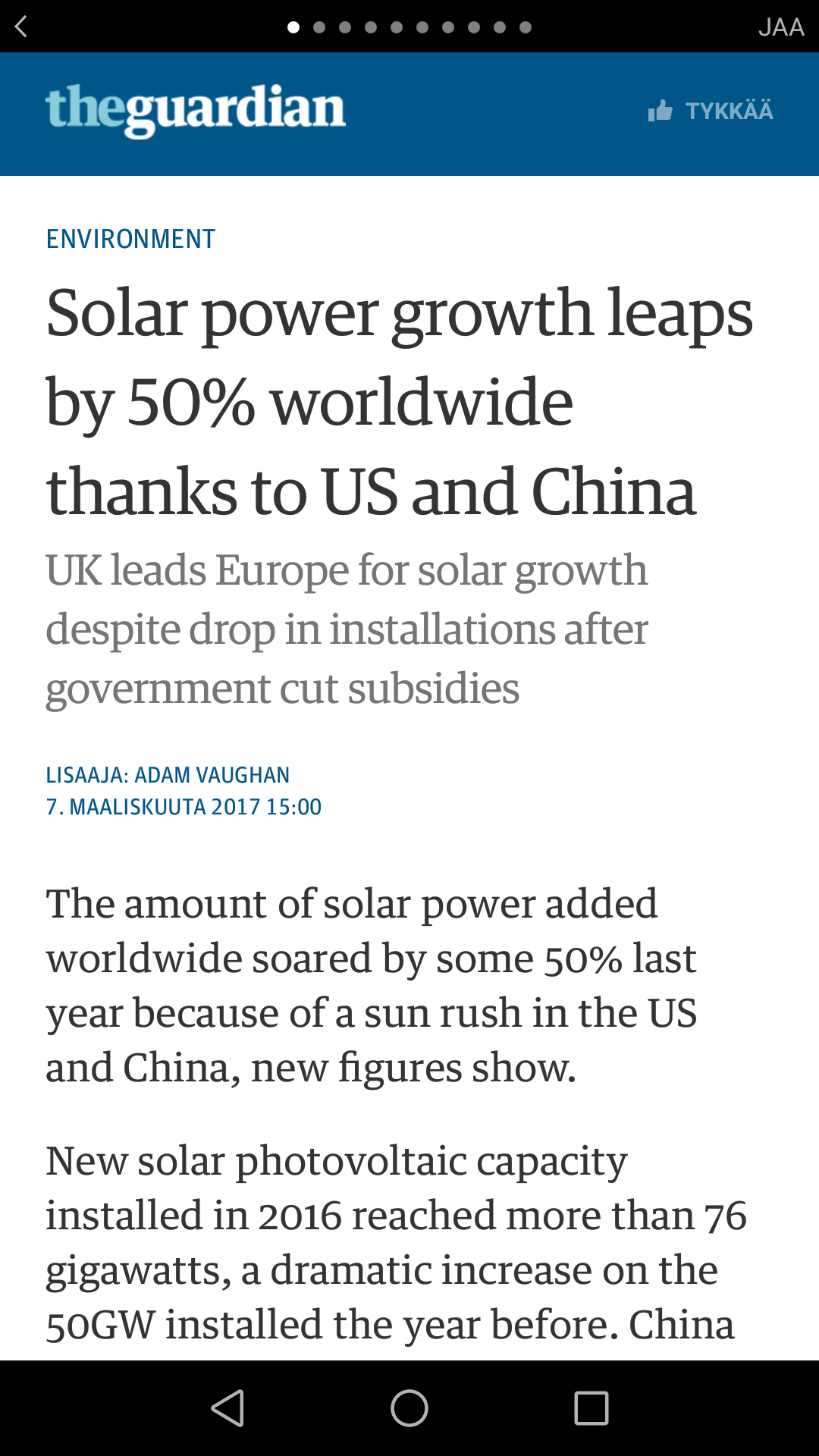
After defying projections, solar’s dramatic growth means it is now overtaking nuclear as a global power source. Here are seven reasons for solar’s success, and where it might go from here.
The world’s solar power is crossing a threshold. A decade ago, it barely registered on a global scale, providing just 1% of the world’s power. In 2026, it will almost certainly increase to 10% of power, and overtake nuclear, a mainstay of electricity since the late 1970s.
Globally, solar electricity generation quietly overtook nuclear power (just) in 2025, according to statistics from UK-based energy think tank Ember. And BBC analysis of Ember data over the past 12 months up to September 2026 shows it clearly outstripping nuclear, producing 13% more power.
“[Solar] generating more electricity than all the world’s nuclear power plants is a pretty insane stat, for sure,” says Dave Jones, co-founder of Ember.
Most solar installers are still fitting external DC isolators.
The industry’s own fire safety guidance says they shouldn’t.RC62 is a 50-page document covering fire safety across the entire solar PV installation — panels, cables, connectors, inverters, the lot.
But buried in Section 5.5.18 is a line that most electricians have missed:”Eliminate the use of DC isolators whenever possible. Many inverters now have integrated isolators.”Why?
Because DC isolators and connectors are widely acknowledged as the highest-risk components for developing faults and fires in solar PV systems.BS 7671 still requires isolation and switching on the DC side, but the IET Code of Practice confirms it can be satisfied by devices built into the inverter itself. If the built-in unit meets BS EN 60947-3, you’re covered.
So why are so many installers still fitting an external one “just in case”?
Full breakdown — including how to verify your inverter’s built-in isolator actually meets the standard — in the first comment
Integral isolators on an inverter are as much use as a hole in a parachute! If the inverter needs to be replaced, how do you safely isolate the DC feed? Electricity at Work Regs (and, hence, the Health and Safety at Work etc Act) requires a suitable method of isolation that eliminates live working. Provision of a **correctly rated** DC switch-disconnector, external to the inverter and capable of interrupting the rated load current of the inverter is likely to satisfy the “reasonably practicable” requirements of the aforementioned legislation.
Craig Watson understanding DC is important.
You know when you pop on an MC4 you don’t get zapped, well, when you open the DC circuit under the inverter by turning off the DC you can pull out each plug safely.
CDM Regs also suggest a method of disconnection and isolation external to the inverter is required. In-situ repair or adjustment of the inverter or its complete replacement are reasonably foreseeable events during its service life and must be planned for accordingly.
Ive worked in the industry since 2010. In my experience going to repair jobs Ive found poorly made MC4s is the biggest fire risk.
Use of cheap non Staubli MC4s, is a close second. MC4 connections not pushed properly together is also up there.
Optimisers are an issue both from electrical failure of the unit itself and again poor MC4 connections to the optimiser (at least doubles the amount of connections on the roof).
Under sizing DC isolators is up there, where people have tried to isolate a string on a sunny day and its failed and set on fire. Never had much issue with DC Isolator connections, ferruled or no.
Rubbed DC cables doesnt seem to cause fire in my experience, probably because not much fuel there generally, but it will electrify a tin roof, or any roof on a wet day.
The biggest issue is people confusing an off-load isolator with a DC load-break switch (switch-disconnector, IEC 60947-3) and trying to use a pure isolator as a switch-disconnector. An isolator has no arc-quenching mechanism and is only meant to be operated off-load — pulling it under live PV DC load causes sustained arcing and fire. Combine that with cheap, UV-exposed rooftop enclosures and loose terminals, and that’s where the real fire hazard comes from.
At the end of the day, the isolator itself isn’t the fire hazard — the person operating (or misusing) it is.
Why are these isolators so shit that they are a problem ?
It’s not the isolators that are sh*t — it’s mainly the users operating them under load, and secondly the installers mounting cheap enclosures outdoors or not tightening the terminals properly.
Donald Trump’s return to the Oval Office has been a devastating blow for American soft power, the network of global institutions that structurally tie foreign economies to US capital. Under his second administration, programs like the US Agency for International Development have become shells of their past iterations, leaving countries dependent on US support struggling in the short term and US interests weakened on the world stage for years if not decades to come.
A case in point is the US’s disastrous war against Iran. After suffering generations of brutal economic sanctions from the US, the Iranian state and its allies have imposed a kind of reverse-sanction on their adversaries, choking a crucial supply of oil from world markets.
In Nigeria — which has been a key US stronghold in Africa for years — the rising costs of oil resulting from Trump’s compounding failures in Iran are driving more and more markets away from the US-dominated fossil fuel economy altogether, and straight into the hands of increasingly accessible Chinese solar infrastructure.
“Most people selling electrical items are migrating to solar,”
Though Nigeria is one of West Africa’s major oil producers, its consumers, companies, and government alike have steadily embraced cheaper solar panels over recent years. Installation rates in Nigeria have only gone up since Trump began his war on Iran, with the country’s total added capacity across 2026 already surpassing that of 2024 and 2025 combined, per the LA Times.
And while major hurdles remain in upfront installation costs, solar energy is now a multi-billion dollar industry in Nigeria alone, with imports of Chinese solar panels rising by two-thirds between June 2024 and June 2025, per Yale’s Environment360.
As Nigerian homeowner Oluwaseun Aguda told the LA Times, domestic gasoline prices have risen by 40 percent since the US first began its war on Iran, making his previous energy source — a fuel generator — a losing proposition.
“I looked at my future, there was no savings left,” Aguda explained. Now after installing a three-kilowatt solar array supplied by a Chinese company, he told the paper that “I don’t struggle for power anymore. That alone gives me peace of mind.”
We use cookies to ensure that we give you the best experience on our website. If you continue to use this site we will assume that you are happy with it.
We are a professional review site that has advertisement and can receive compensation from the companies whose products we review. We use affiliate links in the post so if you use them to buy products through those links we can get compensation at no additional cost to you.OkDecline
155 Comments
Tomi Engdahl says:
https://www.uusiteknologia.fi/2026/10/21/aurinkopaneeleille-oma-pesurobotti/
Tomi Engdahl says:
Aurinkopaneelit tuottavat nyt enemmän sähköä globaalisti kuin ydinvoimalat. Aurinkoenergian kasvuvauhti on ylittänyt kaikki ennusteet ja jatkaa kiihtyvällä kasvu-uralla.
‘It’s offensively cheap’: How solar power is quietly becoming bigger than nuclear
https://www.bbc.com/future/article/20261023-how-solar-became-bigger-than-nuclear?fbclid=IwdGRjcAVNaXVleHRuA2FlbQIxMQBwZG9mBXNydGMGYXBwX2lkDDM1MDY4NTUzMTcyOAABHq65qEjNFDUiowW74LrUfG8y6rKp4_XvTq4qW-Q5Bb1e8lTmusIsq9A4ozEO_aem_cYU9VPRw2uPZTT5Tgm0p5A
After defying projections, solar’s dramatic growth means it is now overtaking nuclear as a global power source. Here are seven reasons for solar’s success, and where it might go from here.
The world’s solar power is crossing a threshold. A decade ago, it barely registered on a global scale, providing just 1% of the world’s power. In 2026, it will almost certainly increase to 10% of power, and overtake nuclear, a mainstay of electricity since the late 1970s.
Globally, solar electricity generation quietly overtook nuclear power (just) in 2025, according to statistics from UK-based energy think tank Ember. And BBC analysis of Ember data over the past 12 months up to September 2026 shows it clearly outstripping nuclear, producing 13% more power.
“[Solar] generating more electricity than all the world’s nuclear power plants is a pretty insane stat, for sure,” says Dave Jones, co-founder of Ember.
Tomi Engdahl says:
https://www.facebook.com/share/1CHqVWiMi6/
Most solar installers are still fitting external DC isolators.
The industry’s own fire safety guidance says they shouldn’t.RC62 is a 50-page document covering fire safety across the entire solar PV installation — panels, cables, connectors, inverters, the lot.
But buried in Section 5.5.18 is a line that most electricians have missed:”Eliminate the use of DC isolators whenever possible. Many inverters now have integrated isolators.”Why?
Because DC isolators and connectors are widely acknowledged as the highest-risk components for developing faults and fires in solar PV systems.BS 7671 still requires isolation and switching on the DC side, but the IET Code of Practice confirms it can be satisfied by devices built into the inverter itself. If the built-in unit meets BS EN 60947-3, you’re covered.
So why are so many installers still fitting an external one “just in case”?
Full breakdown — including how to verify your inverter’s built-in isolator actually meets the standard — in the first comment
DC Isolator — Do You Actually Need One? https://youtu.be/2BBCclJuM4I?si=clSPm9RcyyECHcov
Tomi Engdahl says:
Integral isolators on an inverter are as much use as a hole in a parachute! If the inverter needs to be replaced, how do you safely isolate the DC feed? Electricity at Work Regs (and, hence, the Health and Safety at Work etc Act) requires a suitable method of isolation that eliminates live working. Provision of a **correctly rated** DC switch-disconnector, external to the inverter and capable of interrupting the rated load current of the inverter is likely to satisfy the “reasonably practicable” requirements of the aforementioned legislation.
Craig Watson understanding DC is important.
You know when you pop on an MC4 you don’t get zapped, well, when you open the DC circuit under the inverter by turning off the DC you can pull out each plug safely.
CDM Regs also suggest a method of disconnection and isolation external to the inverter is required. In-situ repair or adjustment of the inverter or its complete replacement are reasonably foreseeable events during its service life and must be planned for accordingly.
Ive worked in the industry since 2010. In my experience going to repair jobs Ive found poorly made MC4s is the biggest fire risk.
Use of cheap non Staubli MC4s, is a close second. MC4 connections not pushed properly together is also up there.
Optimisers are an issue both from electrical failure of the unit itself and again poor MC4 connections to the optimiser (at least doubles the amount of connections on the roof).
Under sizing DC isolators is up there, where people have tried to isolate a string on a sunny day and its failed and set on fire. Never had much issue with DC Isolator connections, ferruled or no.
Rubbed DC cables doesnt seem to cause fire in my experience, probably because not much fuel there generally, but it will electrify a tin roof, or any roof on a wet day.
The biggest issue is people confusing an off-load isolator with a DC load-break switch (switch-disconnector, IEC 60947-3) and trying to use a pure isolator as a switch-disconnector. An isolator has no arc-quenching mechanism and is only meant to be operated off-load — pulling it under live PV DC load causes sustained arcing and fire. Combine that with cheap, UV-exposed rooftop enclosures and loose terminals, and that’s where the real fire hazard comes from.
At the end of the day, the isolator itself isn’t the fire hazard — the person operating (or misusing) it is.
Why are these isolators so shit that they are a problem ?
It’s not the isolators that are sh*t — it’s mainly the users operating them under load, and secondly the installers mounting cheap enclosures outdoors or not tightening the terminals properly.
Tomi Engdahl says:
“Even tomato sellers have put signs up saying they collect solar batteries and all kinds of solar waste.” https://trib.al/9xZxF6v
Brilliant Move
Trump’s War on Iran is Pushing the Global South Toward Chinese Solar Panels in Record Numbers
“Even tomato sellers have put signs up saying they collect solar batteries and all kinds of solar waste.”
https://futurism.com/science-energy/trump-iran-war-nigeria-chinese-solar-panel?fbclid=IwdGRjcAVmnoNjbGNrBWaeQ2V4dG4DYWVtAjExAHBkb2YFc3J0YwZhcHBfaWQMMzUwNjg1NTMxNzI4AAEf7jGTGHjdaWMGkh6ooiN3cURrnEvs5maFIa3sQSU4gpPFBJH-SDUvSCkbtkg_aem_gANKg1hj4Q1nuN2eMUmlBw
Donald Trump’s return to the Oval Office has been a devastating blow for American soft power, the network of global institutions that structurally tie foreign economies to US capital. Under his second administration, programs like the US Agency for International Development have become shells of their past iterations, leaving countries dependent on US support struggling in the short term and US interests weakened on the world stage for years if not decades to come.
A case in point is the US’s disastrous war against Iran. After suffering generations of brutal economic sanctions from the US, the Iranian state and its allies have imposed a kind of reverse-sanction on their adversaries, choking a crucial supply of oil from world markets.
In Nigeria — which has been a key US stronghold in Africa for years — the rising costs of oil resulting from Trump’s compounding failures in Iran are driving more and more markets away from the US-dominated fossil fuel economy altogether, and straight into the hands of increasingly accessible Chinese solar infrastructure.
“Most people selling electrical items are migrating to solar,”
Though Nigeria is one of West Africa’s major oil producers, its consumers, companies, and government alike have steadily embraced cheaper solar panels over recent years. Installation rates in Nigeria have only gone up since Trump began his war on Iran, with the country’s total added capacity across 2026 already surpassing that of 2024 and 2025 combined, per the LA Times.
And while major hurdles remain in upfront installation costs, solar energy is now a multi-billion dollar industry in Nigeria alone, with imports of Chinese solar panels rising by two-thirds between June 2024 and June 2025, per Yale’s Environment360.
As Nigerian homeowner Oluwaseun Aguda told the LA Times, domestic gasoline prices have risen by 40 percent since the US first began its war on Iran, making his previous energy source — a fuel generator — a losing proposition.
“I looked at my future, there was no savings left,” Aguda explained. Now after installing a three-kilowatt solar array supplied by a Chinese company, he told the paper that “I don’t struggle for power anymore. That alone gives me peace of mind.”